

The Ultimate Guide to Method Statements in UK Construction
Method statements are how you turn a risk assessment into a clear plan that supervisors can run on site. They describe the job in a logical sequence, set out the controls, and make the interfaces and hold points visible before work starts. The Health and Safety Executive describes a method statement as explaining exactly how a job is carried out safely, including the control measures.
If you are standardising your approach, start with the commercial capability context here: Method Statements software. That page is focused on delivery and management, while this guide focuses on what a good method statement looks like, when you need one, and how to keep it live through change.
This guide is UK-specific. It is written for site managers, supervisors, HSEQ teams, project managers, and subcontractor coordinators who need method statements that work in the real world, not documents that look compliant but fall apart in front of a principal contractor, an auditor, or the workforce.

Table of contents
- What Is a Method Statement in UK Construction
- Why Method Statements Matter on UK Construction Sites
- When a Method Statement Is Required in Practice
- How a Method Statement Is Written and Used on Site
- Who Writes, Reviews, and Approves a Method Statement
- Common Method Statement Mistakes That Cause Problems on Site
- What a Good Method Statement Should Include
- How to Standardise Method Statements Across Projects
- Digital Method Statement Apps and Mobile Site Access
- Are Method Statements a Legal Requirement in the UK
- How Method Statements Improve Site Safety and Coordination
- The Future of Method Statements in Digital Construction
- Frequently Asked Questions
- Explore More Related Reads and Resources
What Is a Method Statement in UK Construction
A method statement is a task-specific plan that explains how a job will be carried out safely, in sequence, with the control measures built in. The HSE framing is simple and useful: a method statement describes in a logical sequence exactly how a job is carried out safely and includes the control measures.
The key point is that a method statement is not just a list of hazards or a set of generic rules. It is the operational translation of risk control into a sequence that supervisors can run and workers can follow. If you cannot walk a team through the steps and point to where each control is applied, you do not have a usable method statement.
A method statement is most valuable when work is higher-risk, complex, or unusual, or when the risks increase due to interfaces, access constraints, plant movements, temporary works, or sequencing. The moment there is more than one way to do the job, or the plan depends on coordination between trades, a method statement becomes the easiest way to make the safe way explicit.
What a method statement is not
A method statement is not a construction phase plan, not a permit, and not a toolbox talk topic sheet. It can reference those items, and it can trigger them, but it does not replace them. It also does not replace the legal requirement to assess risk. Risk assessment is a duty in its own right and must be suitable and sufficient.
A common confusion is treating the method statement as the “paperwork” and the risk assessment as the “real safety”. In practice, the opposite is often true. The risk assessment identifies hazards and selects controls. The method statement makes those controls executable by tying them to steps, responsibilities, and supervision checks.
What “site-ready” means
A site-ready method statement is written at the level of detail that matches the task. It uses plain language, names the roles that do the checks, includes hold points and permit interfaces, and makes the constraints visible. It also assumes change. If the work sequence changes, if access changes, or if different plant arrives, the statement should trigger a review and a re-brief.
Why Method Statements Matter on UK Construction Sites
Method statements matter because they reduce uncertainty. Uncertainty on site is what creates unsafe improvisation. When a supervisor is under time pressure, and the plan is vague, teams will fill the gaps themselves. The method statement is a control that makes the safe method the default method, not an afterthought.
Method statements also matter because they are a coordination tool. Most serious site issues are not caused by one trade doing one thing wrong. They happen at interfaces: two activities overlapping, a plant movement during pedestrian access, a lift crossing an exclusion zone, or a change in sequence that invalidates the original controls.
Finally, method statements matter because they create briefing content that can actually be understood. A briefing that says “work at height: take care” is not a briefing. A briefing that walks through access, edge protection, anchor points, rescue plan, and hold points is a briefing.
Control of sequencing and interfaces
The work sequence is not “nice to have”. It is where you prevent cross-trade conflict. If you have scaffolding, MEP, cladding, and lifting operations in the same zone, the sequence needs explicit rules. If those rules are not written, the supervisor ends up making live decisions without a consistent control baseline.
Evidence without paperwork theatre
Evidence is a by-product of good control. If you brief method statements properly and keep revisions controlled, you naturally create a record trail that supports audits and investigations. HSE guidance explicitly points to method statements as a way to manage and communicate what is required.
The wrong approach is writing for an auditor and hoping it improves safety. The right approach is writing for the people doing the work, and allowing the audit evidence to fall out of the process.
When a Method Statement Is Required in Practice
There is no single list in law that says “these tasks always require a method statement”. In practice, method statements are expected whenever the work is complex, unusual, higher-risk, or heavily interface-driven. Principal contractors also set requirements through their management systems and permit regimes, so “required in practice” is often a mix of risk, complexity, and contractual control.
HSE guidance for work at height is a good example of where method statements are used to manage and communicate what is required, alongside risk assessment and precautions. That pattern generalises well to other high-control activities.
Typical scenarios that justify a method statement
Most sites treat the following as strong triggers, even if the exact content varies by task:
-
Working at height, especially where edge protection, MEWPs, rescue, or fragile surfaces apply
-
Lifting operations, including load paths, exclusion zones, and appointed person controls
-
Demolition, temporary works, and any activity with structural stability constraints
-
Confined spaces or restricted access where emergency and rescue controls must be explicit
-
Hot works, energised systems, and isolations where permits and hold points apply
-
Interfaces between multiple contractors, trades, or simultaneous operations
Multi-site reuse and what must change
Standardisation is useful, but copying is dangerous. You can standardise structure, language, and minimum controls, but you must still tailor the statement to site constraints. The minimum set of “must tailor” items should include access, plant, supervision arrangements, exclusion zones, adjacent activities, and any permit interfaces.
If you want a practical example that shows how the structure and fields come together, use this Method Statement (SWMS) template example when you are writing or reviewing your own document.
How a Method Statement Is Written and Used on Site
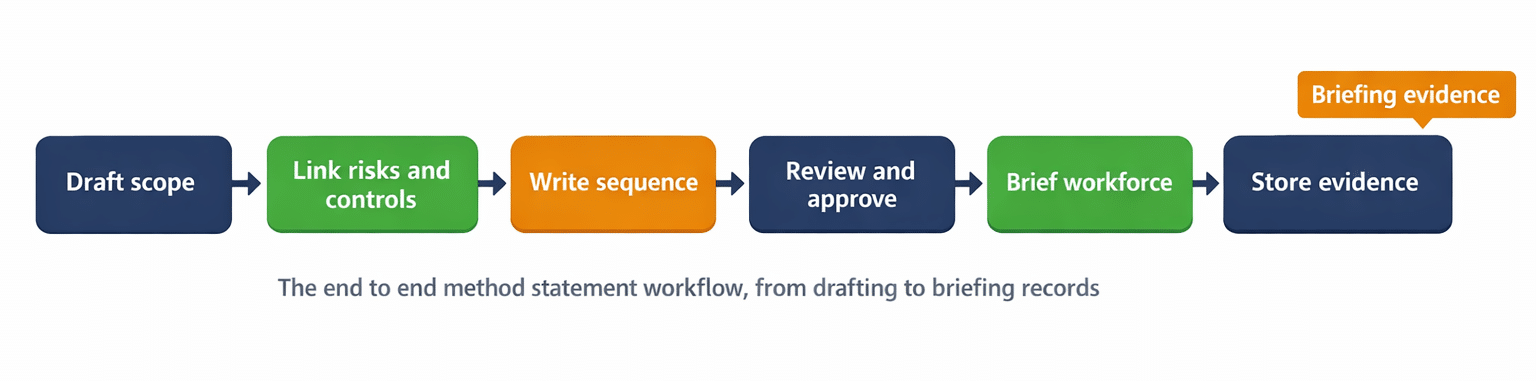
A useful way to think about method statements is that they are built from controls, not from templates. Templates help, but the content should follow a consistent logic: define the task, define the constraints, select the controls, write the sequence, embed the checks, and then brief it properly. The risk assessment remains the foundation for identifying hazards and deciding on controls.
The most common failure here is writing a method statement first, then doing a risk assessment afterwards to “match it”. That reverses the logic. The risk assessment is where you decide what needs to be controlled. The method statement is where you decide how those controls are applied during the work.
Method statements should also be treated as live documents. If work changes, the method statement should trigger a review, a revision, and a re-brief, so the workforce is aligned to the updated safe method.

A step-by-step writing process that holds up on site
-
Define the task scope and boundaries
-
Review hazards and chosen controls
-
Write the sequence with controls
-
Add roles, checks, hold points
-
Confirm resources, competence, permits
-
Brief, capture sign-off, review on change
The “embedded controls” rule
Do not list controls separately and hope the team applies them. Put each control where it belongs in the sequence. If Step 3 is “position MEWP”, then Step 3 should also state the exclusion zone, banksman, ground bearing checks, and the stop condition.
Review and re-brief triggers
Common real-world triggers include: change of method, change of access, change of plant, change in sequence, discovery of hidden services, weather effects for work at height, and a new interface trade entering the zone.
Get Your Free Risk Assessment Template
Faster Reviews. Clearer Risk Controls.
Use a clean RA template to document hazards, control measures, and responsibilities clearly, making reviews, approvals, and site briefings simpler.
Who Writes, Reviews, and Approves a Method Statement
Method statements only work when ownership is clear. The person writing the statement must understand the method, and the person supervising must be empowered to stop or change the method when controls cannot be met. Workforce involvement is also practical, not political. The people doing the work often spot the gaps fastest because they understand the physical reality of the steps.
Under CDM 2015, dutyholders have defined responsibilities for managing and coordinating construction work. HSE provides a practical summary of dutyholder roles and what they need to do. A method statement supports those duties by creating a clear plan and a briefing mechanism that can be checked and evidenced.
Who typically writes and who typically approves
On many sites, subcontractors draft task method statements because they own the means and method. The principal contractor or project team then reviews for interface risks, permit alignment, and site constraints. The supervisor owns delivery and compliance with the method.
A robust setup usually includes:
-
Author: competent person who understands the task method
-
Reviewer: site management or HSEQ to test suitability for the site
-
Approver: role defined by project governance for higher-risk activities
-
Supervisor: accountable for briefing, checks, and stop decisions
Competence in practical terms
Competence is not a CV statement. It is whether the author can describe the method, the constraints, and the controls, and whether the supervisor can run the method under real site conditions. If the method statement cannot be briefed in a way that the workforce can repeat back, it is not competent documentation.
Subcontractor interfaces and control gaps
Interface gaps appear when one contractor assumes another contractor is controlling something. Examples include exclusion zones, isolations, temporary works checks, and handover points. Your method statement should explicitly state what you control and what you rely on others to control, with hold points where those dependencies must be confirmed.
Common Method Statement Mistakes That Cause Problems on Site
Most “bad method statements” fail in predictable ways. They are generic, they miss interfaces, they do not describe the actual sequence, and they are not kept live when conditions change. Those failures create two risks at once: operational risk during delivery, and governance risk when you cannot evidence control.
The other common failure is over-detail in the wrong places. If your document has long paragraphs of policy language but does not clearly explain the task steps and checks, it will not support safe delivery.
Generic wording and missing constraints
Generic text is easy to spot. Phrases like “ensure suitable PPE” and “use trained operatives” do not tell anyone what to do today. The fix is to write in a way that references the work zone and constraints: access points, plant routes, exclusion zones, stop conditions, and permit points.
Sequence without interfaces
A sequence that ignores interfaces is a partial sequence. If scaffolders, cladders, and a crane lift all touch the same zone, the method statement must state who has priority, when zones are handed over, and what checks are required before a new activity starts.
Out-of-date documents and unbriefed changes
If the method statement changes and the workforce is not re-briefed, you have created controlled paperwork but uncontrolled work. A simple governance rule helps: if a revision changes steps, controls, or interfaces, then a re-brief is mandatory.
What a Good Method Statement Should Include
Best practice is not about making method statements longer. It is about making them clearer, more specific, and easier to run on site. A strong method statement has a consistent structure, uses plain language, embeds controls into steps, and makes supervision checks explicit.
It also reflects the hierarchy of control. You should be able to see where hazards are eliminated or reduced by design and planning, not just pushed down to PPE. If the only control is “wear PPE”, the method is weak.

A field-by-field quality checklist
A practical method statement should normally cover:
-
Project and task details, location, dates, and boundaries
-
Scope, assumptions, and constraints
-
Roles and responsibilities, including supervision
-
Plant, equipment, materials, and access requirements
-
Step-by-step sequence of work
-
Controls embedded in each step
-
Hold points, permits, inspections, and stop conditions
-
Emergency arrangements relevant to the task
-
Briefing method and sign-off evidence
-
Review triggers and revision control
Controls selection logic
Use a simple control selection logic when writing:
-
Can the hazard be eliminated by changing the method
-
Can it be reduced by substitution or engineering
-
What administrative controls make it workable on site
-
What PPE is truly task-specific, and why
How to Standardise Method Statements Across Projects
If you want method statements to work across multiple projects, you need a system, not just templates. The system should define the standard structure, who owns drafting and review, what triggers a revision, and how briefings are captured. The aim is consistency in governance, while still allowing the content to be tailored to the job.
A useful framing is “standardise the container, tailor the method”. The container is the document structure, the mandatory fields, and the minimum governance. The method is the sequence and controls that depend on the site.
Standard template plus controlled variability
Lock the structure so every method statement is scannable in the same way. Then control the variability with required site-specific fields such as zone, interfaces, plant routes, and hold points.
Briefing workflow and evidence capture
Make briefing part of the process, not the end. If a method statement is not briefed, it is not operational. If it is briefed but not evidenced, it is not auditable. The evidence should be lightweight but reliable: date, attendees, supervisor, and the statement version briefed.
Governance cadence
Define review triggers and periodic checks. A practical baseline is: review on change, and also review at defined milestones such as phase changes, a change in supervision, or major plant changes.
Digital Method Statement Apps and Mobile Site Access
Digital method statements matter for one core reason: they reduce the time between change and alignment. When the method changes, you need the workforce to see the current version, be briefed on it, and for supervisors to have confidence that the correct method is being followed.
Digital tools also reduce failure modes caused by document sprawl: multiple versions in circulation, unclear approvals, and missing briefing records. The practical aim is not “paperless”. It is controlled distribution, controlled revision, and reliable evidence.
If you are evaluating digital workflow options, you can step into the commercial detail here: Method Statements software.
What changes when method statements go digital
The strongest operational changes are:
-
Faster distribution of updated methods to site
-
Clear version control so teams stop using old copies
-
Structured briefing capture and retrieval
-
Better consistency across sites without unsafe copying
Offline and adoption constraints
Digital systems still have to work in the real world: poor signal, shared devices, subcontractors with different processes, and supervisors with limited time. A good rollout accounts for these constraints with simple briefing workflows and a clear minimum evidence standard.
Are Method Statements a Legal Requirement in the UK
Risk assessment is a legal baseline. HSE states employers must make a suitable and sufficient assessment of risks to employees and others. Method statements are not always spelled out as a standalone legal artefact, but they are a widely used control tool in construction because they translate risk control into an executable plan.
HSE construction guidance describes method statements as setting out how work is carried out safely in a logical sequence and including the control measures. That is why method statements appear in pre-start checks, permit interfaces, supervision routines, and audit requirements across UK sites.
CDM 2015 sets expectations around planning, managing, and monitoring construction work, and clarifies who must do what. For the primary legal text, legislation.gov.uk hosts CDM 2015 in full. For a practical dutyholder summary, HSE provides a clear overview of who dutyholders are and their main duties.

How method statements support CDM duties in practice
They support planning and coordination by:
-
making the safe method explicit before work starts
-
clarifying interfaces and supervision checks
-
enabling briefings that communicate what is required
-
creating a record trail that supports assurance
What compliance reviewers look for
Most reviewers test whether the method statement is suitable for the site and task. They look for site constraints, real sequence, embedded controls, permit interfaces, and evidence that the workforce was briefed on the version in use.
Download Your Free Method Statement Template
Build Clear Method Steps Faster
Use a practical, site-friendly template to document sequence, roles, plant, and controls for clear briefings and easier site delivery.
How Method Statements Improve Site Safety and Coordination
Method statements are not just a safety document. They are a delivery control. Good method statements reduce stoppages caused by confusion, reduce rework caused by uncontrolled changes, and reduce commercial friction caused by disputes about what was agreed as the safe method.
They also improve supervisor efficiency. When the method is clear, supervisors spend less time improvising and more time checking the right things at the right time. That has a direct impact on productivity, programme stability, and incident risk.
Fewer stoppages and fewer “reset” moments
Many work stoppages come from unclear interfaces or permit mismatches. A method statement that includes hold points and permit triggers prevents work starting in a state that cannot be safely controlled.
Better subcontractor coordination
Subcontractors often work to their own routines. A method statement creates a single shared method for the task, which reduces the chance that one contractor’s “normal” conflicts with the site’s constraints.
Audit readiness as a by-product
When the method statement is briefed, version-controlled, and reviewed on change, audit readiness becomes a natural output. You are not trying to recreate evidence after the fact.

The Future of Method Statements in Digital Construction
The trend is towards live documentation. Sites are increasingly intolerant of static packs that are produced once, signed once, and then ignored. The operational reality is that construction work changes, often daily, and control documents must keep up.
Another trend is tighter integration between planning, permits, and briefings. The method statement is the connective tissue between “what we intend to do” and “what we will actually do today”. When planning changes, the method statement should be a visible trigger for review and re-brief.
“Live document” governance becoming normal
Expect to see stronger expectations for revision control, re-brief triggers, and evidence capture. The work at height framing already shows method statements sitting alongside assessment and precautions as part of the control set.
Better interface control across multiple teams
As sites become more complex, interfaces become the dominant risk. Method statements will increasingly be judged on how well they manage these interfaces, not on how well they repeat generic policy statements.
Frequently Asked Questions
1) What is a method statement in construction?
A method statement explains, in a logical sequence, how a specific task will be carried out safely, including the control measures. It is most useful for higher-risk, complex, or unusual work where sequencing, interfaces, and supervision checks need to be explicit.
2) Are method statements a legal requirement in the UK?
I cannot confirm a single legal rule that mandates a standalone “method statement” for every task. However, risk assessment duties are explicit, and method statements are a widely used control tool in construction to plan and communicate safe methods, especially for higher-risk work.
3) When do you need a method statement on a construction site?
You typically need one when work is complex, unusual, higher-risk, or heavily interface-driven. Common triggers include working at height, lifting operations, demolition, confined access, and tasks with permit and hold-point controls. HSE notes method statements are widely used to help manage and communicate work requirements.
4) What should a method statement include?
At minimum it should include task scope and constraints, the step-by-step sequence, controls embedded into steps, roles and supervision checks, plant and resources, permit and hold points, emergency arrangements relevant to the task, briefing arrangements, and review and revision triggers.
5) What is the difference between a risk assessment and a method statement?
A risk assessment identifies hazards, evaluates risk, and selects controls. A method statement turns those controls into an executable plan by describing the sequence, responsibilities, and checks on site. HSE describes risk assessments as needing to be suitable and sufficient.
6) What is the difference between RAMS and a method statement?
RAMS usually refers to the combined package of risk assessment and method statement. The risk assessment selects controls, while the method statement explains how those controls are applied during the work. If you are managing both together digitally, see RAMS software.
7) Who writes and approves a method statement?
Typically the contractor or subcontractor who owns the means and method drafts it, and the site team or principal contractor reviews it for interfaces, site constraints, and permit alignment. Approval roles vary by project governance, especially for higher-risk activities under CDM duty holder arrangements.
8) How often should method statements be reviewed?
Review when anything changes that affects the method, sequence, controls, or interfaces. Common triggers include change of access, plant, supervision, adjacent activities, or discovery of new constraints. If revisions change steps or controls, a re-brief should be treated as mandatory.
9) How do you brief a method statement to the workforce?
Brief it as a walk-through of the sequence and controls, focused on where errors are likely and what the stop conditions are. Confirm understanding, capture who attended, and record the statement version briefed. A method statement is only operational when it has been communicated and understood.
10) Can you use one method statement across multiple sites?
You can reuse structure and baseline controls, but you must tailor for site constraints such as access, plant routes, interfaces, supervision, permits, and hold points. Copying without tailoring is one of the fastest ways to produce a statement that fails both practically and under review.
Explore More Related Reads and Resources
If you want deeper examples and supporting topics, these related articles may help:
-
Method Statement (SWMS) template example
See a full worked example showing typical method statement sections, field structure, and how sequencing and controls are presented for site use. -
Method statement templates guide
Compare template formats and learn how to tailor a standard method statement layout to different tasks without creating generic, copy and paste paperwork. -
Method statement examples for construction
Browse multiple practical examples across common construction activities, with notes on what makes each one site-ready and reviewable. -
Method statement mistakes in construction
Learn the most common issues that trigger rework, delays, or rejected submissions, and how to fix them before they cause problems on site. -
Method statement inspection failures
Understand why method statements fail audits and inspections, including missing constraints, weak sequencing, and evidence gaps that reviewers flag first. -
RAMS construction guide
Get the wider context on how risk assessments and method statements work together as RAMS, including briefing expectations, revision control, and audit evidence. -
AI generated risk assessments and method statements guide
Explore where AI can help with drafting and consistency checks, what still needs competent human review, and how to manage governance without over-relying on automation.


Download Your Free Briefing & Attendance Template
Ready-to-Use Briefing Sheet
Track attendance, signatures, and daily safety briefings with a free HSE-aligned record sheet for toolbox talks, inductions, and site audits.