

Daily Briefing App for Construction
Digital pre-start briefings that keep today’s plan clear and evidenced
Run Construction Daily Activity Briefings digitally so supervisors can align crews on today’s work, capture key updates, and confirm attendance without paper sign-in sheets. Daily briefings work best as part of a consistent briefing system, so this capability sits under Safety Briefing Software to keep briefing records organised across projects, shifts, and teams.
 Standardise daily briefings across crews
- Confirm attendance without paper sheets
- Capture changes while they are current
- Keep daily records easy to retrieve
- Support consistent site supervision

Daily briefings that stick
Daily briefings only work when they are consistent, quick, and easy to prove later. On busy sites, pre-start messages can drift across gangs, interfaces, and subcontractors, especially when plans change during the shift. A digital daily briefing helps supervisors capture the plan for today, record what has changed, and confirm who received the message without relying on paper sign-in sheets or scattered notes.
It also keeps the daily record tied to the job, so it can be retrieved by project and date when questions arise. This feature supports daily alignment within your broader briefing workflow.
Daily pre-start briefing structure
Keep today’s message consistent and clear
Use a repeatable daily briefing structure so every supervisor covers the essentials without missing key points. Capture what is happening today, the main interfaces, and the controls crews must follow, using the same layout each shift. This improves clarity when multiple gangs are working, reduces reliance on informal updates, and helps prevent mixed messages that lead to rework or unsafe assumptions.
It is most useful at pre-start, handovers, and before high-change activities where the plan can drift during the day. The structure removes the variability of paper notes and ad hoc briefings.
- Reduce missed messages across crews
- Improve clarity during daily start-up
- Standardise supervisor briefing quality
- Support better shift handovers
- Cut ad hoc briefing variation

Attendance confirmation for daily briefings
Know who was briefed, and when
Confirming attendance is central to proving a daily briefing happened and to following up when someone missed the message. Capture the briefing attendance as part of the same daily record so you can show who was present and when it was delivered, without chasing paper sheets at the end of the shift. This helps supervisors manage late arrivals, cross-crew interfaces, and rotating subcontractors, and reduces disputes about whether instructions were shared.
It is used whenever daily plans, access arrangements, plant movements, or sequencing need a clear record. It removes lost sign-in sheets and incomplete attendance trails.
- Prove briefing delivery to attendees
- Reduce lost attendance sign-in sheets
- Support follow-up on absentees
- Improve accountability at shift start
- Strengthen daily supervision records

Daily briefing updates and changes
Capture changes before they become gaps
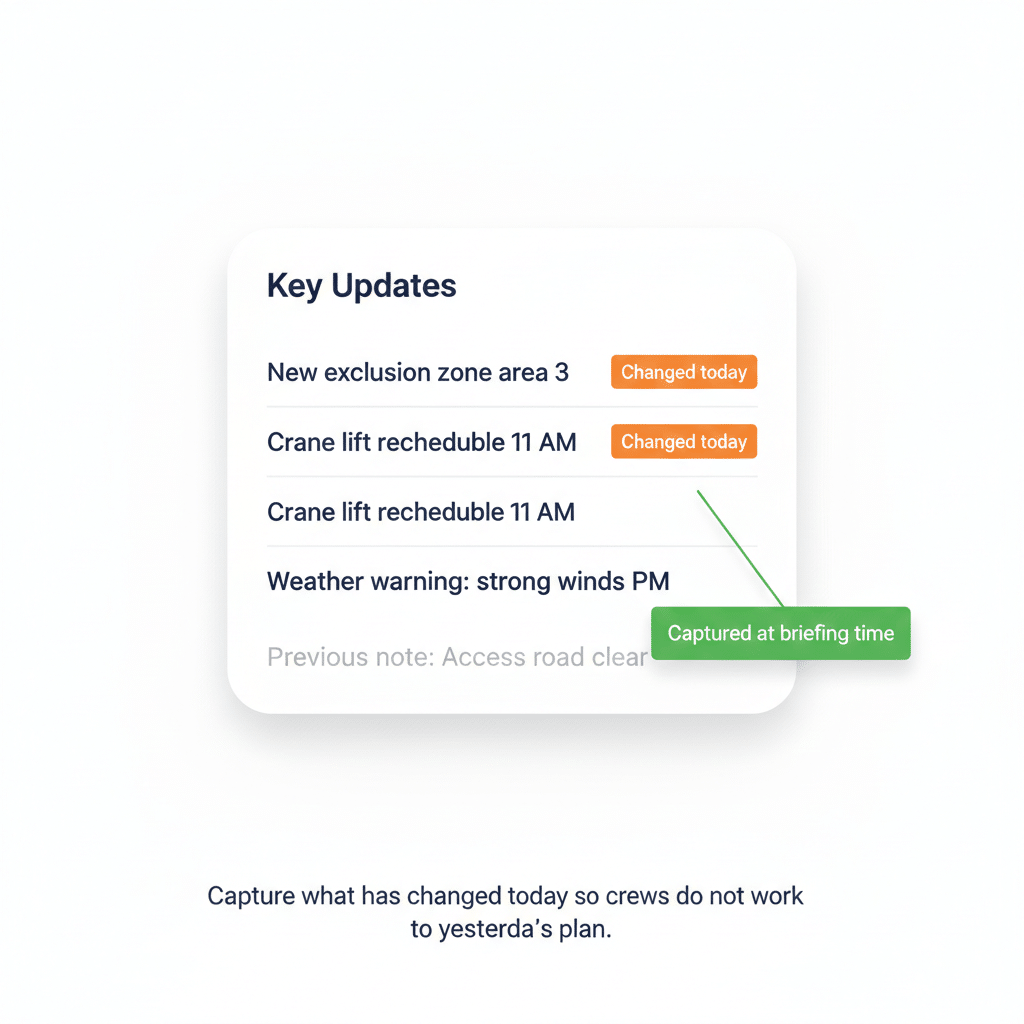
Daily briefings often change due to deliveries, interfaces, access restrictions, sequencing, or temporary constraints. Record the key updates at the point of briefing so crews are aligned on what is different today, not what was planned yesterday.
A structured update record supports consistent supervision because it keeps the shift plan and change notes together, and makes it easier to reinforce controls when conditions shift.
This is used whenever work fronts move, interfaces appear, or the day’s programme is re-sequenced. It removes reliance on memory, verbal-only updates, and unclear handover notes.
- Reduce confusion from plan changes
- Keep updated controls clear today
- Improve coordination at interfaces
- Support better supervisor reinforcement
- Cut reliance on verbal updates
Daily briefing evidence and context
Keep the proof with the record
Daily briefings commonly depend on a whiteboard update, marked-up plans, or quick sketches that are hard to retrieve later. Add supporting context to the daily briefing record so the “what we briefed” detail is kept alongside the entry, not separated into someone’s phone album or a site diary.
This helps when supervision changes mid-shift, when teams query what was agreed, or when you need to review a specific day during an investigation or compliance check. It is used when the daily plan needs extra clarity beyond text. It removes missing context and fragmented evidence.
- Preserve today’s plan context
- Reduce missing information later
- Support clearer handovers mid-shift
- Improve confidence in daily records
- Keep evidence tied to briefing

Try Paperless Free for 14 Days
Test it with your own team and workflows.
Explore how Paperless can help you manage workforce, compliance and site records before deciding whether it is right for your business.
Project filing and retrieval
Find the right daily record fast
A daily briefing is only valuable if it can be retrieved quickly by the people who need it. File daily briefings to the project record so supervisors, managers, and HSQE teams can locate the right entry by project and date when questions come up.
This supports consistent oversight across multiple work fronts and reduces delays caused by searching through notebooks, photos, or email threads.
It is used during supervision reviews, weekly lookbacks, incident follow-up, and compliance checks where “what was briefed that day” matters. It removes the friction of scattered records and hard-to-find evidence.
- Retrieve briefings by project and date
- Reduce time spent searching records
- Support stronger supervision oversight
- Keep records consistent across shifts
- Improve review during follow-up

How daily briefings work
-
Supervisor opens the daily briefing for the project
-
Record today’s plan and key updates
-
Add supporting notes where needed
-
Capture attendance for the briefing
-
Save the daily record for retrieval

Who uses daily briefings
-
Site managers and supervisors
-
Project managers and delivery leads
-
HSQE managers supporting site control
-
Subcontractor coordinators managing interfaces
-
Operations leadership overseeing consistency
Use Cases
-
Pre-start alignment before shift work begins
-
Capturing changes to access or sequencing
-
Managing interfaces between crews and trades
-
Recording handover notes between supervisors
-
Reviewing what was briefed on a date

Governance and audit-ready records
Daily briefings support supervision, coordination, and compliance evidence when records are complete and consistent. A structured daily record helps maintain clarity on what was briefed, when it was delivered, and who received the message, which is useful during incident follow-up, client queries, or internal reviews.
Governance improves when daily briefings are filed to the job record and kept in a repeatable format across projects and supervisors. This reduces the risk of missing attendance, unclear change notes, and fragmented evidence.
The outcome is a daily briefing record that can be reviewed by managers and HSQE teams to check consistency, reinforce controls, and resolve disputes about daily instructions.
Rollout notes for supervisors
Daily briefings adopt fastest when the structure mirrors how supervisors already run pre-start meetings. Start by agreeing a standard set of prompts for “today’s plan”, “what has changed”, and “key interfaces”, then keep the record short and consistent.
Assign ownership to site leadership so the briefing cadence remains routine, and align it to shift start times and handovers. Common blockers are overlong forms, unclear expectations on what to record, and inconsistent use across gangs.
Avoid this by keeping the daily record focused on the operational essentials and making attendance capture part of the normal briefing flow rather than an extra admin step.
FAQs
What is a Daily Activity Briefing (DAB) in construction?
A Daily Activity Briefing is a structured pre-start briefing that aligns crews on the plan for the shift, key interfaces, and anything that has changed. It helps supervisors communicate the day’s work clearly and keep a record of what was briefed.
What should a daily site briefing include?
Most daily briefings cover the plan for today, sequencing and interfaces, key updates, and the controls crews must follow. The goal is clarity on what is happening and what is different today, captured in a consistent format.
How do you prove a daily briefing was delivered?
You prove delivery with a record showing who attended and when the briefing occurred, plus the briefing notes for that shift. Keeping this tied to the project record makes it easier to retrieve and review later.
How is a daily briefing different from a toolbox talk?
A daily briefing focuses on today’s work and what has changed for the shift. A toolbox talk is a topic-led safety briefing that is not specific to the day’s plan. Both can sit within the same briefing system.
See how briefings connect across the site
Daily briefings are most effective when they sit inside a consistent briefing process that covers other briefing types and keeps records organised. Read more about the wider briefing capability, including how daily briefings fit alongside other briefing workflows, here: Safety Briefing Software

Watch a Live Demo Now
See It in 2 Minutes
No appointment needed. Watch a short live demo of digital inductions, safety briefings, workforce tracking, and compliance tools in action.