

RAMS Software for Construction
Build, brief and evidence RAMS without paper
RAMS software helps you standardise risk assessments and method statements, communicate controls to the workforce, and keep evidence organised for supervision and audits. In practice, it supports clearer planning, fewer gaps on site, and faster approvals by keeping the right information accessible when teams need it.
- Standardise RAMS across projects
- Brief controls and confirm attendance
- Keep evidence tidy and searchable
- Reduce rework from unclear plans

Why construction RAMS software matters
RAMS sits at the point where planning meets delivery: if your risk assessment and method statement are inconsistent, out of date, or hard to brief, the site team fills the gaps themselves. Construction RAMS software closes that operational gap by standardising how you build a safe system of work, keeping revisions controlled, and making it easy to brief the right controls to the right people.
It also helps you keep the supporting evidence connected to the RAMS record, so supervision, reviews and audits are not reliant on chasing paper, screenshots or email chains. In the UK context, that supports stronger compliance behaviours aligned to CDM expectations and routine risk assessment practice.

See Paperless Construction in Practice
Read how construction and infrastructure teams have applied Paperless to real operational challenges across live projects.
Explore customer experiences across construction, civil engineering and specialist contracting.
Risk Assessments
Identify hazards and controls clearly
Risk assessments are the foundation: you identify hazards, who could be harmed, what controls are already in place, and what further action is needed. HSE provides a simple structure for recording significant findings, which is a useful baseline for consistent site documentation.
 Consistent assessment structure
- Clear actions and owners
- Easier review and updates
- Better visibility on controls

Method Statements
Turn controls into a safe sequence
Method statements explain the safe sequence of work and how control measures will be implemented on site, especially where risks are more complex. They help supervisors and operatives align on the right steps, resources and precautions, and they are widely used to communicate what is required for safe delivery.
- Clear step-by-step delivery
- Controls embedded into method
- Better briefings for crews
- Fewer assumptions on site

RAMS briefings and attendance evidence
Prove controls were communicated
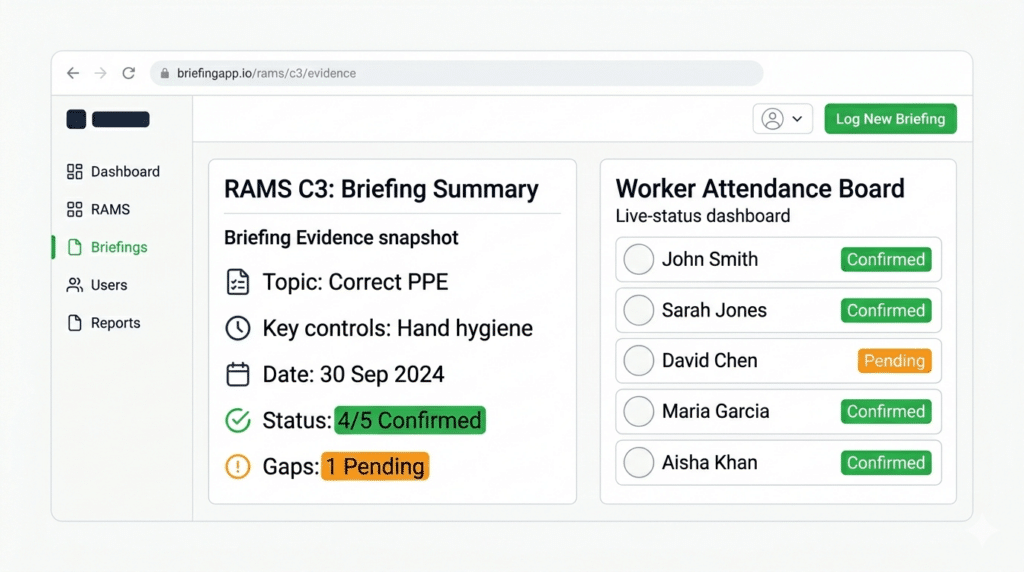
A RAMS process is only useful if the message reaches the workforce. Digital briefings help supervisors run consistent briefings, link the relevant RAMS and plans, and capture who attended. This supports the practical expectation that controls are communicated, understood, and evidenced as part of day-to-day supervision.
- Consistent briefing delivery
- Attendance confirmation captured
- RAMS and plans linked
- Faster retrieval during reviews
COSHH alignment for hazardous substances
Keep hazardous substance controls joined up
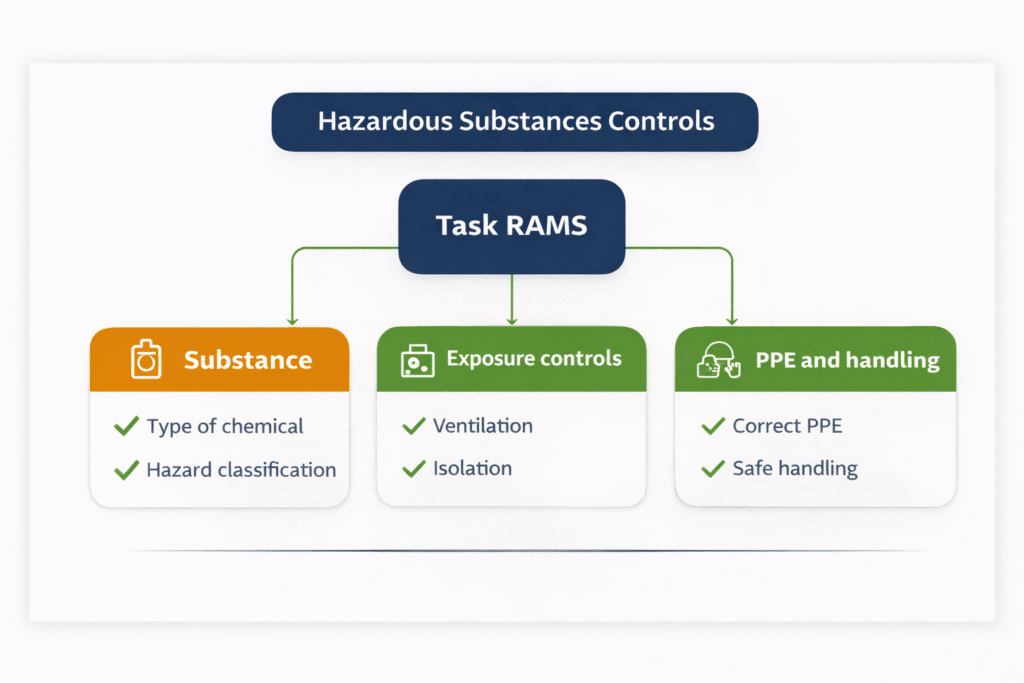
Where hazardous substances are involved, COSHH-specific controls need to be communicated and followed. Risk assessment expectations include specific assessments for hazards such as hazardous substances, so it helps when RAMS and COSHH controls are easy to reference and brief alongside the task plan.
- COSHH controls visible in context
- Easier briefing consistency
- Reduced missed-control risk
- Better evidence for audits
See How Construction Teams Use Paperless
Explore real project examples showing how contractors have used Paperless Construction to improve site processes and manage project records.
Discover the challenges, workflows and practical outcomes behind each customer story.
Permit-to-work interfaces for controlled activities
Keep high-risk work controlled
For certain controlled activities, a permit-to-work process adds another layer of control and authorisation. When RAMS and permits are linked conceptually, it becomes easier to brief the right controls, keep supporting evidence together, and avoid gaps between the planned method and the permitted activity.
- Clearer control and authorisation
- Better coordination across teams
- Stronger evidence trail
- Reduced stop-start on permits

Why These Capabilities Work Better Together
RAMS performance improves when risk assessments, method statements and briefings sit in one connected workflow. The practical benefit is fewer “orphan” documents: the plan, the communication of controls, and the evidence of attendance and site context remain joined up. That supports supervision, review, and fast retrieval when questions arise during delivery or after an incident or audit.
Who is this for?
-
Principal contractors who need consistent RAMS from subcontractors and clear site evidence
-
Subcontractors who want faster approvals and fewer RAMS reworks
-
Supervisors and foremen who need simple, repeatable briefing workflows
-
HSEQ teams who need organised records and straightforward retrieval
FAQs
Are risk assessments a legal requirement in the UK?
HSE states employers must assess health and safety risks and record significant findings where required.
Are method statements legally required?
I cannot confirm a single UK law that universally requires a “method statement” document in all cases. HSE guidance indicates method statements are widely used to manage and communicate safe working arrangements, particularly for higher risk work.
How does CDM 2015 relate to RAMS?
CDM 2015 sets out duties and expectations for managing health and safety in construction projects. RAMS are commonly used as part of demonstrating safe planning and control of construction activities under that framework.
What should a good RAMS process achieve?
A good process identifies hazards and controls, explains the safe method of work, communicates controls to the workforce, and keeps evidence organised so it can be retrieved when needed.
Learn more in our Guide to RAMS in Construction
Put RAMS into a briefing workflow
RAMS only reduces risk when the controls are understood and followed on site. A connected workflow helps you take the risk assessment and method statement, brief it consistently, confirm attendance, and keep the evidence tied to the record. That means fewer gaps between what was planned and what was delivered, and faster retrieval when a supervisor, client or auditor asks for proof.
See How Paperless Could Work for Your Sites
Less admin. Clearer records. More control.
Book a personalised demo and see how Paperless can help your teams manage workforce, compliance and site records in one connected platform.