
Risk Assessment Example (UK Construction) + (DOCX) Template

Introduction
A good risk assessment is not a form you complete at the end. It is the planning work that decides what could harm people, what controls will prevent it, and who owns those controls on site.
If you want the wider context, start with Risk Assessments in Construction Guide. This article stays focused on one thing: a complete example structure, with every field explained so you can copy the layout without missing key governance details.
Below, you will see a section-by-section explanation that matches a full construction risk assessment template, followed by a worked example (roofing works at height and materials handling) and a DOCX template download route.
Quick Answer..
A “complete” construction risk assessment template should include more than the hazard table. It should also include document control, approvals, scope, scoring method, competence, emergency arrangements, review and change control, revision history, and briefing evidence. HSE’s overview of managing risk also reinforces that a risk assessment should be suitable and sufficient, recorded, and reviewed. HSE Managing risks and risk assessment.
What is a risk assessment in UK construction
A risk assessment is the structured decision process used to identify hazards, evaluate risk, and define controls before work starts. In practice, it is how a supervisor or safety lead makes sure the plan matches site reality, including access, interfaces, sequence, weather constraints, and the capability of the people doing the work.
HSE guidance focuses on identifying hazards, deciding who might be harmed and how, evaluating risk and controls, recording findings, and reviewing the assessment. That maps directly to how most construction teams structure their documents, even when the document name and layout differs by client or principal contractor. HSE Steps needed to manage risk
A key point for construction is that the “wrapper” fields matter. Without clear revision control, approvals, distribution, and briefing evidence, you cannot reliably prove people were briefed on the correct controls for the work they actually did.
When is a risk assessment required in UK construction?
A risk assessment is legally required whenever work activities expose people to risk. In construction, that effectively means almost all site activities.
The primary legal duty sits under the Management of Health and Safety at Work Regulations 1999. Regulation 3 states:
“Every employer shall make a suitable and sufficient assessment of –
(a) the risks to the health and safety of his employees to which they are exposed whilst they are at work; and
(b) the risks to the health and safety of persons not in his employment arising out of or in connection with the conduct by him of his undertaking.”
This duty applies before work starts and must be reviewed if it is no longer valid or if there has been a significant change. You can see the HSE’s summary of this duty here:
HSE Managing risks and risk assessment
For construction specifically, the Construction Design and Management Regulations 2015 reinforce this requirement. Regulation 15 requires contractors to:
“plan, manage and monitor construction work… so that it is carried out without risks to health or safety.”
In practice, a risk assessment is the mechanism that demonstrates that planning has taken place.
You are required to record the significant findings of your risk assessment where you employ five or more people. Even where fewer than five are employed, recording the assessment is considered best practice on construction projects because it supports coordination, supervision, and audit.
A risk assessment must also be reviewed:
-
If there is reason to suspect it is no longer valid
-
If there has been a significant change in the matters to which it relates
-
After incidents, near misses, or changes in method, equipment, or environment
On a construction site, that can mean:
-
A change in scope or sequence
-
Introduction of new plant or materials
-
Changes to access or scaffold
-
Adverse weather affecting work at height
-
New trades introducing additional interfaces
The legal test is not whether you have “a document on file”. The test is whether the assessment is suitable and sufficient for the actual work taking place.

Risk assessment template fields explained
This section is designed to match the fields you listed, in the same order. If you are building a template, this is the checklist for what each field is doing and what “good” looks like.
Where a field is “admin”, the test is still operational: does it help someone on site understand what work is covered, what controls must be in place, and whether they are looking at the current revision.
1) Overview and project information
These fields anchor the assessment to a real job and prevent uncontrolled reuse. Your set includes: Risk Assessment Title, Contractor, Project, Project or Job Number, RA Reference, Revision, Issue Date, Site Address or Location, Client, Principal Contractor, Principal Designer, and Distribution.
In practice, “Distribution” is not a nice-to-have. It is the list of roles who must see the assessment and be briefed, and it often drives whether the briefing record is required to capture subcontractors and visitors who enter the work area.
2) Author, reviewer and approver
Your approval table includes Role, Name, Position, Signature, and Date for Author, Reviewer, and Approver. This is the accountability chain. It clarifies who drafted, who checked the technical and safety content, and who authorised it for delivery.
If you do nothing else, make sure the approver role aligns to how decisions are made on the project. On many sites this is a project manager or site manager, with HSQE reviewing, but the specific roles can vary.
3) Summary and overview statement
Your summary paragraph does three important things: it states the activity, names the key hazards (falls, handling, tools, interfaces), and defines who is affected (operatives, subcontractors, others near the workface).
A strong summary also makes it harder to hide a generic assessment inside a folder. If the summary clearly describes the job, it becomes obvious when the document does not match the work.
4) Introduction and scope
Your scope fields include: Location, Working hours, Start and end dates, Duration, Scope of works, Interfaces, and Restrictions. These fields are where most “suitable and sufficient” failures start, because a hazard table cannot be correct if the scope is vague.
Interfaces and restrictions are especially important for roofing. The interface with other trades, pedestrian routes, scaffold access, and deliveries can change the risk picture quickly. Weather restrictions also matter because they define stop-work rules, not just PPE.
5) Assumptions, exclusions and restrictions
Assumptions record conditions that must be true for the controls to work, such as scaffold inspection and tagging, suitable weather, and lifting plan controls. Exclusions define what is not covered, such as hot works or confined spaces, unless a permit and separate assessment exists.
This section is where you prevent accidental scope creep. If a team introduces hot works mid-job, the exclusion forces a new decision and avoids silent risk drift.
6) People at risk legend and risk rating method
Your template includes a People at Risk legend and a scoring method: Severity, Likelihood, risk bands, and the definitions of IRR and RRR.
The operational rule is consistency. Scoring is only useful if the team uses the same bands across tasks and understands what a “high” score forces them to do next. HSE’s guidance on recording who might be harmed and what further action is needed aligns with the idea of capturing ownership and deadlines, even if your table format differs. HSE Risk assessment template and examples
7) Risk register fields
Your risk register includes: Risk ID, Category, Hazard or Risk Title, Description of Risk, Persons at Risk, Severity, Likelihood, IRR, Control Measures, Responsible Person, and RRR.
Every one of these fields has a job:
-
Risk ID and category support filtering, reporting, and audit referencing.
-
Hazard title and description force clarity on the actual harm mechanism.
-
Persons at risk stops you missing visitors, public interface, or other trades.
-
Controls and responsible person convert intent into action and supervision.
-
RRR shows whether the controls actually change the risk.
If the RRR does not change after controls, the assessment is usually describing hazards without selecting meaningful controls, or the scoring method is being used inconsistently.
8) Key controls summary
Your summary table groups hazard themes and critical controls. This is the most briefable part of the document, and it is also where supervisors spot control gaps quickly.
A good key controls summary is short and non-negotiable. It should include stop-work rules, access rules, exclusion zones, and the critical prevention controls, not a long list of PPE.
9) Training and competence requirements
Your list covers CSCS (as applicable), working at height awareness, manual handling, tool competency, scaffold user awareness, banksman training where required, and site induction and task briefing.
Competence fields are not a tick-box for audits. They are the control that prevents “somebody” using equipment or systems they do not understand, such as scaffold access arrangements, hoists, or traffic control interfaces.
10) Emergency arrangements
Your emergency table includes emergency services, site emergency contact, assembly point, height rescue plan reference, nearest hospital, emergency access, first aid, and a location reference.
For working at height, the rescue plan reference is critical. It shows that emergency response is not just “call 999”, and it ties rescue planning to the actual hazard profile of the job. HSE’s working at height guidance stresses assessment and suitable controls for work at height risks. HSE Assessing all work at height
11) Reference documents
Your reference list covers site rules and induction requirements, manufacturer instructions, scaffold inspection records and tagging procedure, and permits and lifting plans if used.
The practical standard is availability. If you reference a document, it should exist, be current, and be accessible to supervisors. “To be confirmed” should be treated as a temporary placeholder, not a permanent state.
12) Review and change management
You have review triggers, a planned review interval, and a sign-off table for review outcomes.
This is where you control change. Review triggers like scope change, incidents, new equipment, new interfaces, and adverse weather are exactly the conditions that make last week’s assessment wrong. Planned review intervals (weekly in your example) are useful, but triggers are the real mechanism that keeps the assessment alive.
HSE’s general risk guidance also reinforces that risk assessments should be reviewed and updated when needed, not left static. HSE Managing risks and risk assessment
13) Revision history
Your revision history records revision, date, change summary, changed by, and approved by. This is the evidence trail for governance.
Minor formatting changes should still be captured if they affect readability, indexing, or what users will see during briefings. The key is that people can confirm they are working to Rev C and not Rev A.
14) Briefing and acknowledgement
Your briefing table captures: name, company, signature, date, and whether RA and MS were briefed (Y/N). This is your proof of communication, and it ties directly to supervision duties on site.
If you want to digitise the capture without changing what you record, this is the natural link-out point to your briefing workflow. Safety Briefing App
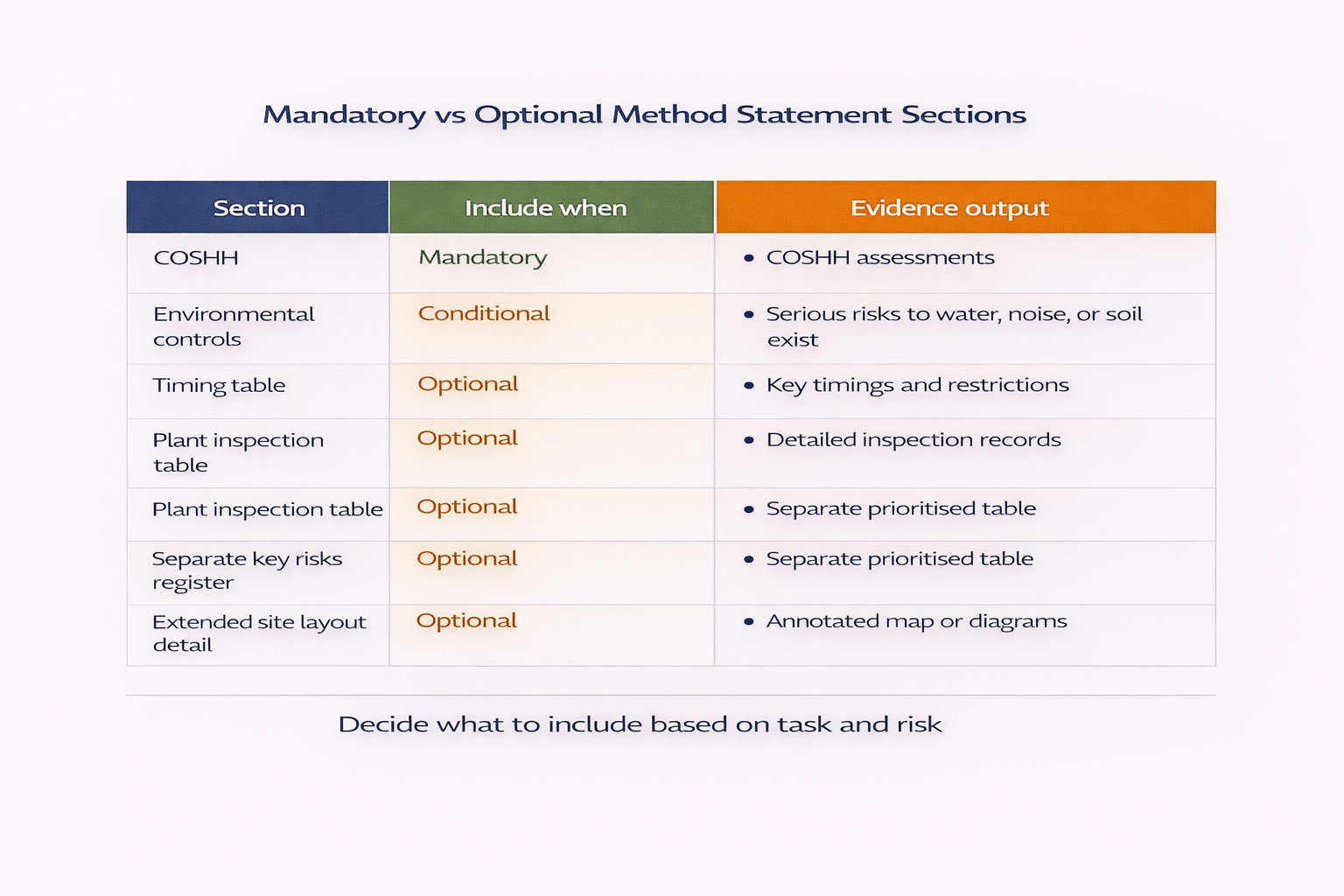
Optional sections and when they are worth adding
Optional sections are only valuable if they help a decision or improve control. If they add noise, they reduce engagement and make it harder to spot what matters.
Category groupings are useful when you have larger registers and need filtering for dashboards or reporting. A separate “key risks” manager summary can help when supervisors need a one-page view of the top risk drivers across multiple plots.
An extended environmental section is often optional for a task risk assessment if environmental risk is governed elsewhere through a site environmental plan, permits, or specific assessments. The rule is simple: if environmental controls are task-critical and not covered elsewhere, include them here.
Common construction risk assessment mistakes
The most common failure is writing controls as PPE-only. PPE is rarely the primary control for high-consequence hazards like falls from height, falling objects, or traffic interfaces. It sits at the end of the control chain.
The next failure is missing ownership. If there is no responsible person, controls become intentions, not actions. A risk register without ownership cannot be supervised.
Another common failure is scoring that does not change after controls. If the “after” score is identical to the “before” score, either the controls are not meaningful, or the scoring system is not being used consistently.
Finally, copy-paste hazards that do not match the task is still widespread. You can spot it when the scope says “roofing works” but the hazards list includes unrelated items, or when the interfaces and restrictions do not match the site layout.
Get Your Free Risk Assessment Template
Faster Reviews. Clearer Risk Controls.
Use a clean RA template to document hazards, control measures, and responsibilities clearly, making reviews, approvals, and site briefings simpler.
Risk Assessment example
The example below shows a complete worked RA layout, written in a way you can brief on site. Use it as a reference for structure, tone, and the level of detail that is typically expected for a site-ready document.
Roofing Works at Height and Materials Handling
Risk Assessment

1. Overview / Project Information
| Risk Assessment Title | Roofing Works at Height and Materials Handling |
| Contractor | Roofing Pro Yorkshire Ltd |
| Project | Meadow View Phase 2 |
| Project / Job Number | ROOF-001 |
| RA Reference | RA-ROOF-001 |
| Revision | Rev C |
| Issue Date | 27/02/2026 |
| Site Address / Location | Meadow View Estate Phase 2, Oak Lane, North Yorkshire, LS24 5NT |
| Client | Meadow View Developments Ltd |
| Principal Contractor | Oakridge Homes Ltd |
| Principal Designer | Meadow View Developments Ltd |
| Distribution | Site Supervisor, Site Manager, Operatives (briefed), Client/PC (as required) |
2. Author and Approval
| Role | Name | Position | Signature | Date |
|---|---|---|---|---|
| Author | L. Brown | Site Supervisor | 27/02/2026 | |
| Reviewer | S. Khan | H&S Manager | 27/02/2026 | |
| Approver | A. Patel | Project Manager | 27/02/2026 |
Jump to section
3. Summary / Overview
This risk assessment covers roofing works on a residential development, including work at height on scaffolded elevations, manual handling of roof components, use of power tools, and interface with other trades. It applies to operatives, subcontractors, and others who may be affected by the work area and deliveries. Controls focus on fall prevention, safe access, lifting and handling controls, tool safety, and emergency arrangements.
4. Introduction & Scope
Location
Plots 101 to 110 roof zones
Working hours
08:00 - 17:00, Mon-Fri
Start date / End date
01/02/2026 to 01/05/2026
Duration
4 Months
Scope of works
Installation of pitched roof components on timber trusses, including handling and fixing of tiles and ancillary materials
Interfaces
Other trades working on plots, deliveries to laydown area, pedestrian routes near scaffold
Restrictions
Weather dependent works at height; site rules and permit conditions as applicable
5. Assumptions, Exclusions and Restrictions
Assumptions
• Weather is suitable for safe work at height
• Lifting plans and exclusion zones are implemented where mechanical lifting is used
Exclusions
• Confined spaces not covered
Restrictions
• No unauthorised access to scaffold or roof zones
6. Risk Register
People at Risk Legend
E = Employees | S/C = Subcontractors | V = Visitors | Pub = Public | O = Others
Risk Rating Method
Severity (S): 1 Minor | 2 Moderate | 3 Serious | 4 Major | 5 Fatal
Likelihood (L): 1 Rare | 2 Unlikely | 3 Possible | 4 Unlikely | 5 Almost Certain
Risk Bands: Low: 1 to 4 | Medium: 5 to 12 | High: 15 to 25
Initial Risk Rating (IRR): before additional controls
Residual Risk Rating (RRR): after controls are applied
Risk Rating: Severity (S) × Likelihood (L)
| Risk ID | Category | Hazard / Risk Title | Description of Risk | Persons at Risk | S | L | IRR | Control Measures | Responsible Person | RRR |
|---|---|---|---|---|---|---|---|---|---|---|
| RA-01 | H&S | Falls from height | Fall from scaffold or roof edge causing serious injury/fatality | E, S/C | 5 | 3 | 15 |
• Scaffold erected by competent contractor, inspected and tagged. • Guardrails, toe boards, brick guards where required. • Safe access (stair towers/ladders) secured and maintained. • Exclusion zones below workface. • Stop work in high winds or unsafe weather. |
Site Supervisor | 6 |
| RA-02 | H&S | Falling objects | Tools/materials dropped from height striking persons below | E, S/C, V | 4 | 3 | 12 |
• Toe boards, brick guards, debris netting where required. • Tool lanyards where practicable. • Good housekeeping and controlled storage. • Exclusion zones and signage in place and maintained. • Controlled loading and lifting of materials. |
Site Supervisor | 4 |
| RA-03 | H&S | Manual handling | Strains/sprains from lifting tiles, rolls, timbers | E, S/C | 3 | 3 | 9 |
• Mechanical handling where possible. • Team lifts and agreed weight limits. • Manual handling briefing and task planning. • Rotate tasks and manage fatigue. • Clear routes and use hoists where available. |
Supervisor | 4 |
| RA-04 | H&S | Power tools | Cuts, abrasions, eye injury, noise exposure | E, S/C | 3 | 3 | 9 |
• Pre-use checks and defects reported immediately. • Guards and safety devices in place and used. • Competent users only, follow manufacturer guidance. • PPE: eye, hand and hearing protection as required. • 110v or battery tools, PAT where applicable. |
Supervisor | 4 |
| RA-05 | Public Interface | Site traffic and deliveries | Vehicle movement causing collision with pedestrians | E, S/C, V, Pub | 5 | 2 | 10 |
• Traffic management plan in place and briefed. • Banksman for reversing and high-risk manoeuvres. • Segregated pedestrian routes where practicable. • Delivery booking and controlled unloading zones. • Speed limits, signage and compliance monitoring. |
Site Manager | 5 |
| RA-06 | Environmental | Dust and debris | Dust generation affecting workers/nearby areas | E, S/C | 2 | 3 | 6 |
• Cut suppression where practicable. • Housekeeping and waste control. • Protect adjacent areas as required. • RPE selection subject to assessment. • Brief controls and monitor exposure. |
Supervisor | 3 |
| RA-07 | H&S | Fragile surfaces and openings | Fall through fragile roof areas or openings (e.g. roof lights, incomplete decking) | E, S/C | 5 | 2 | 10 |
• Identify and brief fragile areas before work starts. • Barrier, mark and control access to openings. • Use covers, crawl boards or temporary protection where required. • No stepping on fragile elements. • Supervisor monitoring and stop work if controls are compromised. |
Site Supervisor | 5 |
| RA-08 | H&S | Slips and trips | Slips/trips on scaffold platforms or roof zones due to debris, trailing leads, wet surfaces | E, S/C | 3 | 3 | 9 |
• Maintain housekeeping and remove offcuts/packaging frequently. • Keep walkways and access points clear. • Manage leads, hoses and materials storage. • Non-slip footwear and suitable access/egress maintained. • Stop work if surfaces become unsafe (ice, heavy rain). |
Supervisor | 4 |
| RA-09 | H&S | Electrical hazards | Electric shock from damaged leads, incorrect voltage, wet use, or defective equipment | E, S/C | 4 | 2 | 8 |
• Use 110v or battery tools where practicable. • RCD protection used for temporary supplies. • PAT regime and visual checks before use. • Keep leads managed, protected and away from sharp edges. • Do not use electrical equipment in unsuitable wet conditions. |
Supervisor | 3 |
| RA-10 | H&S | Noise exposure | Noise from cutting/grinding tools causing hearing damage | E, S/C | 3 | 3 | 9 |
• Use lower-noise methods and well-maintained tools. • Limit exposure time and rotate tasks where practicable. • Wear suitable hearing protection. • Designate cutting areas where practicable. • Brief operatives on noise hazards and controls. |
Supervisor | 4 |
| RA-11 | H&S | Hand-arm vibration | Prolonged use of vibrating tools causing HAVS risk | E | 3 | 2 | 6 |
• Select lower-vibration tools where possible. • Limit trigger time and rotate tasks. • Maintain tools to reduce vibration. • Brief signs/symptoms and report early. • Wear suitable gloves where applicable. |
Supervisor | 3 |
| RA-12 | COSHH | Hazardous substances | Exposure to sealants, adhesives, solvents or treated timber dust | E, S/C | 3 | 2 | 6 |
• COSHH assessments available and briefed before use. • Use as per manufacturer instructions and avoid skin contact. • Provide suitable gloves and eye protection. • Ensure ventilation and avoid ignition sources where relevant. • Spill control and safe disposal arrangements. |
Site Supervisor | 3 |
| RA-13 | Fire | Fire risk (hot works and ignition sources) | Ignition of materials from cutting, grinding, temporary electrics or smoking | E, S/C, Others | 4 | 2 | 8 |
• No hot works unless authorised and permit conditions met. • Maintain good housekeeping and remove combustible waste. • Store flammables correctly and keep lids closed. • Fire extinguishers available and access maintained. • Brief emergency arrangements and muster point. |
Site Manager | 4 |
| RA-14 | H&S | Adverse weather | Wind uplift, rain, ice, lightning affecting stability, footing and control of materials | E, S/C | 4 | 3 | 12 |
• Monitor forecast and on-site conditions throughout shift. • Stop work in high winds, lightning, heavy rain or icy conditions. • Secure materials and tools against wind uplift. • Maintain dry, clear access routes where practicable. • Provide suitable PPE and welfare for cold/heat stress. |
Site Supervisor | 5 |
| RA-15 | H&S | Interface with other trades | Conflicting activities causing struck-by incidents, access issues, or falling objects into shared areas | E, S/C, Other trades | 4 | 2 | 8 |
• Daily coordination with Site Manager on programme and interfaces. • Maintain exclusion zones and controlled access points. • Communicate lifting/unloading times and isolate shared routes. • Tool and material control at height at all times. • Stop work and escalate if unsafe interface develops. |
Site Manager | 3 |
7. Key Controls Summary
| Hazard Theme | Critical Controls |
|---|---|
| Working at height | Tagged scaffold, edge protection, safe access, weather stop rules |
| Falling objects | Toe boards, brick guards, exclusion zones, tool control |
| Manual handling | Hoists where possible, team lifts, training, route planning |
| Site traffic | Segregation, banksman, delivery booking, signage |
8. Training / Competence Requirements
• Working at height awareness
• Manual handling training
• Tool and equipment competency (including manufacturer instruction)
• Scaffold user awareness (do not alter scaffold)
• Banksman / traffic marshal training where required
• Site induction and task briefing prior to start
9. Emergency Arrangements
| Topic | Arrangement |
|---|---|
| Emergency services | 999 |
| Site emergency contact | John Smith |
| Assembly point | Site Offices |
| Height rescue plan | WAH-RP-001-Rev3 |
| Nearest hospital | Leeds Hospital, 12 miles, LS14 7ER |
| Emergency access | Access via Oak Lane, LS24 5NT |
| First aid provision | First Aid available at site offices |
10. Reference Documents
• Manufacturer instructions for tools and fixings used
• Scaffold inspection records and tagging procedure
• Any applicable permits and lifting plans (if used)
11. Review and Change Management
Review triggers
• Scope, method, or location changes
• Incident, near miss, or unsafe conditions observed
• New equipment, materials, or interfaces introduced
• Adverse weather impacting working at height
Planned review interval
Weekly
Sign off
| Role | Name | Signature | Date |
|---|---|---|---|
12. Revision History
| Revision | Date | Change Summary | Changed by | Approved by |
|---|---|---|---|---|
| Rev A | 25/02/2026 | Initial issue of RAMS pack (example) | J. Smith | A. Patel |
| Rev B | 26/02/2026 | Updated risk controls and added methodology hold points | J. Smith | A. Patel |
| Rev C | 27/02/2026 | Minor formatting tidy-up and document index amended | L. Brown | A. Patel |
13. Briefing and Acknowledgement
| Name | Company | Signature | Date | RA Briefed (Y/N) | MS Briefed (Y/N) |
|---|---|---|---|---|---|
Download Your Free Risk Assessment Template
Start With a Ready-to-Use RA
Capture hazards, controls, and residual risk in a clear HSE-aligned layout, ready to print, share, or upload into Paperless.


