

The Ultimate Guide to Construction Risk Assessments
Construction risk assessments are the backbone of day-to-day safety control on UK sites. They are where hazards are identified, risks are evaluated, and control measures are agreed in a way that people can actually follow in the field.
The value is practical, not theoretical. A good assessment helps supervisors and gangs work consistently when the programme moves, when interfaces change, and when multiple contractors are working in the same footprint. It also creates a clear record of what was considered and what controls were selected, which matters when something changes or when an incident is investigated.
Risk assessments should be treated as live site controls, not static PDFs. If they are generic, out of date, or written without a realistic understanding of how the job will run, they create a false sense of control and leave supervisors having to improvise on the day.
If you want the digital product context for storing, updating, and briefing risk assessments on site, see Risk Assessments Software.

Table of contents
- What Are Construction Risk Assessments? Definition and scope
- Why construction risk assessments matter on UK sites
- Where risk assessments apply on real projects
- The five-step construction risk assessment process
- Roles, competence, and accountability
- Risks, failures, and misconceptions
- Best practice framework for effective risk assessments
- Implementation roadmap
- Digital transformation context
- Regulatory and compliance alignment
- Commercial and operational impact
- Future trends and industry direction
- Frequently Asked Questions
- Explore More Related Reads and Resources
What Are Construction Risk Assessments? Definition and scope
A construction risk assessment is a structured evaluation of hazards arising from a task, activity, or site condition, and the selection of controls to reduce the likelihood and severity of harm. In UK construction it is typically documented, communicated to the workforce, and reviewed when work changes.
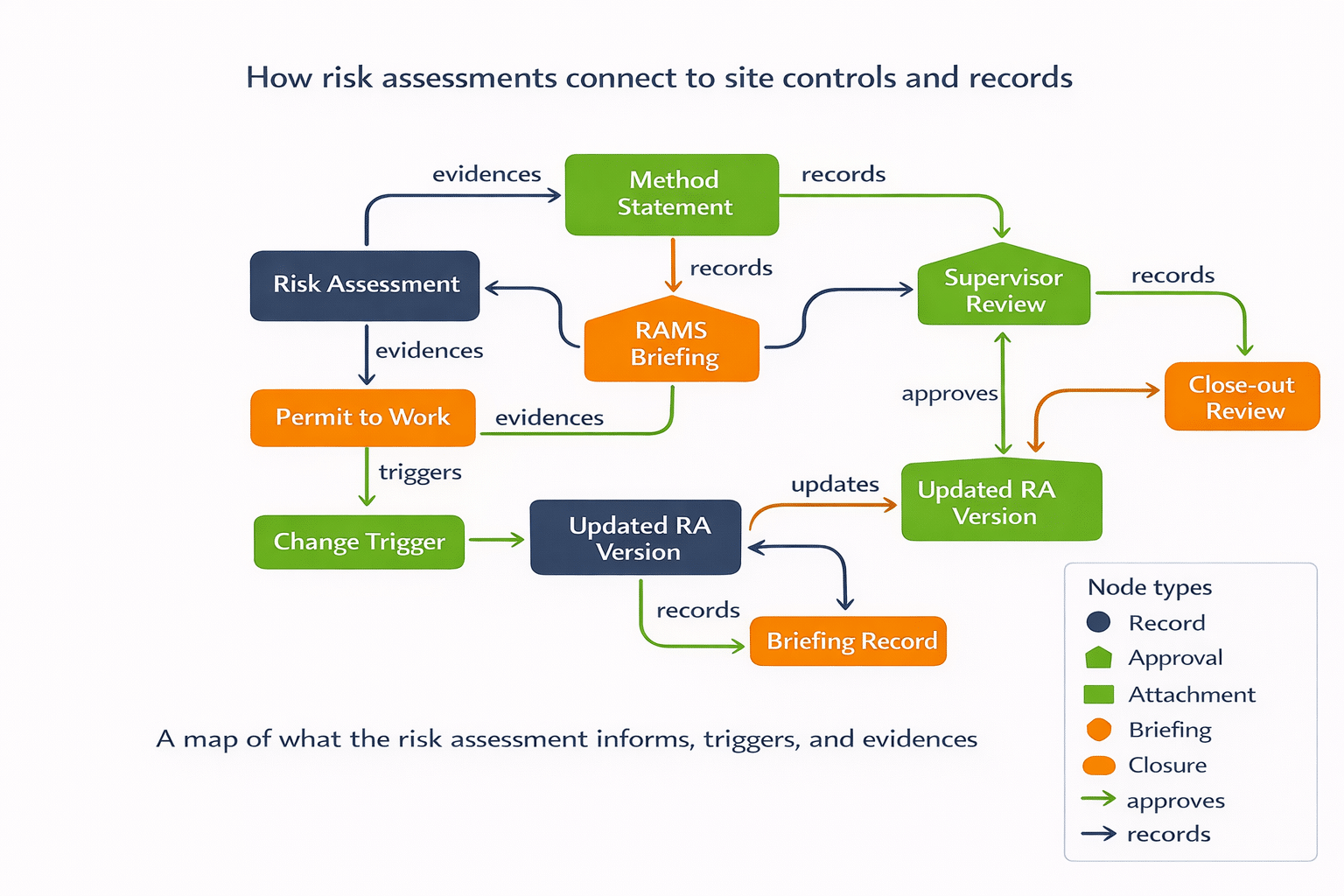
Risk assessment is often confused with other safety documents. It is not a method statement. A method statement describes how the work will be carried out step-by-step. A risk assessment focuses on what can cause harm and what controls must be in place. On many sites they are paired as RAMS, but they remain different documents with different purposes.
It is also not a generic risk register copied across jobs. Construction is too variable. Ground conditions, access, plant routes, public interface, live services, temporary works, and sequencing all change the risk picture. A suitable and sufficient assessment needs to reflect those constraints so that controls are credible and enforceable.
In practice, most organisations use a mix of assessment types:
-
Planned task or activity risk assessments for defined work packages
-
Site-wide risk assessments for broad hazards such as traffic, access, welfare, and shared interfaces
-
Dynamic or point-of-work checks where supervisors confirm conditions before starting a specific activity
The scope decision is a trade-off. If you try to cover everything in one document, it becomes unreadable and does not get used. If you split too far, you create duplication and gaps between contractors. The goal is a structure that makes it easy to find the right controls at the right time.

Why construction risk assessments matter on UK sites
Risk assessments matter because they force decisions before exposure happens. They capture the hazards that are foreseeable, the people who could be harmed, and the controls that make the work acceptably safe. Without that structure, safety relies on memory, experience, and informal habits, which breaks down quickly under programme pressure.
They also protect the project operationally. When multiple contractors are working, risk controls become interface controls. Plant routes, exclusion zones, lifting plans, temporary works constraints, delivery management, and handover boundaries are all safety-critical and programme-critical. A clear risk assessment can reduce stoppages by making expectations explicit.
There is also financial exposure. Incidents create delays, investigations, enforcement activity, and reputational damage. Even without an incident, poor assessments drive inefficiency. Supervisors waste time re-explaining controls, re-briefing teams, and rewriting paperwork because the original document was not fit for the site reality.
A common misconception is that risk assessments exist mainly to satisfy an audit. Audits matter, but the bigger value is control. If the assessment is written in a way the workforce cannot follow, it fails even if it looks good in a file. The test is whether the controls can be implemented at the point of work.
Where risk assessments apply on real projects
Risk assessments apply across every construction sector, but the emphasis changes with project type and constraints. On civils and infrastructure, interfaces with plant, excavations, lifting, and temporary works tend to dominate. On refurbishment and fit-out, the constraints are often access, coexistence with occupants, confined spaces, and complex services.
On a typical project you will see risk assessment needs in:
-
Early mobilisation, when access and traffic management are being set
-
Enabling works, especially groundworks, services location, and temporary works
-
High-risk activities such as lifting, working at height, hot works, and confined spaces
-
Interface management, particularly where subcontractors overlap in the same work area
-
Weather and seasonal exposure, where conditions affect stability, visibility, and manual handling risk
Real-world constraints are what break generic assessments. For example, a control like “segregate pedestrians from plant” is not meaningful until you define the actual route, barriers, banksman coverage, and how deliveries will be marshalled. The risk assessment must translate principles into site actions.
The five-step construction risk assessment process
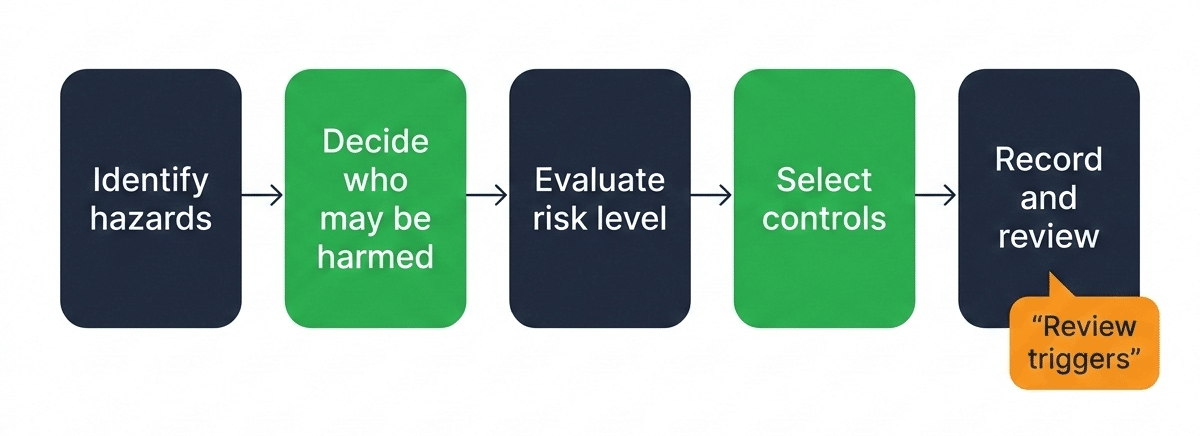
Most UK organisations follow the familiar five-step approach promoted by the HSE. In construction, the important part is not the labels, it is how you gather information and how you keep the record current when the job changes. A strong process is repeatable, quick enough for site teams, and strict about review triggers.
Step 1 is identifying hazards.
On site, hazards are not just obvious physical risks. They include interfaces, temporary conditions, services, access, supervision capacity, and changes to sequencing. Good hazard identification is based on a blend of site walk-throughs, task breakdown, workforce input, and learning from previous jobs.
Step 2 is deciding who might be harmed and how.
Construction sites involve employees, subcontractors, visitors, delivery drivers, members of the public, and sometimes clients or stakeholders walking the site. The “how” matters because it forces you to describe the harm pathway, which leads naturally into workable controls.
Step 3 is evaluating risk
Usually using likelihood and severity. A matrix can help prioritise, but it can also mislead if it becomes a scoring exercise divorced from reality. The key decision is whether the proposed controls reduce risk to a level that is tolerable for the activity and the site conditions.
Step 4 is selecting controls.
This is where assessments often fail. Controls must be specific and deliverable. They must match the plant available, the competence of the workforce, the supervision ratios, and the sequencing of work. Where possible, controls should remove exposure rather than rely on PPE or behaviour alone.
Step 5 is recording and reviewing.
Recording is not just writing it down. It includes assigning responsibilities, communicating controls through briefings, and setting clear review triggers. Review is not a calendar event only. It must happen when the work changes.
If you want a worked example and template guidance, see Risk Assessment Example UK Construction Template.
Get Your Free Risk Assessment Template
Faster Reviews. Clearer Risk Controls.
Use a clean RA template to document hazards, control measures, and responsibilities clearly, making reviews, approvals, and site briefings simpler.
Roles, competence, and accountability
Risk assessments are created and used by people, so role clarity matters. The “competent person” concept is critical. Competence is not just qualifications, it is the ability to identify hazards, understand the work methods, select controls that are realistic, and communicate them clearly.
On most projects, the principal contractor sets site standards for how risk assessments are produced, approved, briefed, and stored. Contractors and subcontractors then produce task assessments for their scope, aligned to site rules, and ensure their teams follow them. Supervisors are often the operational owners because they control sequencing, access, and compliance at the point of work.
Dutyholder alignment matters under CDM 2015. Risk management starts in design and pre-construction planning, then continues through construction phase control and supervision. Where dutyholders are not aligned, gaps appear, especially at interfaces between packages.
A practical rule is that the person who controls the work should be accountable for ensuring the assessment is followed and reviewed when conditions change. If accountability sits with someone remote from the workface, the assessment becomes paperwork rather than control.

Risks, failures, and misconceptions
The most common failure is generic assessments. They are written once, copied across sites, and then signed off without real consideration of the environment. This creates a mismatch between documented controls and real conditions, which increases risk because teams assume controls are in place when they are not.
Another failure is control statements that are not operationally defined. Phrases like “use suitable PPE” or “ensure adequate supervision” are not controls unless they specify what PPE, what supervision level, and what checks will confirm the control is working.
Risk scoring can become a misconception. A low score does not mean low risk if the hazard is high consequence and controls are weak. A high score does not automatically justify proceeding if controls are not deliverable. The assessment must focus on control selection and verification, not just numbers.
Reviews also fail. Many assessments are reviewed only on a set schedule, not on change. Construction changes constantly. Scope shifts, sequencing changes, plant changes, access changes, and weather changes. Without review triggers, the assessment becomes stale and briefings drift.
Best practice framework for effective risk assessments
Good risk assessments are designed for use, not for filing. They are short enough to be read, specific enough to be acted on, and structured so supervisors can find the controls that matter. They also integrate with the rest of the site system, including method statements, briefings, permits, and inspections.
A practical best practice framework is:
-
Define scope and interfaces clearly, including what is excluded
-
Identify hazards using walk-through, task breakdown, and workforce input
-
Select controls using the hierarchy of controls, aiming to remove exposure first
-
Assign responsibilities and verification checks, not just statements
-
Communicate controls through briefings and capture evidence of understanding
-
Set review triggers and make updates visible to the workforce
Where you need a quick self-check, build a simple quality gate for “site-ready” assessments. If controls cannot be delivered with the resources available, stop and revise. The trade-off is short-term delay versus long-term exposure.
Implementation roadmap
Standardising risk assessments across sites is mostly an operating system problem, not a document problem. The aim is to make the right behaviour the easy behaviour.
A realistic rollout sequence is:
-
Define a standard structure and minimum fields for all assessments
-
Create a limited set of templates for common activities, with mandatory site-specific fields
-
Set approval rules, including who can sign off and what triggers re-approval
-
Train supervisors on hazard identification and control selection, not just form completion
-
Establish review triggers and ensure updates cause re-briefing where needed
-
Audit for usability and site alignment, not for word count
Operationally, the biggest barrier is time pressure. If the process is slow, people will bypass it. If it is fast but shallow, it will not control risk. The design target is “quick to produce, hard to get wrong”.
Digital transformation context
Digital risk assessments are valuable when they make control easier, not when they digitise the same broken process. The main gains are usually around version control, availability on site, searchability, and evidence capture for briefings and updates.
A digital approach can support:
-
A live library of templates and previous assessments, searchable by activity and hazard
-
Mobile access so supervisors can check controls at the point of work
-
Clear review triggers and change logs so teams know what changed and when
-
Evidence capture showing who was briefed on the current version
If you want the product context for digital creation, review, and on-site access, see Risk Assessments Software.
Regulatory and compliance alignment
UK risk assessment expectations are shaped by HSE guidance and the Management of Health and Safety at Work Regulations 1999. The legal duty is to make a suitable and sufficient assessment of risks to employees and others who may be affected by the work.
The HSE’s five-step method is widely used as a practical structure for completing assessments. In construction, compliance is not just having a document, it is being able to show that hazards were considered, controls were selected, and the workforce was informed.
CDM 2015 adds a project management frame. Dutyholders must plan, manage, and coordinate health and safety across design and construction. Risk assessment is one of the key mechanisms through which foreseeable risks are identified and controlled across interfaces.
Authoritative references used in this guide:
Get Your Free Risk Assessment Template
Faster Reviews. Clearer Risk Controls.
Use a clean RA template to document hazards, control measures, and responsibilities clearly, making reviews, approvals, and site briefings simpler.
Commercial and operational impact
Risk assessments influence productivity because they shape how work is sequenced and controlled. When they are clear and practical, work starts with fewer stops, fewer clashes, and fewer last-minute changes. When they are vague, supervisors spend time interpreting intent and managing disputes about what controls are required.
They also affect audit readiness. If risk assessments are hard to locate, out of date, or not linked to briefings, organisations struggle to evidence control. Digital systems can reduce that friction when they create a consistent record and make the current version easy to access.
There is a trade-off between documentation depth and usability. Overly detailed assessments can become unreadable. Overly short assessments can become meaningless. The right level of detail is proportionate to the risk and to the site constraints.

Future trends and industry direction
The direction of travel is towards live risk information that is easier to keep current. This includes better integration between planned assessments, point-of-work checks, and briefing evidence, so changes are not lost between documents.
Another trend is improved learning loops. Organisations increasingly want to spot recurring hazards, recurring interface failures, and repeated control breakdowns. This is less about “big data” and more about consistent categorisation and review discipline.
Finally, there is growing focus on frontline usability. If supervisors and gangs cannot apply the controls under real constraints, the system fails. Future improvements will favour simpler, clearer assessments that are easier to review and re-brief when the job changes.
Frequently Asked Questions
1) What is a construction risk assessment?
A construction risk assessment is a structured process for identifying hazards, deciding who may be harmed, evaluating risk, selecting controls, and recording and reviewing those controls. On UK sites it supports legal duties and practical supervision by setting clear expectations for how work will be controlled.
2) What are the five steps of a risk assessment in construction?
The five steps commonly used are: identify hazards, decide who may be harmed and how, evaluate risk and select controls, record findings, and review controls. The value comes from making controls practical and setting review triggers so the assessment stays current.
3) What does “suitable and sufficient” mean in UK risk assessments?
It means the assessment must be proportionate to the risk, identify the real hazards and who may be affected, and select controls that address the actual work conditions. Generic copy-and-paste assessments often fail this test because they do not reflect site constraints or interfaces.
4) When should a construction risk assessment be reviewed?
It should be reviewed when work changes or new hazards emerge, not only on a calendar cycle. Common triggers include changes to scope, method, sequencing, plant, access, weather conditions, interfaces, incidents, near misses, or feedback that controls are not being met.
5) Who is responsible for construction risk assessments on site?
Organisations set responsibilities differently, but the practical owner is usually the contractor controlling the work and the supervisor managing the activity. The principal contractor typically sets site rules and governance, while subcontractors must produce assessments for their scope and brief their teams.
6) What is POWRA in construction?
POWRA stands for Point of Work Risk Assessment. It is a dynamic check used by supervisors or teams to confirm conditions before starting a task. It should be short and decision-led, focusing on what has changed and whether controls can still be met.
7) Do you need to write down a risk assessment in the UK?
Many construction risk assessments are documented because it supports briefing, coordination, and evidence. UK rules also require recording of significant findings in certain situations. In practice, written or digital records are standard on construction projects to demonstrate control and communicate changes.
8) What should a construction risk assessment include?
At minimum it should state the scope, hazards, who may be harmed, risk evaluation approach, control measures, responsibilities for implementing controls, and review triggers. It should also be written so supervisors and workers can apply it at the point of work.
10) What is the hierarchy of controls and how does it apply?
The hierarchy of controls prioritises eliminating the hazard first, then reducing exposure through substitution, engineering controls, and administrative controls, with PPE as a last line. In construction this means designing out exposure where possible and avoiding reliance on PPE alone for high-risk hazards.
11) How does digital risk assessment software help on site?
Digital systems help when they improve availability, version control, search, review triggers, and evidence capture for briefings and updates. The benefit is operational control: teams can access the current assessment, see what changed, and re-brief quickly when conditions change.
Explore More Related Reads and Resources
If you want to go deeper on specific angles, these related articles expand the topic and provide practical examples.
-
Risk Assessment Example UK Construction Template
See a practical example of a site-ready construction risk assessment and download a template that shows how hazards, risk scoring, and control measures are structured in real projects. -
Risk Assessments Software
Explore how digital systems allow teams to create, review, distribute, and update risk assessments on site while maintaining clear version control and briefing evidence. -
Method Statements
Understand how method statements work alongside risk assessments to explain how tasks will be carried out safely and how control measures are applied during construction activities. -
RAMS
Learn how risk assessments and method statements combine into RAMS documents and how they are used to brief workers and coordinate safety across contractors. -
Safety Briefings
Discover how risk assessments translate into daily safety briefings and toolbox talks so that workers understand the hazards and controls before starting work. -
Permit to Work Systems
See how high-risk activities such as hot works, confined spaces, and lifting operations are controlled through permit systems linked to risk assessments. -
Toolbox Talks
Find out how toolbox talks reinforce risk assessments by communicating hazards, lessons learned, and safe working practices directly to the workforce. -
Checklists and Forms
Explore how structured checklists help supervisors confirm that risk controls are actually in place and working before tasks begin. -
AI Generated Risk Assessments and Method Statements Guide
Learn how AI tools can help draft risk assessments faster while highlighting inconsistencies, missing controls, and gaps that still require human review.


Download Your Free Risk Assessment Template
Start With a Ready-to-Use RA
Capture hazards, controls, and residual risk in a clear HSE-aligned layout, ready to print, share, or upload into Paperless.