

The Ultimate Guide to AI-Generated Risk Assessments and Method Statements (RAMS)
AI-generated risk assessments and method statements (RAMS) are becoming common on UK construction projects because they reduce drafting time and help teams start from a consistent structure. The risk is that a believable document can pass a quick read while still being wrong for the job. That is where failures happen: wrong assumptions, missing interfaces, generic controls, and version drift that leaves operatives briefing the wrong revision.
This guide is not about whether AI is “allowed”. It is about how to use AI to draft RAMS without losing the controls that keep work safe and auditable. You will learn what to validate, who remains accountable, what evidence you need for reviews and briefings, and how to run change control when conditions move on site.
If you want the product view of digital delivery and workflows, see RAMS software and keep this page as your operational standard.
Table of contents
- What Are AI-Generated Risk Assessments and Method Statements (RAMS)?
- Why AI-Generated RAMS Matters on UK Construction Sites
- Where AI-Generated RAMS Applies on Real Projects
- AI-Generated RAMS Workflow: How It Should Work End to End
- Who Is Accountable for AI-Generated RAMS? Roles, Competence, and Responsibility
- Common Risks and Failure Modes in AI-Generated RAMS
- Best Practice Framework for AI-Generated RAMS (Draft Fast, Control Hard)
- Implementation Roadmap: Introducing AI-Generated RAMS Without Losing Control
- Digital Transformation Context: Where AI Fits in a Controlled RAMS System
- Regulatory and Compliance Alignment for AI-Generated RAMS
- Commercial and Operational Impact: What AI Changes (and What It Does Not)
- Future Trends: How AI Use in RAMS Is Likely to Evolve
- Frequently Asked Questions
- Explore Related Guides and Resources
What Are AI-Generated Risk Assessments and Method Statements (RAMS)?
AI-generated RAMS are risk assessments and method statements that have been drafted, structured, or expanded using an AI tool. In practice, AI is being used to:
-
turn a scope description into a step-by-step method
-
suggest hazards and control measures for each step
-
rewrite content into a clearer site-friendly format
-
generate alternative sequences for review and comparison
What AI-generated RAMS is not:
-
it is not a replacement for site knowledge, competence, or supervision
-
it is not proof that hazards have been identified correctly
-
it is not an approval, and it does not transfer responsibility away from dutyholders
-
it is not a guarantee of compliance, suitability, or acceptance by a client or principal contractor
The key point is scope control. AI can only work with the inputs you provide, and it will often fill gaps with generic assumptions. If those assumptions are not challenged by a competent reviewer, you can end up issuing a document that is internally consistent but operationally unsafe.
Typical UK use cases include early draft RAMS for planning, standard task RAMS that still need site-specific constraints, and rapid updates when a change trigger is logged and controlled. For the underlying fundamentals of what RAMS is and how it is used, see RAMS construction guide.
Why AI-Generated RAMS Matters on UK Construction Sites
AI changes drafting speed, but it does not change risk exposure. The consequences of getting RAMS wrong stay the same, and the “AI drafted it” defence does not stand up in a review, an incident investigation, or an audit.
Safety impact
Poorly validated AI RAMS tends to fail in predictable ways: missing exclusion zones, wrong lifting assumptions, missing permits, unclear roles, or controls that do not match the step sequence. That is how people end up working without the real critical controls being in place.
Operational impact
When RAMS is challenged late, the job slows down. Supervisors lose time re-briefing, teams stop and start, and plant and access decisions get revisited under pressure. AI can reduce early drafting time, but weak governance increases rework time.
Financial exposure
Delays, re-mobilisation, rework, and claims are common outcomes when approvals are rejected or when controls are not implementable. Even when there is no incident, poor RAMS quality can create measurable programme drag.
Compliance pressure
Clients and principal contractors often expect a clear audit trail: who reviewed, what was changed, what version was issued, who was briefed, and what triggered updates. AI makes it easier to generate documents, but it can also make it easier to lose control of what is current.
If your process relies on RAMS quality to avoid rejection, see how to review and approve RAMS for a deeper reviewer-led approach.
Where AI-Generated RAMS Applies on Real Projects
AI-generated RAMS can be useful across most project types, but the governance needs to scale with complexity and risk. Examples where teams commonly use AI drafting include:
Infrastructure and civils
Temporary works interfaces, traffic management, lifting plans, excavations, and services avoidance all require site-specific constraints. AI can draft a structure quickly, but you need competent checks against drawings, permits, and safe digging requirements.
Commercial builds and fit-out
High task turnover and multiple trades often drive “copy and adjust” behaviour. AI can help reduce poor copying, but only if the inputs are controlled and the reviewer forces step-by-step control alignment.
Refurbishment and live environments
Interface control is usually the failure point: occupied areas, public access, building services, and restricted working hours. AI will not know these constraints unless they are captured before drafting.
High-risk works
Confined spaces, hot works, work at height, lifting operations, and energised systems demand a higher bar. AI can support drafting, but it should never be used to shortcut competence, permits, or hold points.
Repeatable tasks
AI works well as a first draft generator for repeatable tasks where you already have a standard structure, standard controls, and clear change triggers. Even here, every issue must be checked against the actual location and set-up.
If you are managing change on dynamic sites, use RAMS change control on site to frame triggers and re-brief discipline.
AI-Generated RAMS Workflow: How It Should Work End to End
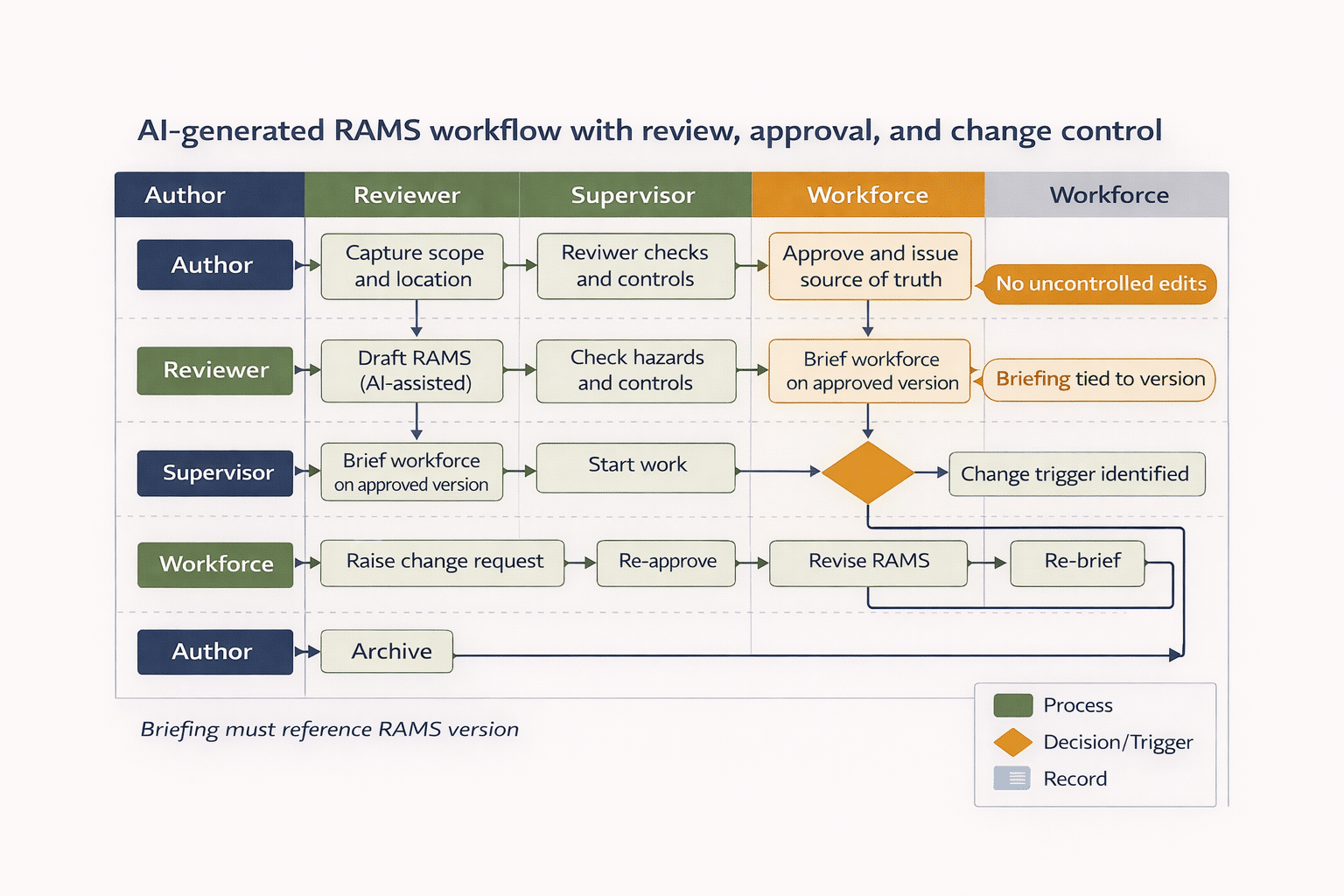
A safe AI-assisted RAMS process looks like a controlled document workflow, not a “generate and send” workflow. The steps below are written to prevent the two main failure modes: incorrect assumptions and uncontrolled versions.
Step 1: Lock the inputs before drafting
AI output quality depends on input quality. Capture and confirm, in writing:
-
scope and exact location
-
access and egress routes, including plant routes
-
drawings, services info, surveys, and constraints
-
interfaces with other trades, the public, live services, or traffic
-
plant, tools, and materials, including lifting and delivery arrangements
-
permits, hold points, and inspection requirements
-
competence requirements and supervision plan
Step 2: Draft with AI, then tighten the method steps
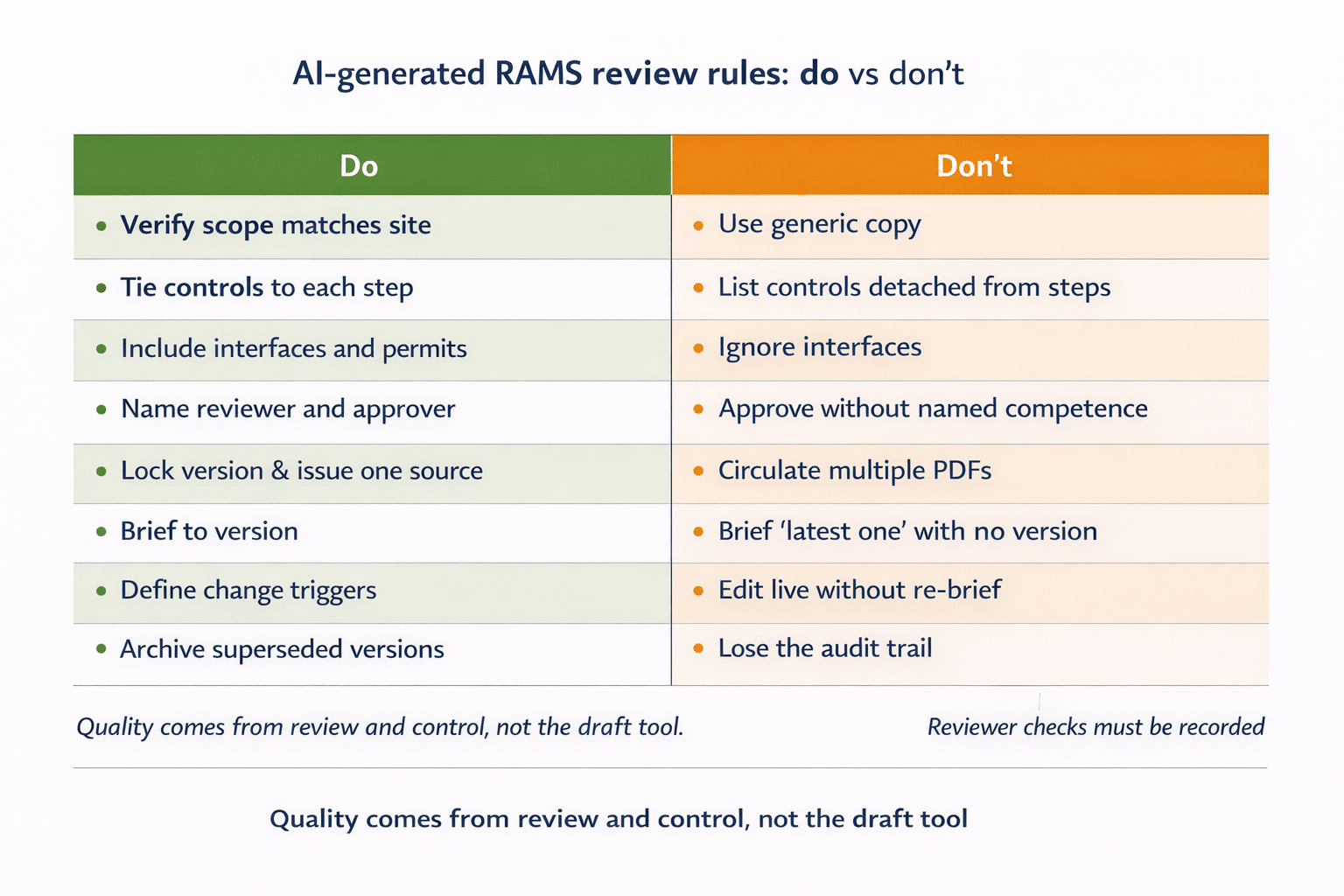
Use AI for structure and clarity, but do not accept a generic method. Edit the steps so they match the real sequence on site. If a control cannot be implemented, it is not a control.
Step 3: Validate hazards and controls against each step
A competent reviewer should challenge the RAMS line-by-line. The goal is to ensure controls are tied to the step where the risk occurs, not listed in a detached section that nobody follows.
Step 4: Approve and issue one source of truth
Record the reviewer, approval decision, and the final revision identifier. Issue a single approved version as the current RAMS. Do not allow parallel copies to circulate.
Step 5: Brief to the approved revision and capture evidence
Brief operatives using the approved version, not a draft. Record attendance, roles, date, and the revision number. If the workforce changes, capture that and re-brief where needed.
Step 6: Control change using triggers, not opinions
Define change triggers in the RAMS and in supervisor checks. When a trigger occurs, stop, log the change, revise the RAMS, re-approve if required, and re-brief before continuing.
For a practical checklist view of this workflow, see digital RAMS workflow for construction teams.
Who Is Accountable for AI-Generated RAMS? Roles, Competence, and Responsibility
AI does not hold competence. People and organisations do. Your governance should make responsibility explicit so there is no ambiguity when RAMS is challenged.
Author or planner
The author is responsible for capturing the correct inputs and producing a draft that reflects the intended method. If the author uses AI, they are still responsible for the draft quality and for escalating unknowns before issue.
Competent reviewer or approver
The reviewer approves the method and controls as suitable for the job and location. “Competent” means they understand the work, the risks, and the controls required, and they have authority to stop the job, request changes, and reject weak RAMS.
Supervisor
The supervisor is responsible for checking the work matches the method, that controls are implemented, and that changes are identified and managed. Supervisors should be trained to spot the common AI failure modes, especially generic steps that do not match the site.
Workforce
Operatives are responsible for following the briefed method and raising concerns where reality does not match the RAMS. This only works if the briefing is clear, role-led, and tied to the current revision.
Principal contractor and client expectations
On many projects, the principal contractor and client expect RAMS to be controlled, briefed, and updated under change control. If you cannot show review comments, approvals, briefing records, and version history, you will struggle to demonstrate control.
For review governance, use how to review and approve RAMS.
Common Risks and Failure Modes in AI-Generated RAMS
AI fails in ways that look credible. That is why AI-generated RAMS needs a tighter review habit, not a looser one.
Risk 1: Generic hazards and controls that do not match the job
AI often defaults to generic control language. The document reads well, but controls are not aligned to the actual set-up, plant, or location. Reviewers should challenge: “Could this apply to any site?” If yes, it needs site-specific control detail.
Risk 2: Wrong assumptions about access, plant, and constraints
AI will invent plausible access routes, deliveries, lifting arrangements, or exclusion zones if these are not specified. That can create unsafe instructions. The fix is input discipline: lock constraints before drafting and validate them in review.
Risk 3: Controls listed separately from method steps
A common RAMS failure is a controls section that is not tied to steps. AI can amplify this by producing long generic control lists. The reviewer should demand controls at the point of risk, in the step where the risk occurs.
Risk 4: Missing interfaces, permits, and hold points
AI will not automatically know about permits, temporary works checks, isolations, traffic management rules, client rules, or inspection hold points. These must be captured as inputs and enforced in the method.
Risk 5: Version drift and uncontrolled edits
Teams often edit AI outputs multiple times and share different PDFs. That creates a real risk of briefing the wrong revision. The fix is simple: one issued source of truth, clear revision ID, and briefing records tied to that revision.
Risk 6: False confidence from professional wording
AI produces confident language. That can suppress challenge culture. Your process should force challenge, not trust. Use a recorded comments log and a structured review checklist so the approval decision is evidence-led.
If your main failure mode is change and re-brief discipline, use how often RAMS should be reviewed to define review triggers clearly.
Generate RAMS in Under 3 Minutes
Compliant RAMS, Faster
Get instant access to our custom-built RAMS GPT tool and create Method Statements and Risk Assessments in minutes. Just £25/year or lifetime access for £167 (limited time).
Best Practice Framework for AI-Generated RAMS (Draft Fast, Control Hard)
A workable framework needs to be simple enough that teams follow it under time pressure. Use this as a baseline model.
1) Input control
-
capture scope, location, constraints, and interfaces before drafting
-
confirm plant, access, and permits as named inputs
-
do not allow “assumed” values to stay in the document
2) Step-led control mapping
-
method steps must be clear, sequential, and site-realistic
-
hazards and controls must sit under the step where they apply
-
every critical control must have an owner (role-based is acceptable)
3) Competence-led review
-
named reviewer and approver, recorded decision
-
recorded comments and responses, even if brief
-
rejections are normal when inputs are weak, treat them as signals
4) Single source of truth
-
one issued approved revision, clearly labelled
-
controlled distribution, avoid parallel copies
-
superseded versions marked and archived
5) Briefing evidence
-
briefing record tied to revision number
-
attendee roles captured, not just names
-
understanding checks captured, not just signatures
6) Change control loop
-
clear change triggers written into RAMS
-
change request recorded before revising
-
re-approval and re-brief captured where required
If you want to implement this with a structured workflow approach, see digital RAMS workflow for construction teams.

Implementation Roadmap: Introducing AI-Generated RAMS Without Losing Control
You do not need a big transformation programme to adopt AI drafting safely. You need phased governance and clear standards.
Phase 1: Standardise inputs and drafting rules
Start by defining what a “complete input pack” looks like. Train authors to capture constraints and interfaces before generating drafts. Set a rule that drafts cannot be issued without a reviewer check.
Phase 2: Train reviewers on AI-specific failure patterns
Reviewers should know what to look for: generic controls, invented assumptions, missing permits, missing interfaces, and step-control mismatch. Make the review process consistent by using a checklist and a recorded comments log.
Phase 3: Tighten version control and issuing discipline
Make it normal to use one issued revision with a clear identifier. Define where the source of truth is stored. Make uncontrolled edits unacceptable. Build a habit of marking superseded versions and archiving them properly.
Phase 4: Build change triggers into supervisor checks
Write change triggers in plain language and teach supervisors to stop work when triggers hit. Common triggers include access changes, plant changes, sequence changes, new interfaces, weather or ground changes, and permit changes.
Phase 5: Audit readiness and continuous improvement
Review outcomes: rejections, re-brief frequency, common change triggers, and common reviewer comments. Use that data to improve input capture, templates, and training.
For site change control detail, use RAMS change control on site.
Digital Transformation Context: Where AI Fits in a Controlled RAMS System
AI drafting becomes safer when it sits inside a controlled digital workflow. The goal is not “paperless for the sake of it”. The goal is predictable control.
A controlled digital RAMS system should support:
-
structured inputs, so authors do not miss constraints and interfaces
-
revision history, so changes are visible and traceable
-
review comments capture, so approvals are evidence-led
-
a clear “approved” status and a single published source of truth
-
briefing records linked to the exact revision
-
change requests and re-approval workflows, not informal edits
If AI sits outside this control loop, it tends to increase version drift and reduce review quality. If it sits inside a controlled workflow, it can reduce admin time while improving consistency.
If you want to see how Paperless positions RAMS workflows and briefings, see RAMS and safety briefings.
Regulatory and Compliance Alignment for AI-Generated RAMS
You should avoid framing AI-generated RAMS as “compliant by default”. Compliance is an outcome of a competent process, not the drafting tool.
A practical alignment approach is:
-
use recognised risk assessment principles as your baseline expectations
HSE: Managing risks and risk assessment at work -
treat method statements as a communication tool for the safe system of work, built from the risk assessment conclusions
HSE construction: method statements and administration -
keep evidence that shows control: review comments, approvals, issued revision, briefing record tied to revision, and controlled changes
What auditors and clients typically look for is straightforward:
-
Was the RAMS suitable for the work and location?
-
Was it reviewed and approved by a competent person?
-
Was the workforce briefed on the approved version?
-
Were changes controlled, re-approved where needed, and re-briefed?
-
Can you show a clear audit trail from first draft to close-out?
If you cannot evidence those points, the fact that AI was used becomes an additional risk factor, not a benefit.
Commercial and Operational Impact: What AI Changes (and What It Does Not)
AI can reduce drafting time, but the benefits only count if approvals, briefings, and change control stay tight.
Where AI can help operationally
-
faster first drafts for planners and supervisors
-
consistent structure across teams and projects
-
quicker updates when changes are controlled and reviewed
-
improved readability when plain language rewrites are used correctly
Where AI can increase operational cost
-
late rejections due to weak review discipline
-
re-briefing time due to version drift
-
stop-start work when controls do not match the site
-
additional supervision burden because the method is not realistic
If you are choosing tools, focus on the control system first: review workflow, version control, single source of truth, and briefing evidence. The drafting method is secondary.
If you want the broader risk assessment and method statement capability context, see risk assessments.
Future Trends: How AI Use in RAMS Is Likely to Evolve
AI drafting will get better, but industry expectations are likely to move towards stronger governance, not weaker governance.
Trends to expect:
-
more structured input capture, because free-text prompting leads to inconsistent outputs
-
clearer competence and approval expectations, especially on higher-risk work
-
stronger emphasis on version control and traceability, because AI increases document volume
-
more attention on briefing evidence and re-brief triggers, because change is constant on site
-
increased client scrutiny of “how you control RAMS”, not “what tool you used”
Teams that succeed with AI-generated RAMS will treat AI as a drafting assistant inside a controlled workflow. Teams that struggle will use AI as a shortcut and then fight rejections, re-briefs, and audit gaps.
Frequently Asked Questions
Can you use AI to write a risk assessment and method statement?
Yes, AI can draft content, but you still need a competent person to check, edit, and approve it for the actual site and task. AI often makes assumptions when inputs are missing. Treat AI output as a draft that must be validated step-by-step before issue.
Who is responsible for AI-generated RAMS on site?
Responsibility remains with dutyholders, not the AI tool. Authors are responsible for inputs and draft quality, reviewers are responsible for the approval decision, and supervisors are responsible for ensuring the work matches the briefed method and controls. The tool does not hold competence.
What should you check before issuing AI-generated RAMS?
Check that the scope, location, access, interfaces, plant, permits, and constraints match reality. Then validate hazards and controls against each method step. Confirm a named competent reviewer has approved the revision and that you will issue one source of truth for briefing.
How do you stop version drift with AI-generated RAMS?
Use a single issued approved revision with a clear identifier, keep drafts separate, and avoid informal edits after approval. Store the source of truth in one location and ensure briefing records reference the exact version. Supersede and archive old versions properly.
When do you need to re-brief RAMS after changes?
Re-brief when a change affects the method, sequence, controls, plant, access, interfaces, or permits. If operatives could be working to the wrong controls, stop and re-brief before work continues. Tie the re-brief record to the revised version.
Are AI-generated RAMS accepted by principal contractors?
Often yes, but acceptance usually depends on evidence of control: correct inputs, competent review, clear approvals, briefing records tied to the revision, and change control. A professional-looking document without an audit trail can be rejected quickly.
Is AI-generated RAMS compliant in the UK?
Compliance depends on the quality of the risk assessment, the suitability of the method statement, and the competence and control process around them. Avoid claims that AI output is compliant by default. Focus on review, approval evidence, briefing, and change control.
What are the most common mistakes in AI-generated RAMS?
Generic hazards and controls, invented assumptions about access and plant, controls not tied to method steps, missing permits and interfaces, and uncontrolled versions. These issues are preventable with locked inputs, step-led review, and a single source of truth.
How do you review hazards and controls in AI-generated RAMS quickly?
Use a structured checklist and review the method step-by-step. For each step, ask: what can harm someone here, what control prevents it, who owns that control, and is it implementable on this site. Record comments and require responses before approval.
Explore Related Guides and Resources
For wider context on AI-assisted RAMS, use these guides to cover the fundamentals, UK compliance, review responsibilities, and change control.
-
RAMS construction guide
A foundation guide to what RAMS is, what it should include, and how to make it usable on site. -
Is AI-generated RAMS compliant in the UK? | Guidance
UK-focused guidance on compliance expectations, review requirements, and how AI fits into a controlled process. -
Who is responsible for AI-generated RAMS on site?
Clarifies who owns drafting, review, approval, issue, and briefing when AI is involved. -
What should you check before issuing AI-generated RAMS?
A practical pre-issue checklist for site specifics, hazards, controls, assumptions, and sign-off readiness. -
RAMS Automation: AI for Faster, Safer Construction
Explains how to speed up RAMS drafting while keeping approvals, version control, and evidence intact. -
RAMS with AI | How to Create Safety Docs in 3 Minutes
A practical guide to rapid AI drafting, plus the checks required before anything goes live on site. -
Get RAMS Done in 3 Minutes with AI
A quick-start view of AI-assisted RAMS and what a competent reviewer still needs to confirm. -
Consistent, Compliant RAMS in Minutes with AI
How to keep outputs consistent across teams using structure, controlled distribution, and traceable records. -
Write Method Statements & Risk Assessments in Minutes, Using AI
Covers using AI to draft method statements and risk assessments faster, with reviewer-led control. -
RAMS change control on site
Practical triggers and steps for revising, re-approving, and re-briefing when conditions change. -
How often should RAMS be reviewed?
Clear guidance on review frequency, trigger points, and what “review” should mean in practice. -
Digital RAMS workflow for construction teams
A workflow view of RAMS control, including evidence capture, traceability, and audit readiness. -
Method statements
Product overview for controlling method statements, distribution, acknowledgements, and revision history. -
Risk assessments
Product overview for creating and controlling risk assessments with clear review and record keeping.
If you are adopting AI drafting for RAMS, prioritise the control loop first: locked inputs, competent review, one approved source of truth, briefing evidence tied to version, and a clear change trigger process. If you want to see how Paperless supports RAMS control and safety briefings in a practical workflow, explore RAMS and safety briefings and map it against the governance model in this guide.
Generate RAMS in Under 3 Minutes
Compliant RAMS, Faster
Get instant access to our custom-built RAMS GPT tool and create Method Statements and Risk Assessments in minutes. Just £25/year or lifetime access for £167 (limited time).