

Is AI-generated RAMS compliant in the UK? | Guidance

Introduction
If you are asking “is AI-generated RAMS compliant in the UK?”, you are usually trying to avoid two real problems: generic RAMS that get rejected by clients, and missing evidence when someone asks “who checked this, which version was briefed, and what changed?”.
AI can produce a fast first draft, but compliance is not created by the drafting tool. It is created by the competence, controls, and records around the document. That is why this article focuses on how to judge whether AI-drafted RAMS will stand up to review, briefing, and change control on a UK project.
For the wider context on AI-assisted risk assessments and method statements, start with AI-generated risk assessments and method statements guide.
Quick Answer..
AI-generated RAMS can be usable on UK projects if it is treated as a draft and then brought under a controlled process. The practical test is whether you can prove: (1) it is site-specific, (2) it has been checked by a competent person, (3) it was approved and issued as a controlled version, (4) the workforce was briefed on the issued version, and (5) changes trigger revision, re-approval where required, and re-briefing.
What “compliant” means in practice for AI-drafted RAMS
On most UK projects, “compliant” RAMS is not about whether a tool drafted the words. It is about whether the document is suitable for the job, understandable on site, and controlled in a way that stands up to client scrutiny and audit.
This matters because RAMS is normally used as a live control mechanism. It shapes how the job is set up, how interfaces are managed, what checks must happen before work starts, and what the supervisor expects the team to do when conditions change.
A practical definition that works in day to day operations is: a RAMS that is accepted, briefed, followed, and kept under change control, with evidence to prove each step.
The site-specificity test: how to spot a generic AI RAMS fast
AI tends to write “reasonable sounding” RAMS that reads well but fails the workface reality test. If the scope and inputs are weak, the output will be generic, even if the writing looks professional.
The fastest way to assess site specificity is to look for constraints and interfaces, not buzzwords. A site-specific RAMS should clearly reflect what is unique about this location, this sequence of work, and this team.
Use the checks below as a pass or fail screen:
-
Scope clarity: Does it state what is included, excluded, and the exact sequence of activities?
-
Constraints: Does it name constraints such as access limits, overhead hazards, buried services expectations, public interface, live traffic, or restricted zones?
-
Interfaces: Does it cover plant and pedestrians, subcontractor overlaps, deliveries, and any handover points?
-
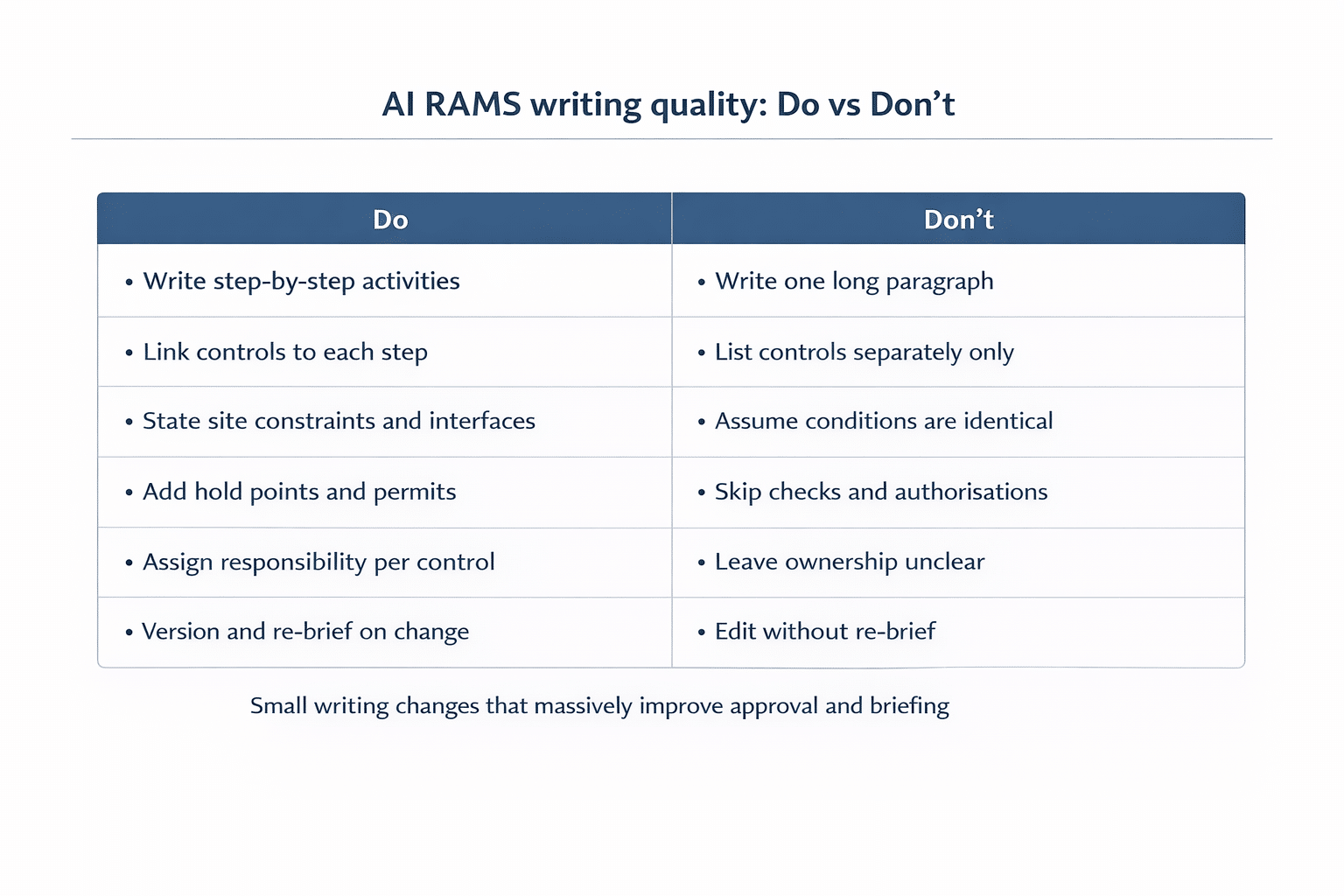
Method-control linkage: Are controls tied to the step they relate to, or dumped into a separate list?
-
Responsibility: Is each critical control owned by a role, not “the team”?
-
Workface language: Would a supervisor brief it without rewriting half of it?
If you want a deeper RAMS quality baseline to compare against, use RAMS construction guide as the reference point for what “good” should look like.

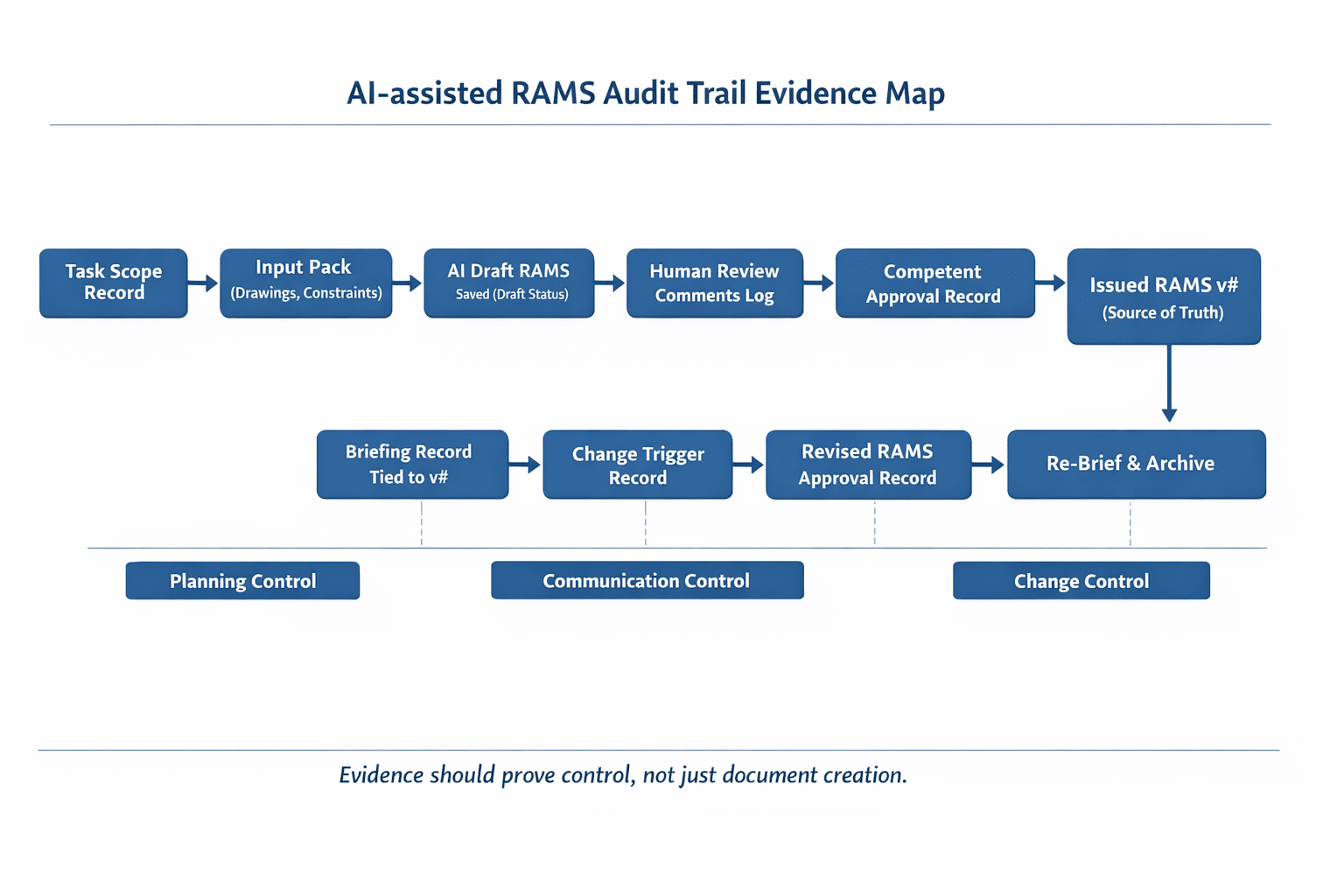
The control test: evidence that proves review, approval, and issue
Even a strong RAMS can fail a compliance discussion if you cannot evidence control. Most rejections are not “your controls are wrong”, they are “we cannot see who checked this and what version is live”.
This is where AI changes the risk profile. AI makes it easy to generate lots of text quickly, which increases the chance of uncontrolled drafts being treated as final. The governance has to make it difficult to issue a draft by accident.
At minimum, you need an audit trail that answers these questions:
-
Who drafted the initial version, and when?
-
What inputs were used to shape it for this site?
-
Who reviewed it, what did they query, and what changed as a result?
-
Who approved it as competent, and what revision was issued?
-
What is the single source of truth version for briefing and delivery?
A simple way to implement this is to separate the process into four clear states:
-
Draft: AI output and early edits, not for issue
-
Review: comments and queries captured, edits tracked
-
Approved: competent sign-off recorded against a revision
-
Issued: controlled version distributed and briefed
If you are using a digital briefing process, you can also strengthen the evidence by linking the issued RAMS version to the briefing record and attendance record, so it is always clear what the workforce was briefed on.

Using ChatGPT for RAMS?
Draft Faster. Review Site Risks Properly.
Get access to our free RAMS generator now.
Briefing evidence: proving the workforce saw the issued version
RAMS is only useful if the workforce has been briefed on the version that is actually in use. This is where many sites fail, especially when edits are made after the initial briefing.
In Paperless, method statements and RAMS can be delivered as a digital briefing type, with attendance captured and records emailed to attendees or compliance officers. Workers can also self-enrol onto briefings via a link or code, and for online training an OTP authentication can be used to strengthen authenticity of the record. These operational features make it easier to prove that a briefing happened, who attended, and what was covered.
For the briefing record to do its job, it should always include:
-
RAMS ID and version number
-
Date, time, and supervisor completing the briefing
-
Attendees and roles
-
Notes on key controls and any understanding checks
-
Supporting evidence where relevant, such as photos of set-up or marked-up plans
Where you are using daily briefings, capturing a photo of the whiteboard with marked-up plans is a practical way to show the job was planned and communicated in a way the team could understand.
Change control: when AI makes the risk worse, and how to fix it
Change control is the point where AI can create a real governance failure. If people can generate a “better version” in seconds, they will be tempted to edit the document without treating it as a controlled revision.
You need a clear rule on what triggers a change, and what must happen next. Without that rule, you end up with mismatched versions: one on the system, one on a PDF, one in someone’s inbox, and one in the supervisor’s head.
A practical change control workflow on site looks like this:
-
Change trigger identified: scope, sequence, access, plant, temporary works, or new interface
-
Change recorded: short note of what changed and why
-
RAMS revised: update the steps and controls, not just the hazards list
-
Re-approval decision: if the change affects critical controls, record competent re-approval
-
Re-issue: publish the revised version as the new source of truth
-
Re-brief: brief the workforce against the revised version and record attendance
-
Archive: retain superseded versions as historical records
Paperless also supports expiry dates for briefings, which can be useful when a permit or control needs to expire automatically after a set date, reducing the chance of outdated controls being treated as current.
Common reasons AI-drafted RAMS gets rejected by clients
Most client reviewers are not trying to “catch you out”. They are trying to reduce project risk, and they use predictable red flags as a proxy for whether the job is being controlled.
AI-drafted RAMS is more likely to be rejected when:
-
Controls are listed but not embedded in the method
-
Interfaces are missing such as deliveries, pedestrians, other trades, and public boundaries
-
Hold points are absent where a check should stop work until confirmed
-
Responsibilities are vague such as “ensure” with no named role
-
The document reads like a template with no location or constraint signals
-
Evidence is missing such as no review comments log, no approval record, no issued version, no briefing record
If you want to show reviewers you are operating a controlled workflow, a short internal link to a relevant system page can be appropriate when the reader shifts into evaluation. For example: RAMS software feature overview.

A practical example: turning an AI draft into an acceptable RAMS pack
Assume you start with an AI draft for a common civils activity like excavation and reinstatement. The draft might list hazards and generic controls, but it will usually miss your site’s constraints and the interface rules that actually prevent incidents.
A controlled approach would look like this:
-
Lock the task scope: exact limits, sequence, plant, people, and exclusions
-
Gather inputs: site constraints, interfaces, permit requirements, and any client standards
-
Generate the AI draft: treat it as a starting point, not the final
-
Edit for site reality: update method steps, embed controls, assign responsibility
-
Run review and approval: capture comments, resolve queries, record competent approval
-
Issue version v1.0: this becomes the source of truth
-
Brief the workforce: record attendance, notes, and supporting evidence
-
Operate change control: revise and re-brief when conditions change
If you want separate supporting documents for the pack, link out only when it helps the reader complete the job. For example, your risk assessment may sit alongside your method statement and briefing records. If the reader is assessing digital delivery of these, method statements briefing capability is a relevant supporting page.
Frequently Asked Questions
Do I need to tell my client that AI helped draft the RAMS?
You are usually better off describing your process rather than the tool. If you can evidence site-specific inputs, competent review, controlled approval, and versioned briefing records, you are answering what most reviewers actually care about.
What is the minimum evidence pack for RAMS control on site?
At minimum: task scope and inputs, review comments log, competent approval record, issued RAMS version identifier, briefing record tied to that version, and a change log that triggers revise and re-brief when needed.
When should a RAMS be revised after issue?
Revise when scope, sequence, plant, access, interfaces, or key controls change. The trigger should be recorded, then the RAMS updated under version control, and the workforce re-briefed against the new issued version.
Can a digital briefing record strengthen RAMS governance?
Yes, if it ties attendance and briefing notes to the issued RAMS version and supports supporting evidence like photos, marked-up plans, and supervisor notes. The value comes from proving what was briefed, to whom, and when.
How to make AI-drafted RAMS stand up to scrutiny
AI can speed up drafting, but it also increases the risk of uncontrolled documents being treated as final. The safest position is to treat AI output as a draft and enforce a controlled workflow from review through to briefing and change control.
Three takeaways to apply immediately:
-
Make site specifics non-negotiable, especially interfaces and constraints
-
Prove control with review comments, competent approval, and a single issued version
-
Treat change triggers as mandatory events that force revise and re-brief
For the broader context and supporting guidance, return to AI-generated risk assessments and method statements guide.
If you want a clean baseline to compare your AI draft against, use a structured template and then layer your site specifics, approvals, and briefing records on top.
Primary action: Download the Risk Assessment template

Using ChatGPT for RAMS?
Draft Faster. Review Properly.
Get access to our free RAMS generator and speed up your first draft with site-specific review built in.


