

Construction RAMS template UK

Introduction
RAMS construction guide is the wider framework, but if you are searching for a construction RAMS template UK, you are usually trying to standardise how your team documents and briefs work on site.
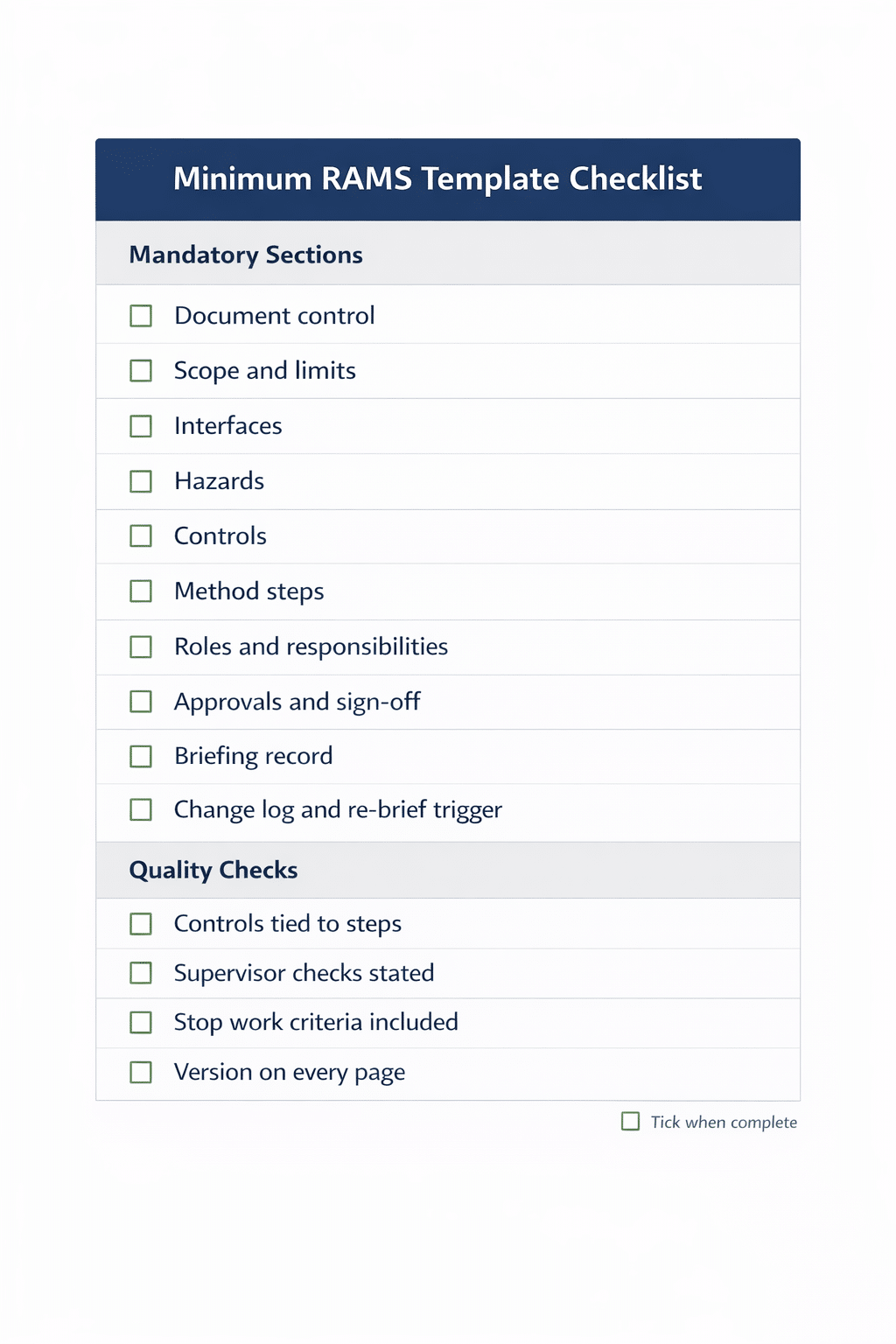
A RAMS template is only useful if it forces the right information into a practical structure: scope, hazards, controls, and a step-by-step method that supervisors can brief and operatives can follow. It also needs simple governance: approvals, a briefing record, and a clear way to manage changes so the site is always working to the latest version.
This guide covers what sections a UK construction RAMS template should include, how to write method steps that work on live sites, and how to run the approval, briefing, and change control loop without creating admin overhead.
Quick Answer..
A construction RAMS template UK should include: task scope, interfaces, hazards and controls, a step-by-step method sequence, roles and responsibilities, plant and equipment, approvals and sign-off, a briefing record, and change control. If your template does not force those sections, RAMS quality varies by author and version control becomes harder to manage.
What a construction RAMS template UK should include as standard sections
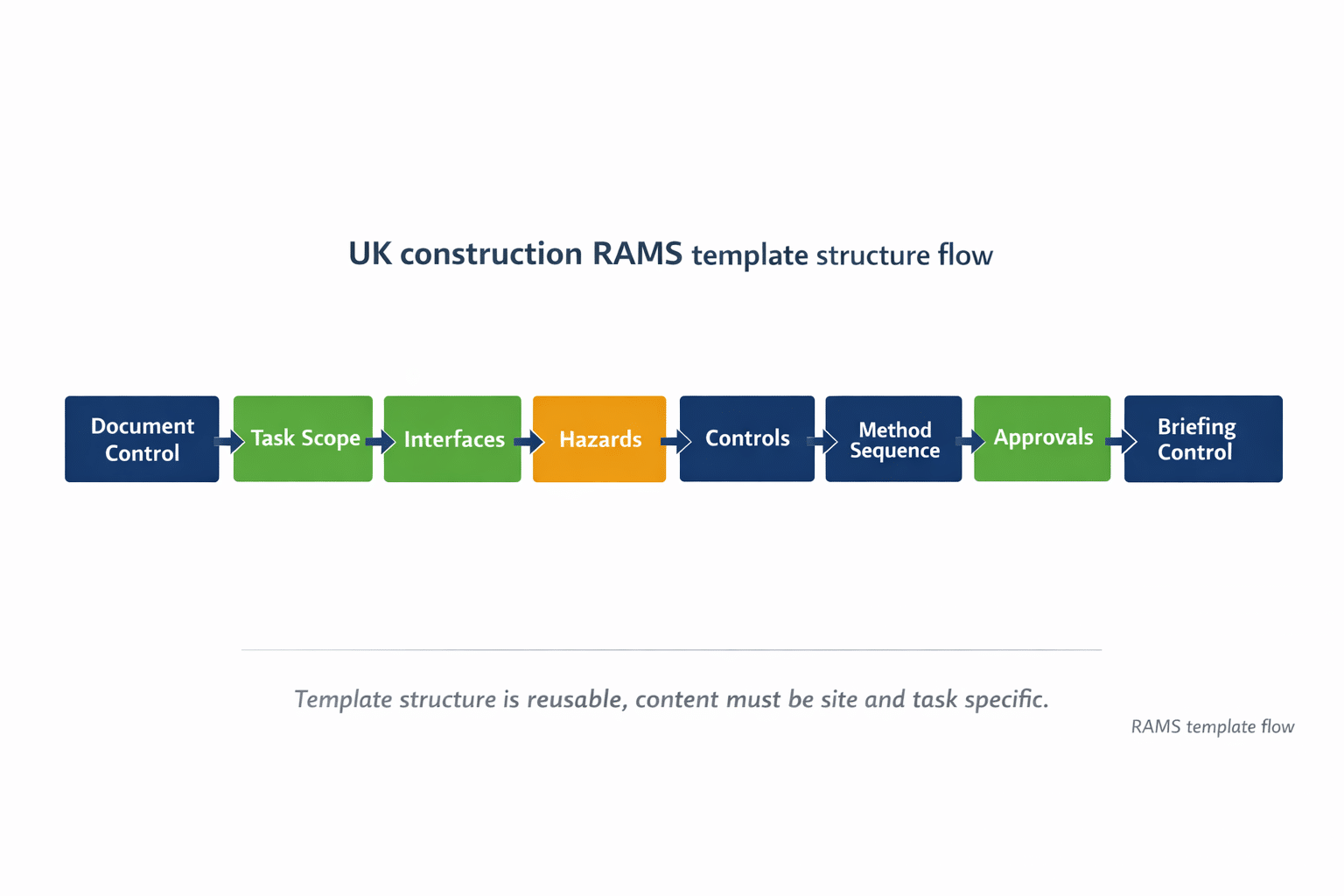
A template is the fastest way to reduce variability. These are the sections that should be present every time, even for smaller tasks:
-
Document control
-
RAMS title, project or site reference, author, reviewer, approver
-
Version number and date
-
Status (draft, approved, superseded)
-
Task scope and limits
-
What is included and what is excluded
-
Work area, access constraints, and interfaces with other activities
-
Hazards and controls
-
Task-specific hazards
-
Control measures that can actually be implemented on site
-
Any checks or hold points that confirm controls are in place
-
Method sequence
-
The job steps in the order they will be carried out
-
Who does what at each step
-
Where controls apply within the steps
-
Roles, supervision, and responsibilities
-
Supervisor responsibilities and checks
-
Operative responsibilities and stop points
-
Who signs off briefings, permits, or inspections where applicable
If you want a clearer split between the two core parts of RAMS, use the linked feature breakdowns for reference: risk assessments and method statements.
When a construction RAMS template UK needs more detail
Not every job needs a long RAMS, but certain conditions justify more structure because the site risk profile is higher or coordination is harder.
Use additional sections when the task includes:
-
Multiple trades or active interfaces in the same area
-
Temporary works or changing access arrangements
-
Significant plant movements, deliveries, or lifting operations
-
Work near services, public interfaces, or constrained environments
-
Any requirement for inspections, permits, or staged sign-off
A practical way to keep this controlled is to keep the core template fixed, then add conditional annex sections only when the work demands it.
How to write method steps in a RAMS template so supervisors can brief them
The “method” is where RAMS succeed or fail. The template should push authors to write steps that sound like an operational briefing.
Use these rules:
-
Start each step with an action
Example format: “Set up exclusion zone”, “Install edge protection”, “Confirm access route is clear”. -
Attach controls to the step they belong to
Do not list controls once at the top if they only matter at specific points in the sequence. -
Make supervision points explicit
Include checks like: “Supervisor confirms…”, “Do not proceed until…”, “Stop work if…”. -
Call out interfaces at the moment they occur
If other trades, deliveries, or live areas affect the step, state it there, not in a separate paragraph.
If your organisation briefs digitally, align the method steps to a briefing flow so it is easier to run consistent briefings and capture evidence. The related feature area is RAMS.
Construction RAMS template UK workflow for review, approval, and briefing
A template should support a predictable workflow, otherwise the same document gets used in different ways on different sites.
A workable baseline flow is:
-
Draft
Author completes scope, hazards, controls, and method steps. -
Review
A reviewer checks practicality, interfaces, and whether controls are tied to steps and responsibilities. -
Approval
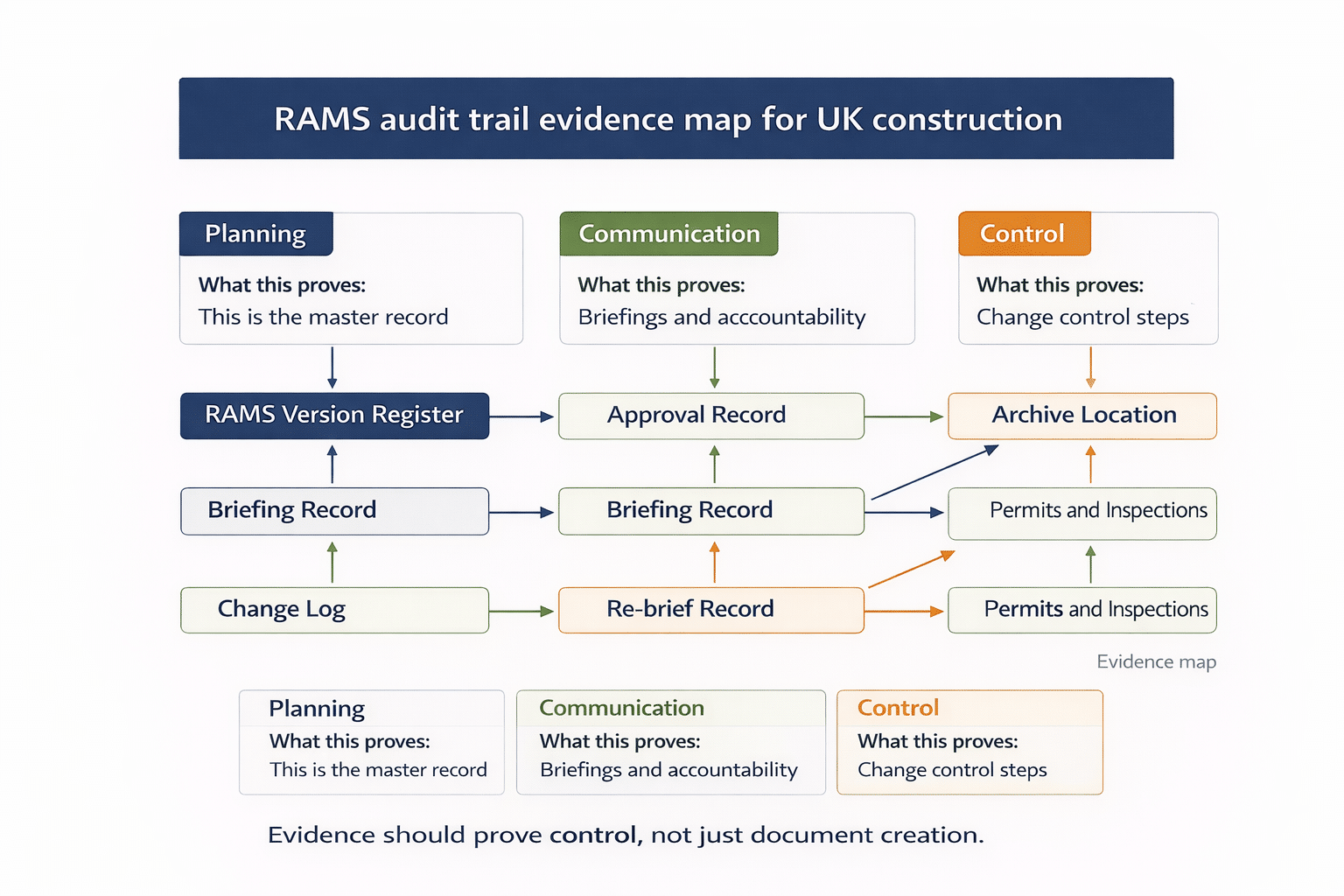
Approval is recorded against a specific version and date. -
Briefing
Supervisor briefs the operatives who will carry out the work and captures a briefing record against the approved version. -
Delivery and monitoring
Supervision checks that controls are in place and being followed.
If you are also producing standalone documents, these supporting resources may help standardise your pack components: risk assessment template and method statement template.
Get Your Free Risk Assessment Template
Faster Reviews. Clearer Risk Controls.
Use a clean RA template to document hazards, control measures, and responsibilities clearly, making reviews, approvals, and site briefings simpler.
How to prevent version drift using change control inside your RAMS template
Most RAMS issues on site are not about whether RAMS exist. They are about whether the current version is the one people are following.
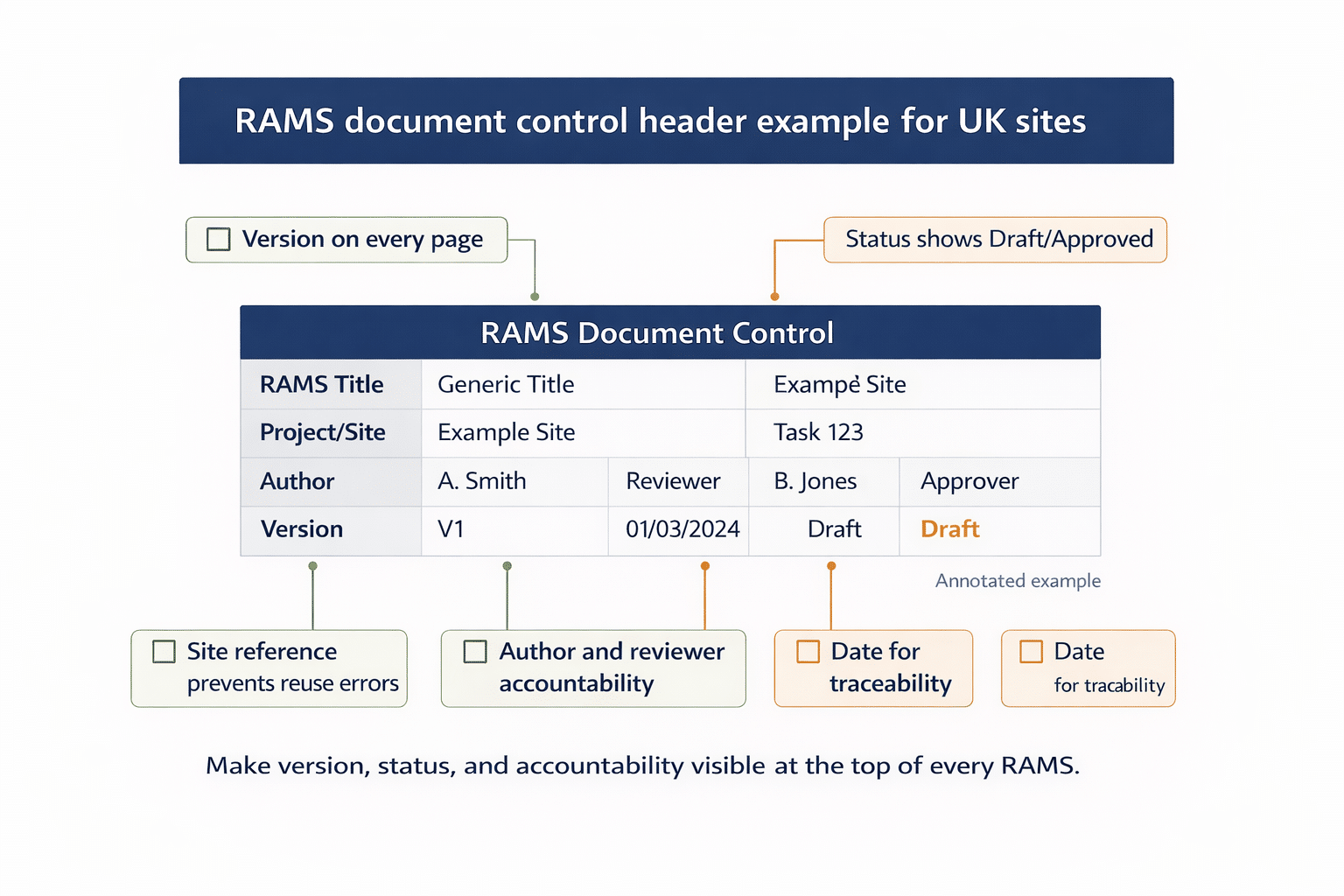
Build these fields into the template:
-
Version and status on every page
-
Change log: what changed, why it changed, who changed it
-
Re-brief trigger: a simple statement that forces a re-brief when scope, sequence, access, plant, or controls change
-
Re-brief record: who was re-briefed and when, linked to the new version
If you need a wider view of how AI-generated drafts should be reviewed and controlled, use this guide to AI-generated risk assessments and method statements as a supporting reference.
Common mistakes in a construction RAMS template UK and how to control them
These are the failure modes that show up repeatedly when templates are used without governance:
-
Copy and paste without re-scoping
Control: force a scope and interfaces section that must be completed each time. -
Controls listed but not applied to steps
Control: require controls per method step, not only as a global list. -
Roles unclear at the point of action
Control: include responsibility fields in the method sequence so supervision and operative actions are explicit. -
Approval recorded but briefing not evidenced
Control: make the briefing record a mandatory section that references the approved version. -
Changes made informally during delivery
Control: include a change log and re-brief trigger so updates are controlled.
Frequently Asked Questions
What is the minimum a UK construction RAMS template should include?
A UK construction RAMS template should include document control, task scope, hazards and controls, method sequence, roles, approvals, a briefing record, and change control. These sections support both delivery and the evidence trail.
Can I use the same RAMS template across different sites?
You can reuse the template format, but the content must be site and task specific. The template should force authors to re-scope the work, update interfaces, and rewrite steps and controls to match the actual site conditions.
How do I make sure operatives follow the latest RAMS version?
Use version control, a change log, and a re-brief trigger inside the template. When anything material changes, issue a new version and record who was re-briefed against that version.
Using a construction RAMS template UK to improve consistency and control
A construction RAMS template UK works best when it standardises both content and governance.
Key takeaways:
-
A strong template forces core sections: scope, hazards, controls, method steps, roles, approvals, briefing record, and change control.
-
Method steps should read like an on-site sequence, with controls and checks attached to the steps where they apply.
-
Version control and re-briefing rules prevent the most common site failure: working to an outdated copy.
For the broader RAMS lifecycle and how the pieces fit together, return to the RAMS construction guide.
If you want a fast starting point, use the AI RAMS Generator to create a structured first draft, then review it properly against your site scope, interfaces, method sequence, and change control before approval and briefing.
Download Your Free Method Statement Template
Build Clear Method Steps Faster
Use a practical, site-friendly template to document sequence, roles, plant, and controls for clear briefings and easier site delivery.


