

How to write RAMS for construction work

Introduction
If you are searching for how to write RAMS for construction work, you are usually trying to solve one problem: turning “how we plan to do the job” into something that is clear enough to approve, brief, and follow on site. A good RAMS document is not long for the sake of it. It is specific to the task, the location, and the team doing the work.
This article gives a practical, UK site-friendly method for writing RAMS that supervisors and operatives can actually use. It covers what to include, how to structure the method steps, how to show controls properly, and how to avoid the mistakes that cause rework or rejection at approval stage.
For a broader end-to-end overview (including governance, review cycles, and audit trail), start with the main guide: RAMS in construction: the complete guide.
Quick Answer..
To write RAMS for construction work, define the task scope and site conditions, identify hazards, assess risk, select control measures, then write the method sequence step-by-step with roles and hold points. Finally, put the RAMS through review and approval, brief the team with sign-off, and control changes through versioning and re-briefs.
What a “good” construction RAMS includes
A RAMS package is typically a Risk Assessment plus a Method Statement, supported by any task-specific attachments (permits, lifting plan, temporary works checks, etc.). In practice, reviewers want to see these essentials:
-
Task scope and boundaries: what is included and excluded, and where the work starts and finishes
-
Site and work environment assumptions: access and egress, segregation, lighting, weather exposure, ground conditions, services, nearby operations
-
Hazards and people at risk: who can be harmed (operatives, other trades, public) and how
-
Risk evaluation and controls: control measures that match the hazard and are realistic on that site
-
Method sequence: a step-by-step plan that a supervisor can brief and enforce
-
Roles and responsibilities: who does what, who checks, who authorises
-
Plant, tools, and materials: including inspection requirements and operator competence
-
PPE and RPE: specified where it is genuinely needed, aligned to the controls
-
Emergency arrangements: first aid, rescue plans where relevant, fire points, spill response
-
Approvals, briefings, and change control: who signs, who is briefed, and what triggers a review
If your RAMS are routinely rejected, it is usually because one of these is missing, or the method steps do not clearly show how controls are applied in practice.

Step 1: Define the task properly before you write anything else
Most “bad RAMS” start with a copied scope. Fix that by gathering the minimum inputs first. A useful scope block typically includes:
-
Task description in plain language (what you are doing)
-
Location and boundaries (exact area, levels, access route, laydown)
-
Interfaces (other trades, vehicles, services, live environments, occupants)
-
Constraints (working hours, noise limits, exclusion zones, permits)
-
Materials and plant (including lifting, access equipment, and power tools)
-
Competence requirements (tickets, training, supervision level)
Practical tip: write the scope as if the reader has never visited the site. If you cannot visualise the work from the scope, your method sequence will be guesswork.
Related reading (useful when RAMS are shared across projects): site RAMS compliance.
Step 2: Identify hazards in a way that matches the work sequence
A fast way to improve hazard identification is to map hazards to the actual activities. Instead of listing generic hazards, link them to steps such as:
-
Deliveries and unloading
-
Setting up exclusion zones and access
-
Access equipment set-up (scaffold, MEWP, podium steps)
-
Isolation and permits
-
The main work activity (cutting, drilling, excavation, installation)
-
Testing and commissioning
-
De-rig and demobilisation
For each activity, ask:
-
What could go wrong here?
-
Who could be affected?
-
What is the worst credible outcome?
-
What controls stop it happening, and what reduces harm if it does?
This approach produces RAMS that are easier to brief, because operatives recognise the steps and the risks in each step.
Download Your Free Briefing & Attendance Template
Ready-to-Use Briefing Sheet
Track attendance, signatures, and daily safety briefings with a free HSE-aligned record sheet for toolbox talks, inductions, and site audits.
Step 3: Select control measures that are specific, measurable, and enforceable
Controls should not be vague statements like “take care” or “use PPE”. A reviewer is looking for controls that are:
-
Specific: “Barriered exclusion zone with signage at all access points”
-
Measurable: “Minimum 2 m exclusion” or “Spotter required during reversing”
-
Assigned: “Supervisor to confirm barriers are in place before work starts”
-
Timed: “Check before start, after breaks, and after any change”
A practical hierarchy for construction RAMS is:
-
eliminate or substitute
-
engineering controls (guards, barriers, temporary works, mechanical aids)
-
administrative controls (permits, supervision, sequencing, briefings)
-
PPE as the last line of defence
If you want the RAMS to survive real site pressure, put your strongest controls earlier in that hierarchy.
Step 4: Write the method statement as a sequence, not a paragraph
Your method statement should read like a site plan, not an essay. Use numbered steps, keep each step to one main action, and attach controls to the step where they matter.
A reliable structure:
H3: Pre-start and set-up
-
Confirm permits, isolations, and competence
-
Establish exclusion zones and access routes
-
Plant checks and tool inspections
-
Confirm emergency arrangements and communications
H3: Work sequence (numbered steps)
-
Step describing the action
-
Step describing the next action
-
Include hold points where an inspection or authorisation is required
H3: Quality and checks
-
What gets inspected, by whom, and what evidence is produced (photos, forms, sign-off)
H3: Close-out
-
Remove waste, remove barriers when safe, reinstate, hand back area
If you are using digital workflows, it helps to embed briefing and sign-off into the process. See: construction safety briefings and digital RAMS.

Common RAMS mistakes that cause rejection (and how to fix them)
Mistake 1: The RAMS are not site-specific
Fix: add a short “site conditions” block (access, segregation, interfaces, services, constraints).
Mistake 2: Controls are copied but do not match the hazard
Fix: ensure each hazard has at least one strong preventative control, plus monitoring.
Mistake 3: No clear responsibility
Fix: assign a named role to every critical control (Supervisor, Appointed Person, Banksman, First Aider).
Mistake 4: Method steps do not include hold points
Fix: insert hold points for permit sign-off, inspections, temporary works checks, lifting operations, and isolations.
Mistake 5: Briefing and change control are missing
Fix: include a simple version control statement, who approves changes, and what triggers a re-brief.
If you are trying to improve governance and audit trail, this is covered in depth in the main guide: RAMS in construction guide.
A practical example outline (what “finished” RAMS looks like)
Below is an example outline you can reuse for most construction tasks. The content must be tailored to your specific work.
H3: Header and scope
-
Project, location, task title, dates
-
Scope boundaries and exclusions
-
Interfaces and constraints
H3: People and responsibilities
-
Supervisor responsible for briefings and checks
-
Operatives responsible for following method and reporting change
-
Review and approval roles (contractor, principal contractor, client where required)
H3: Plant, tools, materials, and competence
-
Plant list with inspection expectations
-
Tools and consumables
-
Competence requirements and supervision ratio
H3: Risk assessment (hazards, controls, residual risk)
-
Hazards grouped by activity or hazard type
-
Controls linked to activity
-
Monitoring and checks
H3: Method statement (sequence and controls)
-
Pre-start
-
Set-up and segregation
-
Step-by-step work method
-
Hold points and inspections
-
Close-out and handover
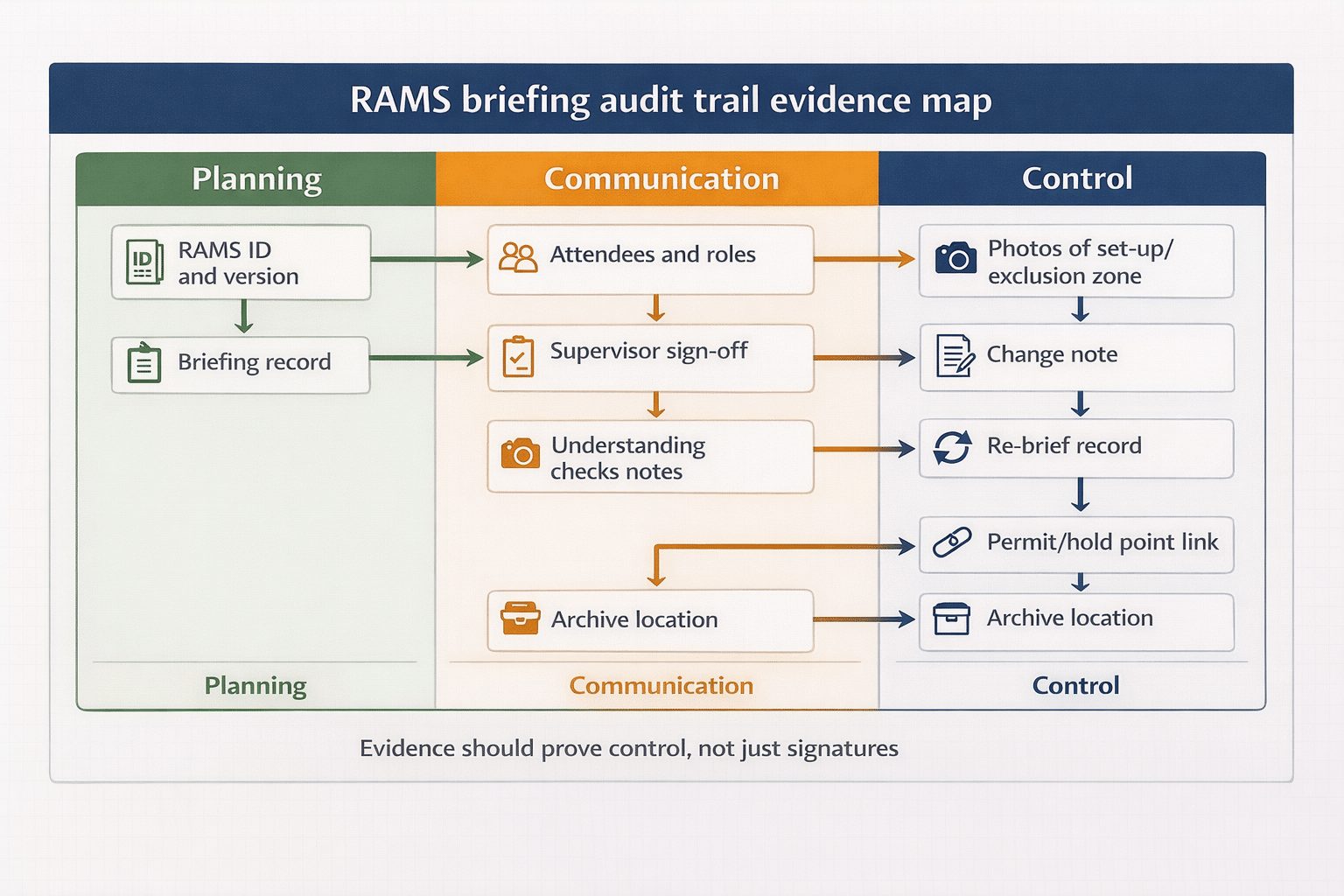
H3: Briefing and records
-
Briefing method (toolbox talk, pre-start, onsite briefing)
-
Attendees sign-off
-
Where the signed record is stored and how changes are handled
For role-specific guidance on using RAMS day-to-day, see: RAMS for site supervisors.
Frequently Asked Questions
Do RAMS need to be site-specific?
Yes, in practice they should be. If the hazards, interfaces, access, or controls change between sites, the RAMS must be reviewed and tailored so the method steps and controls reflect the real conditions and risks.
Who should write RAMS on a construction project?
Typically a competent person within the contractor team drafts them, then a supervisor and responsible manager review for practicality and control. They may also need review by the principal contractor or client depending on site rules.
When should RAMS be briefed to operatives?
Before the work starts, and again whenever the method, controls, location, or team changes. Briefings work best when the method steps are walked through in order, with controls explained at the point they apply.
What should be included in a RAMS approval and sign-off process?
At minimum: author, reviewer, approver, version number, date, and confirmation that the RAMS has been briefed. If changes occur, record the change, issue a new version, and re-brief affected people.
Can you use AI to help write RAMS?
AI can help structure and draft, but the output still needs competent review and site-specific tailoring. The quality of the RAMS depends on the inputs (scope, hazards, interfaces) and on proper approval, briefing, and change control.
Conclusion
Writing RAMS that work on site comes down to three things: define the job clearly, tie hazards and controls to the real work sequence, and make the method steps briefable. If you build approvals, briefings, and version control into the process, your RAMS become a practical control tool rather than paperwork.
Next step: use the parent guide as your checklist for governance and audit readiness, especially if you are managing multiple crews or changing site conditions: RAMS in construction guide.
If you want a fuller end-to-end process (including review cycles, briefings, and evidence for audits), use the main guide here:
Read the complete RAMS in construction guide

Using ChatGPT for RAMS?
Draft Faster. Review Site Risks Properly.
Get access to our free RAMS generator now.


