

The Ultimate Guide to COSHH in Construction: Managing Hazardous Substances
COSHH in construction is not just about chemicals stored in a cupboard. It covers anything on site that can harm health through inhalation, skin contact, ingestion, or injection, including dusts and fumes created by the work. The legal framework is the Control of Substances Hazardous to Health Regulations 2002 (as amended), supported by HSE guidance on how to assess and control exposure.
Construction makes COSHH harder because work changes by location, trade, and programme. Subcontractors rotate, products get substituted, and a single task can create short, high exposures. That is why COSHH has to be task-led and checked at the point of work, not treated as a one-off paperwork exercise.
This guide explains what COSHH covers, where it applies on real UK projects, how a COSHH assessment works in practice, and what evidence matters when someone asks, “How do you know exposure was controlled?”. For COSHH briefing delivery and acknowledgement records, see COSHH Briefing App.

Table of contents
- What Is COSHH in Construction and What It Covers
- Why COSHH Matters on UK Construction Sites
- Where COSHH Applies on Construction Projects
- How to Carry Out a COSHH Assessment on Site
- COSHH Roles and Responsibilities in Construction
- Common COSHH Failures and How to Avoid Them
- COSHH Best Practice Framework for Construction Work
- How to Roll Out COSHH Consistently Across Sites
- Digital COSHH Management for SDS, Briefings, and Evidence
- COSHH Regulations and Compliance Evidence on Site
- The Operational Impact of Good COSHH Control
- COSHH Trends in UK Construction and Occupational Health
- Frequently Asked Questions
- Explore More Related Reads and Resources
What Is COSHH in Construction and What It Covers
COSHH is the UK framework for controlling exposure to substances hazardous to health at work. HSE guidance is explicit that COSHH is not limited to “bottled chemicals”. It includes substances that can cause harm through the way they are used, and substances created by work processes such as dust, fume, vapour, mist, and gas.
On a construction site, the COSHH scope commonly includes cement and cementitious products, silica-containing materials (especially where cutting, drilling, or grinding takes place), paints and coatings, solvents, adhesives, sealants, resins, foams, fuels, cleaning chemicals, and welding or cutting fumes. It also includes task-generated airborne contaminants like wood dust, demolition dust, and fine particulates from finishing activities.
What COSHH is not:
-
It is not a generic risk assessment for all hazards on site. It is specific to health exposure from substances and processes.
-
It is not satisfied by having a Safety Data Sheet (SDS) in a folder. SDS supports decisions, but you still need to assess exposure and decide controls.
-
It is not “PPE only”. PPE can be part of control, but HSE emphasises assessing risks and controlling exposure in a proportionate way.
COSHH on site is best thought of as a practical loop: identify what could harm health, assess the exposure route and intensity, select controls that reduce exposure, brief the people doing the work, and review when anything changes. That is why COSHH links closely to day-to-day supervision and briefing discipline, not just document production.

Why COSHH Matters on UK Construction Sites
COSHH matters because health harms often build slowly, and by the time symptoms show, the exposure has already happened for months or years. In construction, that can mean respiratory disease from fine dusts, occupational asthma from sensitisers, dermatitis from repeated wet cement contact, or longer-term disease risk from certain exposures. The lack of an immediate incident can create a false sense of safety.
There is also a practical delivery problem. Construction teams work under programme pressure, and “controls” can drift towards what is quickest. Ventilation gets moved, extraction is not set up, water suppression is skipped, and people rely on a disposable mask that is not face-fit tested. Even when the paperwork exists, the work can diverge from the assumption the assessment was written against.
Operationally, COSHH failures create disruption. Work gets stopped when controls are found to be missing, products arrive without an SDS, or a principal contractor asks for evidence that exposure was assessed and briefed. The cost is not just enforcement risk, it is lost time, rework, and supervision churn when teams have to backfill missing information.
If you make COSHH practical, it supports delivery rather than slowing it down. The goal is a predictable routine: check what is being used today, confirm controls are in place before exposure begins, and keep a short evidence trail that matches reality.
Where COSHH Applies on Construction Projects
COSHH applies wherever construction work involves substances that can harm health or where the work itself generates harmful exposure. That includes short-duration tasks. A single shift of dry cutting indoors can create high airborne exposure, and a short application of a resin or solvent in a confined area can create a concentrated vapour risk.
Typical project scenarios where COSHH is live and should be actively managed include:
-
Civils and infrastructure work with frequent cutting, coring, breaking, and sweeping
-
Refurbishment and fit-out where ventilation is constrained and trades overlap
-
Utility and confined space work where fumes can build quickly
-
Waterproofing, coatings, and resin work that relies on correct product selection and curing conditions
-
Any project with frequent product substitution due to procurement or design changes
A key construction-specific reality is interface risk. The people exposed are not always the people choosing the products. A subcontractor may swap a sealant, a cleaner may introduce a chemical, or a delivery may arrive with a different formulation. That is why COSHH needs a simple gate: confirm what the product is, confirm the SDS is current, confirm the controls match the task and location, then brief.
If you need a practical example of how one exposure dominates UK construction risk, HSE’s construction silica advice shows the task-led approach expected for controlling respirable crystalline silica (RCS).
How to Carry Out a COSHH Assessment on Site
A COSHH assessment on a construction site is a workflow, not a form. HSE describes the basics as identifying hazardous substances using labels and SDS, considering harmful substances produced by processes, assessing risks, and deciding controls. The construction difference is that you also need a change trigger that forces review when the work moves or changes.
A practical on-site process looks like this:
-
Identify the substances and tasks
Start with what is actually being used and what the task produces. Check product labels and the SDS. Then check the method of use and the environment, because a safe product can become a high exposure if it is sprayed in a confined area. Include process-generated dusts and fumes, not just purchased chemicals. -
Assess exposure in context
Assess who is exposed, how exposure occurs (inhalation, skin, ingestion, injection), how long the task runs, and what controls already exist. Construction exposure is often intermittent but intense, so time, ventilation, and proximity matter. Also consider others nearby, such as adjacent trades and passers-by. -
Select controls in the right order
Start with whether the hazard can be eliminated or substituted. If not, focus on engineering controls such as on-tool extraction, local exhaust ventilation, isolation, or wet methods for dust suppression. Administrative controls then support that, like task sequencing, exclusion zones, supervision checks, and training. PPE is last, and only works reliably if it is appropriate, used correctly, and maintained. -
Communicate and verify before exposure starts
COSHH controls fail at the moment of work starting, when the extraction is not fitted, the wrong filter is used, or the product has changed. Brief the team on what is hazardous, what controls are required, and what checks to make before starting. If you run briefings digitally, you can align COSHH briefings with broader site briefings via Safety Briefing App. -
Record, review, and re-assess when conditions change
Construction needs review triggers. If the product changes, the task changes, a new trade starts, the work location changes, or an incident occurs, the assessment should be reviewed. HSE’s COSHH assessment guidance and FAQs both reinforce the need to decide when review is required and to keep records where relevant.

Get Your Free Risk Assessment Template
Faster Reviews. Clearer Risk Controls.
Use a clean RA template to document hazards, control measures, and responsibilities clearly, making reviews, approvals, and site briefings simpler.
COSHH Roles and Responsibilities in Construction
COSHH works when responsibility is clear and checks happen at the right level. The “competent person” writing or owning COSHH assessments needs enough understanding of the work to identify exposure routes and realistic controls. On construction projects, that competence often sits with HSEQ support, site management, or a competent supervisor, but it still has to connect to daily task planning.
The principal contractor’s role is usually to set minimum standards, ensure coordination, and verify that subcontractor COSHH arrangements are adequate for the site conditions. That includes making sure product substitution is controlled, that SDS are available, and that high-risk exposures such as silica are managed consistently.
Supervisors and foremen are the control point. Their responsibility is less about writing documents and more about verifying that the assessment matches today’s work, controls are in place before exposure begins, and the team understands the requirements. This includes checking that the right RPE is used when required, that extraction is fitted and maintained, and that housekeeping does not create secondary exposure through dry sweeping.
The workforce has a practical responsibility too: follow the controls, use PPE and RPE correctly, and raise issues when conditions differ from what was briefed. The best performing sites treat COSHH as a routine pre-task check, not a compliance exercise, because the check prevents disruption later.

Common COSHH Failures and How to Avoid Them
The SDS folder myth
A common failure pattern is assuming COSHH is “done” because SDS are stored on site. HSE guidance makes SDS a key input for identifying hazards, but the assessment still needs to consider the task and exposure route. A folder does not tell you whether the product is being sprayed, whether the area is ventilated, or whether others are exposed nearby.
Generic assessments reused across sites
Generic COSHH assessments are often written to cover a range of tasks, but they become vague. Vague controls do not survive a site change. When teams move from outdoors to indoors, or from open demolition to a fit-out zone, exposure changes dramatically. If the document is not task-led, it will not drive behaviour.
PPE as the only control
PPE fails first in construction because it relies on perfect human compliance. Masks are taken off for comfort, the wrong filters are used, face seals are poor, and the work pace increases. Engineering controls reduce the exposure at source and are more reliable when properly set up. HSE’s COSHH Essentials approach exists to make this style of control selection practical, not theoretical.
Briefings that are not specific to the task
COSHH briefings often fail because they become generic. The crew hears “wear PPE and avoid dust” every week, so it stops being information. Good COSHH briefings are short and specific: what is hazardous today, where exposure occurs, what control must be in place before starting, and what to do if conditions change.
Do’s and don’ts table for supervisors
| Do's | Don'ts |
|---|---|
| Verify products match the assessment | Assume “same as last time” |
| Use engineering controls first | Rely on PPE alone |
| Brief before exposure starts | Brief after the task begins |
| Control dust at source | Dry cut indoors without extraction |
| Check SDS is current | Use an old SDS printout |
| Set review triggers for change | Reuse generic assessments unchanged |
| Protect nearby trades and public | Ignore secondary exposure routes |
| Record checks and briefings | Rely on verbal assurance only |
COSHH Best Practice Framework for Construction Work
A practical best practice framework for COSHH in construction needs to work under site pressure. It has to be quick enough to apply daily, but structured enough to survive audits and project handovers. The core principle is simple: control exposure at source where possible, verify controls before exposure begins, and keep evidence that matches what happened.
Use this grouped model as a repeatable approach:
-
Task-led identification
-
Confirm what product is being used and where
-
Confirm what the task generates (dust, fume, mist)
-
Confirm who is exposed, including nearby trades
-
Control selection in the right order
-
Eliminate or substitute where feasible
-
Use engineering controls (extraction, ventilation, wet methods, isolation)
-
Add administrative controls (sequencing, exclusion zones, supervision checks)
-
Use PPE and RPE only as the final layer
-
Brief, supervise, and verify
-
Brief the crew on the specific exposure points
-
Check controls are fitted and working before starting
-
Stop and reset if conditions change
-
Review triggers and continuous improvement
-
Product substitution, location change, new trade, incident, or time elapsed
-
Refresh briefings when controls or conditions change
-
Keep a clear review trail so the assessment stays live
This framework aligns well with HSE’s step-by-step approach to COSHH assessment and the COSHH Essentials concept of using practical control guidance rather than generic wording.

How to Roll Out COSHH Consistently Across Sites
Rolling out consistent COSHH across multiple sites is usually less about writing new assessments and more about removing variation. Variation is what creates gaps: different SDS versions, different assumptions about controls, and different briefing standards.
A phased roadmap that works on most contractors looks like this:
Phase 1: Stabilise inputs
Create a controlled SDS library and decide what “current” means. Agree who can introduce new products and how substitution is checked. Without a stable SDS and product list, COSHH assessments drift instantly.
Phase 2: Standardise the assessment method
Agree a consistent structure for COSHH assessments so supervisors can recognise what matters quickly. Make sure exposure routes, controls, and review triggers are explicit. Avoid generic “wear PPE” statements unless the specific PPE is defined and verified for the task.
Phase 3: Embed point-of-work verification
Train supervisors to treat COSHH as a pre-task verification routine. Build simple checks into daily coordination so controls are confirmed before work starts. This is where COSHH becomes operational rather than administrative.
Phase 4: Improve briefing discipline
Set a standard for COSHH briefings: short, specific, linked to today’s task and location, and recorded. Use a consistent language for review triggers so teams know when re-assessment is required.
Phase 5: Governance and learning
Introduce periodic spot checks and a simple feedback loop. If a control fails, capture what went wrong and update the assessment and briefing prompt, not just the record.

Digital COSHH Management for SDS, Briefings, and Evidence
Digital COSHH management is not about replacing judgement. It is about making the right information available at the point of work and making the evidence trail coherent. On many sites, COSHH information is split across folders, emails, and printed SDS sheets that may not match the product on the pallet. That creates delay and weakens control.
A good digital approach supports four practical outcomes:
-
Faster hazard identification
Teams can search the SDS library by product name and quickly confirm key hazards and controls. This matters when a product is substituted, which is a common construction reality. -
Better version control
Digital storage reduces the risk of using an old SDS or an out-of-date assessment. It also makes it easier to show what was current at the time the work was done. -
Consistent briefings and acknowledgements
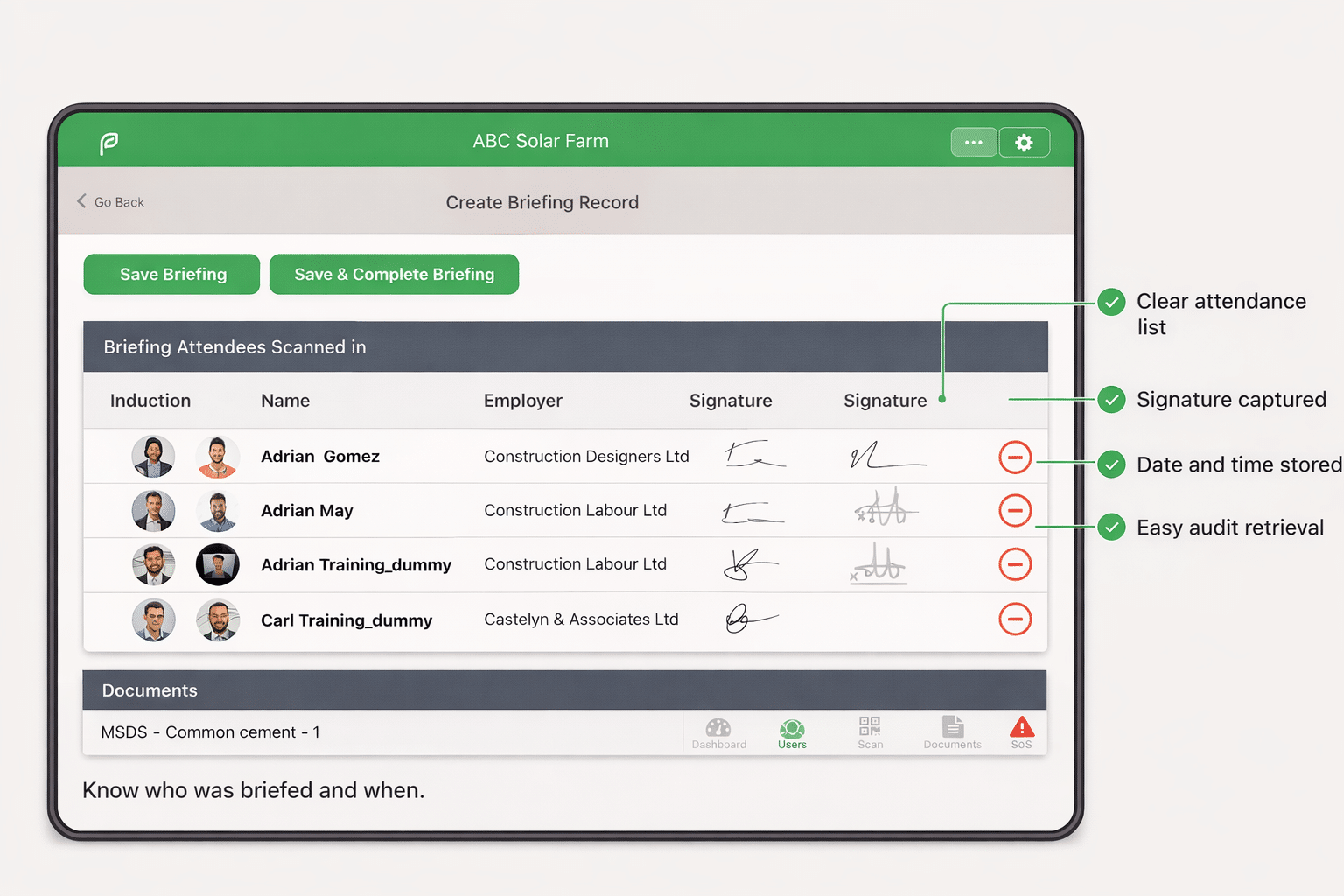
Digital briefings can standardise what is communicated and give you a clear record that workers were briefed on the specific hazards relevant to their work. This is the operational bridge between assessment and behaviour. -
Cleaner evidence packs
When an incident occurs or an audit asks for evidence, a digital trail can link the SDS, the assessment, the briefing record, and the review update. That is what turns COSHH from “paper compliance” into demonstrable control.
For COSHH briefing delivery and acknowledgement on mobile, see COSHH Briefing App.
COSHH Regulations and Compliance Evidence on Site
The legal basis for COSHH is set out in the Control of Substances Hazardous to Health Regulations 2002 (as amended). HSE guidance then explains what dutyholders are expected to do in practice, including assessing risks and putting proportionate controls in place.
On construction sites, compliance alignment is usually tested through three questions:
-
Did you identify the hazard properly, including process-generated dusts and fumes?
-
Did you select controls that realistically reduce exposure, not just describe PPE?
-
Can you show that controls were implemented, briefed, and reviewed when conditions changed?
HSE’s COSHH assessment guidance is clear that labels and SDS are key inputs, and that you should think about harmful substances produced by the work process. The practical implication is that you cannot limit COSHH to a “chemicals register”. Dust and fume exposures are often the dominant risk on construction projects.
Where silica is present, HSE provides construction-specific COSHH Essentials advice that frames the expectation as controlling exposure to respirable crystalline silica to protect health. That is a useful benchmark for how task-led COSHH management should look: identify the exposure, select controls at source, and verify they are used.

Download Your Free Method Statement Template
Build Clear Method Steps Faster
Use a practical, site-friendly template to document sequence, roles, plant, and controls for clear briefings and easier site delivery.
The Operational Impact of Good COSHH Control
COSHH is often presented as compliance, but its commercial impact is delivery stability. When COSHH is weak, sites lose time to stoppages, re-briefing, rework, and urgent product changes. Supervisors spend time chasing SDS, rewriting assessments under pressure, and managing conflict when subcontractors claim controls were “not in the brief”.
Strong COSHH reduces friction in three practical ways:
-
Fewer programme shocks
If products and controls are verified before work starts, you avoid mid-task stoppages caused by missing extraction, wrong RPE, or undocumented substitution. -
Better coordination across trades
COSHH becomes part of sequencing. You can plan dusty tasks away from enclosed fit-out work, control interfaces, and reduce secondary exposure to other workers. -
Cleaner audit and inspection responses
When the evidence trail is coherent, audits become faster and less disruptive. That includes being able to show what was assessed, what was briefed, and what changed when it was reviewed.
This section is where COSHH starts to connect to solution evaluation, but the decision point remains operational: if COSHH management is taking too much supervision time, you either simplify the process or improve how it is managed and evidenced.

COSHH Trends in UK Construction and Occupational Health
Occupational health evidence is becoming more central to how clients and principal contractors judge performance. Incident metrics alone do not capture chronic exposure control, so there is increasing focus on whether controls were planned, implemented, and verified.
Digitisation is moving from “nice to have” to baseline expectation. The most common direction of travel is:
-
SDS libraries and COSHH registers becoming searchable and version-controlled
-
Task-led guidance becoming more standardised, especially for high-frequency exposures like silica
-
Better integration between assessments, briefings, and supervision checks so evidence is joined up, not fragmented
HSE continues to publish and update topic guidance and industry-specific direct advice. For example, HSE’s construction silica content was updated in January 2026, which signals active attention to construction exposure control. The practical takeaway is that contractors should treat COSHH as a living system, with review triggers and periodic refresh, not a one-off pack produced at mobilisation.
Frequently Asked Questions
1) What does COSHH stand for in construction?
COSHH stands for Control of Substances Hazardous to Health. In construction it covers substances used on site and substances created by the work, such as dust and fumes. The expectation is to assess exposure risk, apply proportionate controls, brief workers, and review when conditions change.
2) What is a COSHH assessment on a construction site?
A COSHH assessment is the task-led process of identifying hazardous substances and exposure routes, assessing who may be exposed and how, deciding controls, and recording when the assessment must be reviewed. HSE highlights using labels and SDS, and considering harmful substances produced by processes like cutting or grinding.
3) Who is responsible for COSHH on a construction project?
Employers and those controlling work activities are responsible for managing COSHH risks, with supervisors playing a key role in verifying controls at the point of work. Principal contractors typically set standards and coordinate subcontractor arrangements on their sites. HSE guidance sets out the expectation to assess and control exposure.
4) What must be included in a COSHH assessment?
A good COSHH assessment includes the substance or process hazard, exposure routes, who is exposed, the work method and environment, the controls required, and review triggers. It should reference SDS where relevant and cover process-generated dusts and fumes, not just purchased chemicals.
5) Do I need a COSHH assessment for cement and silica dust?
Yes, if the work can create exposure that may harm health. Cement can cause skin issues and dust exposure, while silica-containing materials can generate respirable crystalline silica during cutting or grinding. HSE provides construction-specific silica control guidance under COSHH Essentials to support compliance.
6) How often should COSHH assessments be reviewed?
There is no single interval that fits every site. Reviews should be triggered when products change, tasks change, locations change, new trades start, an incident occurs, or time has elapsed and conditions may not match the original assumptions. HSE guidance and FAQs emphasise deciding when an assessment needs review.
7) What is the difference between COSHH and a general risk assessment?
COSHH focuses specifically on health risks from substances and exposure routes, while a general risk assessment covers the broader range of site hazards. COSHH should still integrate with wider site risk controls, but it must explicitly address hazardous substances and process-generated exposures like dust and fumes.
8) What are COSHH symbols and what do they mean?
COSHH commonly relies on hazard pictograms shown on labels and SDS to communicate the type of hazard. The symbols support identification, but they do not replace an exposure assessment. On site, the key is linking what the pictogram indicates to the task, exposure route, and required controls.
9) What is an SDS and when must it be available on site?
An SDS is a Safety Data Sheet provided by suppliers that describes hazards, handling, storage, and control advice. HSE guidance treats SDS as a key input for identifying hazards and deciding controls. On construction sites, SDS should be readily accessible where products are used, especially when substitution is common.
10) How do you brief workers on COSHH hazards effectively?
Effective COSHH briefings are short and task-specific. They explain what is hazardous today, where exposure occurs, what control must be in place before starting, and what to do if conditions change. Recording briefing acknowledgement strengthens evidence that controls were communicated and understood.
Explore More Related Reads and Resources
If you want to go deeper on specific angles, these related articles expand the topic and provide practical examples.
-
COSHH Awareness Overview Toolbox Talk
A practical COSHH briefing format for site teams, including what to cover and how to keep it relevant. -
COSHH Toolbox Talk Topics Page
A focused set of COSHH briefing topics to support short, repeatable site briefings. -
Chemical Handling and Storage Toolbox Talk
How to store and handle chemicals on site to reduce exposure risk and prevent spills and misuse. -
Chemical Safety Toolbox Talk
A site-ready chemical safety briefing that supports day-to-day supervision and worker behaviours. -
PPE Toolbox Talk Topics Page
Guidance on keeping PPE controls practical and reliable, including common failure points on site. -
Asbestos Awareness Toolbox Talk Topics Page
A dedicated briefing route for asbestos awareness where refurbishment and intrusive work create higher exposure concerns.




Download Your Free Briefing & Attendance Template
Ready-to-Use Briefing Sheet
Track attendance, signatures, and daily safety briefings with a free HSE-aligned record sheet for toolbox talks, inductions, and site audits.