Step Ladders Toolbox Talk (UK Construction)
Topic: Step Ladders Toolbox Talk
Toolbox Talk Pack: 30 Site Essentials Toolbox Talk Pack
Availability: This individual Toolbox Talk is available as a FREE download
Region: UK
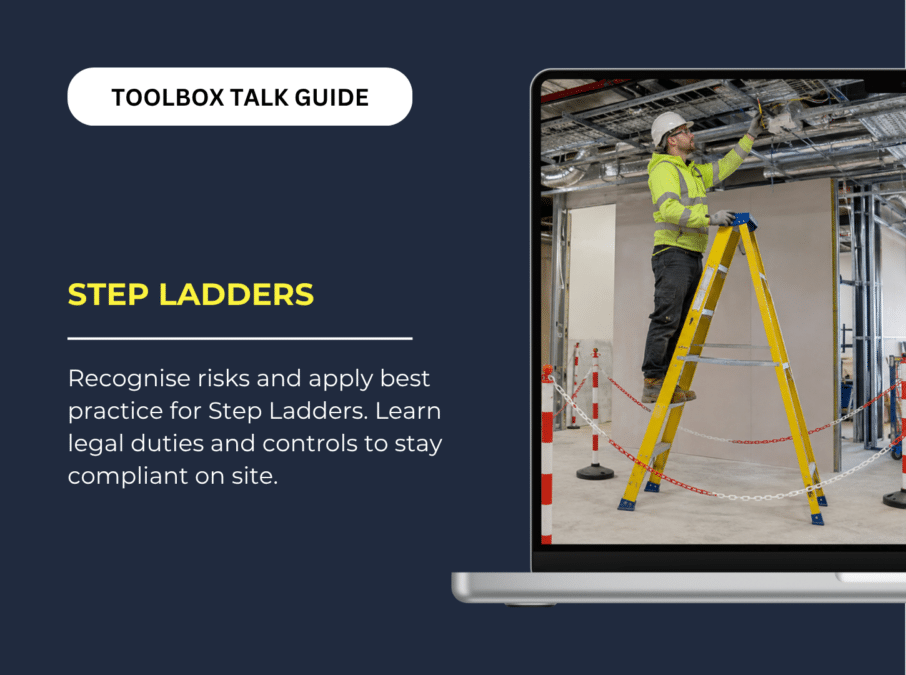
Step Ladders Toolbox Talk Guide

Step ladders provide quick access for light, short-duration tasks, but their convenience can hide poor selection, unstable setup or unsafe working positions. This guide complements our toolbox talk topics for UK construction by focusing on when steps are suitable and how falls can develop.
The guide explains who may be affected, the defects and site conditions to check, the working practices that threaten stability and when a podium, tower or another form of access may provide better protection. It supports, but does not replace, the risk assessment, method statement, equipment instructions or competent supervision.
Jump to section
What are Step Ladders in construction?
A step ladder is a self-supporting portable ladder that opens into a stable working shape using its rear section, hinges and locking or spreader devices. Unlike a leaning ladder, it does not rely on a wall for support. It remains suitable only when the task and environment allow all feet to sit firmly, the steps to remain level and the user to work without overreaching or imposing an uncontrolled side load.
Why it matters on UK construction sites
A fall does not need to start from a great height to cause serious harm. A step ladder can rock, slide, fold or tip when one foot loses contact, a lock is not engaged, the user reaches beyond the stiles or a tool creates sideways force. The falling person may strike equipment or unfinished work, while tools and materials can injure anyone below or beside the task.
Who is exposed and how
Electricians, decorators, ceiling installers, carpenters, plumbers, fitters, surveyors and snagging teams may use steps for high-level details or lightweight fittings. Labourers moving equipment and supervisors checking work may also use them occasionally. Other trades, visitors and members of the public can be exposed when the work takes place near doors, corridors, vehicle routes or occupied areas without effective separation.
Typical site tasks where this comes up
Step ladders are commonly considered for limited work where the task is light and the working position can remain controlled.
- Inspecting ceiling finishes, services or completed high-level details.
- Installing lightweight signs, detectors, clips or small fixtures.
- Completing a small area of decorating, sealing or touch-up work.
- Taking measurements or checking short runs of installed work.
- Addressing short-duration snagging tasks where the assessment confirms steps are suitable.
Common failure modes
Failures often begin with treating the steps as the default choice because the task appears quick.
- The task needs prolonged work, force or frequent movement, but a more stable working platform is not considered.
- One foot sits on debris, a floor-protection sheet or an uneven surface, leaving the steps able to rock.
- The step ladder is not fully opened or its locking devices are not properly engaged.
- Drilling, pulling cable or handling a component creates a side load that can tip the steps.
- The user stands on the top three steps without a suitable handhold or support.
- The user stretches sideways, twists away from the work or tries to reposition the steps while still on them.
- Damaged feet, bent stiles, loose steps or defective stays remain in service because no effective pre-use check or quarantine system is applied.
Pre-start checks
These checks are a starting point only. They do not replace the project's risk assessment, method statement, equipment instructions or task-specific controls.
- ☐ Equipment choice: Confirm that steps are suitable for the task, duration, height, force and number of hand movements required.
- ☐ Condition: Check feet, stiles, steps, hinges, stays, platform and locking devices for wear, contamination or damage.
- ☐ Setup: Place all feet on a firm, level and clean surface, fully open the steps and engage every locking device.
- ☐ Work position: Select the correct height so the user can face the task, avoid the top three steps and work without overreaching.
- ☐ Contact and load: Plan how three points of contact will be maintained and limit carried items to light tools or materials.
- ☐ Surroundings: Control doors, pedestrians, vehicles, openings and other work that could strike the steps or distract the user.
How incidents happen and how to prevent them
A typical event starts when steps are selected for convenience without checking whether the task needs force, two-handed work or repeated movement. The steps are placed close to the work but not fully level or isolated. As the task progresses, the user reaches sideways or pushes against a tool. Weight transfers beyond the base, a foot lifts or slips, and the steps tip or fold before the user can recover.
Prevention starts by avoiding work at height where practical and choosing equipment that matches the task. Position suitable steps square to the work, prepare the ground, engage the locks and separate the area from site traffic. Keep tools light and accessible, descend before moving the steps and change to a podium, tower or other suitable platform when the required reach, force or duration cannot be controlled.
⚠️ Hypothetical site example: An electrician uses a step ladder to fit a lightweight detector in a corridor. One foot rests partly on loose floor protection, and people continue passing behind the work. When the operative turns to reach a tool, the steps rock. Clearing and isolating the area, setting all feet on the firm floor and arranging the tool before climbing would remove the immediate causes. A more suitable platform should be selected if stable support cannot be maintained.
When risk increases
Reassess the task when the work area, equipment or way of working changes.
- The surface becomes wet, dusty, soft, sloping, obstructed or uneven.
- Work moves near an edge, opening, stair, excavation or fragile finish.
- Drilling, pulling, pushing or handling materials adds sideways force or blocks a secure contact point.
- Pedestrians, vehicles, doors, deliveries or nearby trades enter the setup area.
- Outdoor wind, rain or poor visibility affects balance, grip or stability.
- The task lasts longer than planned, fatigue develops, the ladder is dropped or a different user takes over.
UK regulations and compliance
The Work at Height Regulations 2005, regulation 4 requires work at height to be properly planned, appropriately supervised and carried out safely by competent people. Planning must include emergencies and rescue, and relevant weather conditions must be considered.
The Work at Height Regulations 2005, regulation 6 requires work at height to be avoided where reasonably practicable. Where it cannot be avoided, suitable measures must prevent falls or, where that is not reasonably practicable, minimise the distance and consequences of a fall.
The Work at Height Regulations 2005, Schedule 6 sets specific ladder requirements. It restricts ladder use to circumstances justified by the risk assessment and requires a stable, firm supporting surface, secure positioning and horizontal steps or rungs.
The HSE Safe use of ladders and stepladders guidance explains step ladder controls including four feet in contact, level steps, engaged locks, avoiding overreach and side loading, and maintaining three points of contact. HSE's Using ladders safely in construction guidance also calls for a pre-use check by the user before the work and after a change that could affect condition.
Key regulations and guidance
Work at Height Regulations 2005, regulation 4 - covers planning, supervision, competence and safe execution.
Work at Height Regulations 2005, regulation 6 - establishes the hierarchy for avoiding and controlling falls.
Work at Height Regulations 2005, Schedule 6 - sets the specific conditions and setup requirements for ladder use.
HSE Safe use of ladders and stepladders guidance - gives practical controls for selecting and working from step ladders.
HSE Using ladders safely in construction guidance - explains when the user should complete a pre-use check.
Practical controls that make the difference
Start with the highest practical level of control instead of relying on balance or individual caution.
- Avoid the climb: Assemble at ground level, lower equipment or use an extendable tool where this removes work at height.
- Select suitable access: Use a podium, tower, platform or other suitable equipment when the task involves duration, reach, force or repeated two-handed work.
- Prepare the setup: Clear the surface, open the steps fully, engage the locks and protect the area from people, doors and vehicles.
- Position for the task: Face the work, keep the body within the stiles and descend before moving the steps to a new position.
- Control tools and materials: Keep loads light, use a suitable belt or other arrangement and avoid any action that creates side loading.
- Remove defects from use: Label and quarantine damaged steps, arrange competent inspection and store equipment as the manufacturer directs.
FAQs
Are step ladders banned on construction sites?
No. HSE states that ladders and step ladders can be appropriate for low-risk, short-duration work where the assessment shows that equipment offering greater fall protection is not justified and the ladder can be used safely.
How often should a step ladder be checked?
The user should complete a pre-use check before the work and after anything changes that could affect its condition. Employers should also arrange recorded detailed visual inspections by a competent person at intervals reflecting the manufacturer's instructions.
Can a worker stand on the top step?
HSE guidance says not to stand and work on the top three steps, including a step forming the top, unless there is a suitable handhold. The manufacturer's instructions and the task assessment must also be followed.
Explore more toolbox talk topics for UK construction .
Get the ready-to-use Step Ladders Toolbox Talk
Brief your site team on selecting, checking, positioning and working safely from step ladders.