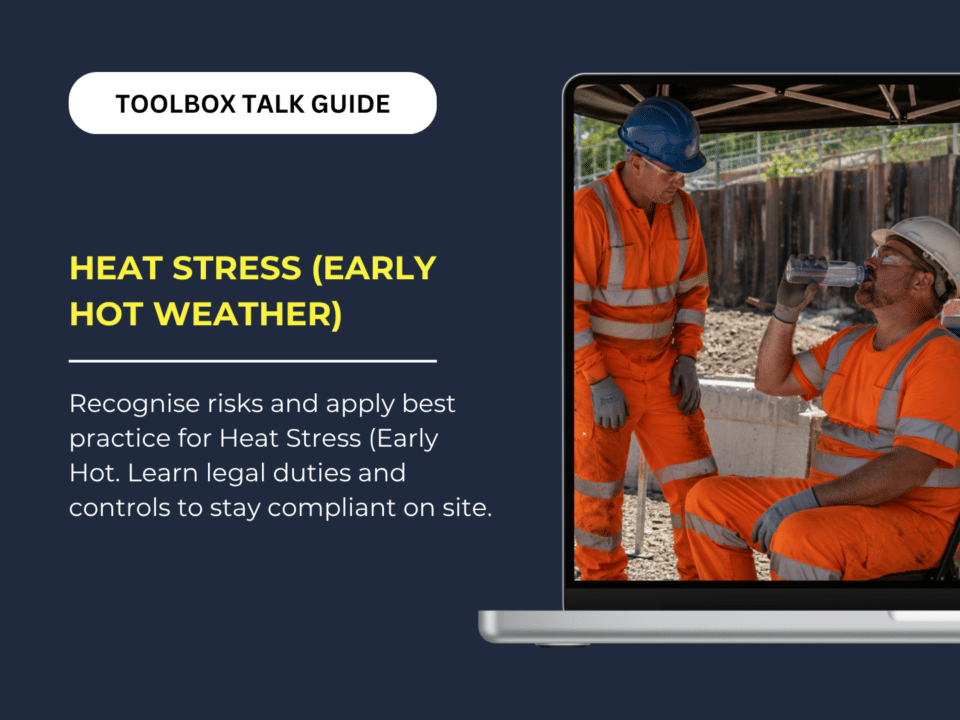
Hot Weather Working Toolbox Talk (UK Construction)
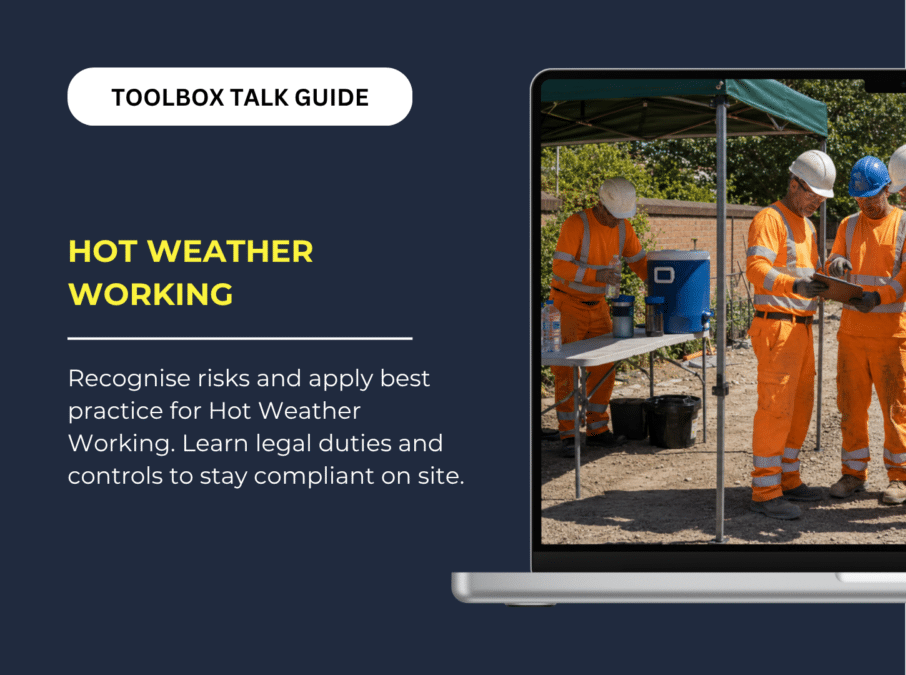
Topic: Hot Weather Working Toolbox Talk
Toolbox Talk Pack: 20 Seasonal Outdoor Working Toolbox Talk Pack
Availability: This individual Toolbox Talk is available as a FREE download
Region: UK
Hot Weather Working Toolbox Talk Guide

Hot weather can change how quickly a routine construction task becomes physically demanding. This guide sits alongside our toolbox talk topics for UK construction and focuses on planning work when heat, direct sunlight, humidity, radiant surfaces and required PPE can combine to increase risk.
The guide explains who may be affected, where hot-weather risks arise and which practical checks can help supervisors respond as site conditions change. It supports, but does not replace, the project risk assessment, method statement, supervision or task-specific controls.
Jump to section
What is Hot Weather Working in construction?
Hot weather working means planning and carrying out construction activities where temperature, sunlight or related conditions may affect health and safe performance. Air temperature is only one factor. Work rate, humidity, air movement, radiant heat, clothing and PPE can all change the amount of heat experienced by a worker.
Heat stress occurs when the body's normal temperature-control process begins to fail. Dehydration is related but distinct, while sunlight also creates a separate risk of short-term and cumulative skin damage. These risks need to be considered together without treating one temperature reading as a complete assessment.
Why it matters on UK construction sites
Construction work often combines physical effort with required protective clothing, direct sunlight and limited access to shade. Early signs of heat stress can include difficulty concentrating, muscle cramps, heat rash, dizziness, headache, nausea or fainting. Severe heat illness is a medical emergency and must be handled through the site's emergency arrangements.
Reduced concentration can also affect decisions around plant movements, lifting, work at height, traffic routes and temporary works. Quality and programme can suffer when fatigued teams miss checks, rush an activity or have to stop unexpectedly because changing weather was not planned for.
Who is exposed and how
Groundworkers, roofers, scaffolders, steel fixers, concrete gangs, roadworkers, rail teams, plant operators and delivery marshals may spend long periods outside or perform strenuous tasks. Workers inside partially completed buildings, service voids, cabins or plant cabs may also be affected where heat builds up and air movement is limited.
New starters, people returning after time away and workers who have not adjusted to hot conditions may require closer monitoring. Individual tolerance varies, and health conditions, medication, pregnancy and personal circumstances may affect risk. Supervisors should provide a confidential route for workers to raise concerns without expecting them to disclose medical details publicly.
Typical site tasks where this comes up
Hot-weather planning is particularly relevant to tasks involving sustained effort, exposed work areas or additional sources of heat.
- Groundworks, drainage installation, kerb laying and manual handling in direct sunlight.
- Roofing, scaffolding, steel erection and other exposed work where shade is limited.
- Road and rail activities near dark, reflective or heat-retaining surfaces.
- Operating or maintaining plant in cabs, enclosures or areas affected by engine and process heat.
- Internal fit-out, refurbishment and service installation in unventilated or partially enclosed areas.
Common failure modes
Problems often develop because the planned system of work remains unchanged while the working conditions become more demanding.
- The forecast is checked once, but changing conditions at the workface are not reviewed.
- Air temperature is considered without looking at humidity, direct sun, radiant heat, work rate or PPE.
- Drinking water is available only at a distant compound, making regular access impractical.
- Breaks, task duration and staffing remain based on normal weather conditions.
- Required PPE is removed at the workface instead of the task being replanned to control heat.
- Lone, remote or mobile workers are not contacted often enough for developing symptoms to be noticed.
- New or returning workers are assigned strenuous work without time to adjust or additional observation.
Pre-start checks
Use these as starting checks only. They do not replace the project's risk assessment, method statement, weather response plan or task-specific controls.
- ☐ Weather and work area: Review the forecast and the actual conditions expected at each workface.
- ☐ Workload and PPE: Consider physical effort, task duration, radiant heat, air movement and required protective clothing.
- ☐ Water and recovery: Confirm that cool drinking water and a suitable shaded or cooler rest area are readily accessible.
- ☐ Work sequence: Decide whether strenuous activities can be moved, shortened, rotated or supported with mechanical aids.
- ☐ People: Identify new, returning, isolated or potentially vulnerable workers who may require different arrangements.
- ☐ Response arrangements: Brief the warning signs, reporting route, supervision checks and emergency actions.
How incidents happen and how to prevent them
A typical sequence begins with direct heat, physical work and restrictive clothing increasing the body's heat load. Sweating leads to fluid loss, while humidity or limited air movement can reduce cooling. If the task continues unchanged, concentration and physical capacity may deteriorate before the person or supervisor recognises the seriousness of the situation.
Prevention depends on interrupting that sequence early. Reduce exposure, move demanding work to cooler periods, provide shade and drinking water close to the activity, use mechanical aids and organise recovery breaks. Workers should know that severe thirst can be a late warning sign, so arrangements should not rely on thirst alone.
⚠️ Hypothetical site example: A team is laying kerbs beside a dark road surface during a hot afternoon. Water is available only at the main compound and the team continues at its normal pace to finish the section. One worker becomes dizzy and steps backwards towards a plant movement area. Moving the activity to the morning, bringing water to the workface, providing shaded recovery breaks, reducing manual handling and briefing the plant interface would interrupt the sequence before control is lost.
When risk increases
Risk can rise during the shift, even where the original plan was reasonable. Review the controls when any of the following changes occur.
- Direct sunlight reaches a previously shaded workface or wind and air movement reduce.
- Work moves onto roofing, asphalt, concrete, steel or another exposed or heat-retaining surface.
- The task becomes more strenuous, runs longer than planned or requires additional PPE.
- Ventilation is reduced inside an enclosure, cabin, temporary structure or partially completed building.
- Breaks are delayed, water supplies run low or production pressure encourages people to continue.
- Staffing changes introduce new, returning, lone or less-experienced workers.
UK regulations and compliance
UK law does not set one maximum workplace temperature at which all work must stop. The HSE Temperature in the Workplace: What the Law Says guidance explains that heat is a workplace hazard and that employers must assess the risk and put suitable controls in place.
The Management of Health and Safety at Work Regulations 1999, regulation 3 requires employers to make a suitable and sufficient assessment of risks to employees and others affected by the work. The assessment should reflect the task, conditions and people involved rather than relying on a generic summer statement.
For construction work, the Construction (Design and Management) Regulations 2015, regulation 34 covers reasonable indoor temperatures and, where necessary for health or safety, protection from adverse weather at outdoor construction sites.
The Construction (Design and Management) Regulations 2015, Schedule 2 includes requirements for accessible drinking water and suitable rest facilities. The HSE Temperature in the Workplace: Heat Stress guidance provides practical information on assessing work rate, climate, PPE and individual factors.
Key regulations and guidance
HSE Temperature in the Workplace: What the Law Says - explains the risk-based approach to workplace temperature.
Management of Health and Safety at Work Regulations 1999, regulation 3 - requires a suitable and sufficient assessment of health and safety risks.
Construction (Design and Management) Regulations 2015, regulation 34 - addresses temperature and adverse-weather protection on construction sites.
Construction (Design and Management) Regulations 2015, Schedule 2 - sets minimum requirements for drinking water and rest facilities.
HSE Temperature in the Workplace: Heat Stress - explains heat-stress factors, symptoms and practical controls.
Practical controls that make the difference
Start by reducing the exposure rather than expecting workers to tolerate it. The combination of controls should reflect the work rate, location, weather, PPE and people involved.
- Change the timing: Move strenuous or exposed work to cooler periods where this can be done without creating another risk.
- Reduce physical demand: Use lifting aids, smaller loads, task rotation or additional resources to control the work rate.
- Create cooler areas: Provide safe shade at the workface and suitable recovery facilities without obstructing traffic routes, lifting operations or emergency access.
- Support hydration: Place cool drinking water where it is readily accessible and encourage frequent, small amounts rather than relying on thirst.
- Monitor and respond: Use supervisor and buddy checks, agreed warning signs and clear authority to pause or change the work.
- Maintain protection: Keep required PPE in use at the workface. Review approved clothing options, shade and sun protection, and remove layers only in a designated safe rest area where site rules allow.
FAQs
Is there a legal maximum temperature for construction work in the UK?
No single legal maximum applies to every workplace. Employers must assess heat as a hazard and introduce suitable controls for the work and conditions.
How often should construction workers drink water in hot weather?
There is no universal interval suitable for every task. HSE guidance recommends providing cool water and encouraging workers exposed to heat to drink frequently in small amounts.
Can workers remove PPE because the weather is hot?
Required PPE should not be removed while performing the task. The work should be replanned using stronger controls, with cooling or clothing adjustments made only where they remain safe and comply with site requirements.
Explore more toolbox talk topics for UK construction .
Get the ready-to-use Hot Weather Working Toolbox Talk
Brief your site team on heat, hydration, sun exposure and practical hot-weather controls.