Heat Stress (Early Hot Weather) Toolbox Talk (UK Construction)
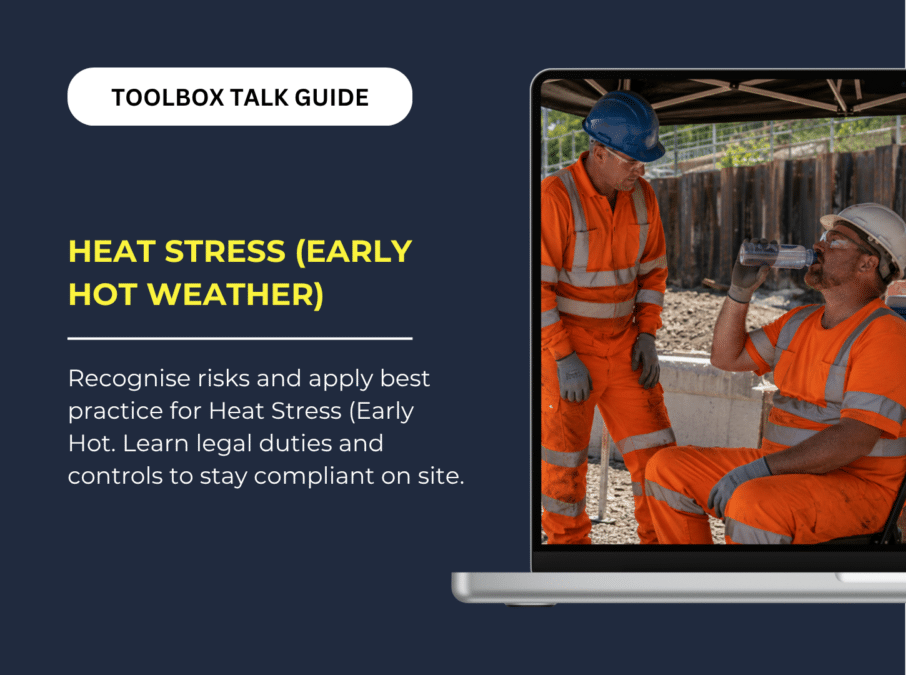
Topic: Heat Stress Early Hot Weather Toolbox Talk
Toolbox Talk Pack: 20 Seasonal Outdoor Working Toolbox Talk Pack
Availability: This individual Toolbox Talk is available as a FREE download
Region: UK
Heat Stress Early Hot Weather Toolbox Talk Guide

The first warm spell can introduce heat stress before teams have adjusted their routines or become accustomed to hotter conditions. This guide complements our toolbox talk topics for UK construction by focusing on the seasonal transition from cooler weather to physically demanding work in heat.
The guide explains why early hot weather needs active planning, who may be more susceptible and how supervisors can adjust tasks, hydration, recovery periods and monitoring. It supports, but does not replace, the project risk assessment, method statement, supervision or task-specific controls.
Jump to section
What is Heat Stress Early Hot Weather in construction?
Early hot weather is the period when working conditions become noticeably warmer after cooler days or a seasonal break. Workers may not yet be acclimatised, and established work plans may still reflect cooler conditions. The risk can therefore change faster than the site's routines, welfare arrangements or task sequencing.
Heat stress occurs when the body's normal temperature-control process begins to fail. Air temperature is only one factor. Work rate, humidity, air movement, radiant heat, sunlight, clothing and PPE all influence the heat experienced by a worker. Dehydration and sun exposure are related hazards, but they are not the same as heat stress.
Why it matters on UK construction sites
HSE identifies symptoms of heat stress that include difficulty concentrating, muscle cramps, heat rash, severe thirst, fainting, fatigue, dizziness, nausea and headache. Symptoms can develop differently between workers, so a team should not assume that everyone will respond to the conditions in the same way.
Reduced concentration or physical capacity can affect lifting, work at height, vehicle movements, tool use and decisions around temporary works. Quality and programme may also suffer when checks are missed, work slows unexpectedly or an activity has to stop because early warning signs were overlooked.
Who is exposed and how
Groundworkers, roofers, scaffolders, steel fixers, concrete gangs, roadworkers, rail teams, delivery marshals and operatives carrying materials may combine direct sunlight with sustained physical effort. Plant operators can also be affected where cab ventilation or cooling is inadequate.
New starters, young workers, people returning after absence and anyone moving from a cooler environment may need closer monitoring while they acclimatise. Medication, health conditions, pregnancy and individual tolerance can also affect susceptibility. Workers should have a confidential way to raise concerns without being expected to discuss personal medical information in front of the team.
Typical site tasks where this comes up
Early hot weather needs particular attention where work is physically demanding, exposed or affected by additional heat sources.
- Groundworks, drainage, kerb laying and manual handling in open areas with little shade.
- Roofing, scaffolding and steelwork where workers are exposed above surrounding structures.
- Road and rail work beside dark surfaces, plant or other sources of radiant heat.
- Concrete placement, formwork and reinforcement activities involving sustained effort and required PPE.
- Internal fit-out or refurbishment where sunlight, temporary sheeting or limited ventilation allows heat to build up.
Common failure modes
Problems often arise when warmer conditions are treated as comfortable weather rather than a change requiring review.
- The first hot days arrive, but the risk assessment and daily work plan still reflect cooler conditions.
- Workers return from leave, cooler locations or different shifts and are assumed to be acclimatised.
- The air temperature is checked without considering humidity, direct sunlight, radiant heat, work rate or PPE.
- Water is available at the compound but is not readily accessible from the workface.
- Break patterns, work rates and task durations remain unchanged as conditions become hotter.
- Early symptoms are mistaken for tiredness, poor fitness or lack of effort.
- Workers loosen or remove required PPE instead of the activity being replanned to reduce heat exposure.
Pre-start checks
These checks are a starting point only. They do not replace the project's risk assessment, method statement, weather arrangements or task-specific controls.
- ☐ Forecast and workface: Review the forecast and the actual conditions expected where each activity will take place.
- ☐ Seasonal change: Identify whether this is an early hot spell and whether workers have had time to acclimatise.
- ☐ Work demand: Consider physical effort, duration, direct sun, air movement, radiant heat and required PPE.
- ☐ Water and recovery: Confirm that cool drinking water and a suitable cooler or shaded rest area are readily accessible.
- ☐ People: Identify new, returning, isolated or potentially vulnerable workers who may require different arrangements.
- ☐ Response: Brief the early warning signs, reporting route, supervision checks and emergency arrangements.
How incidents happen and how to prevent them
A typical sequence starts when warmer weather increases the heat load on a worker who is carrying out a demanding task. Direct sunlight, limited air movement and protective clothing can reduce the body's ability to lose heat. Sweating then increases fluid loss, while fatigue or reduced concentration may make it harder to recognise the developing problem.
The transition into hot weather can make this sequence less obvious because the temperature may not appear extreme. Prevention depends on acting early: review the task, reduce physical demand, move exposed work to cooler periods, provide water and shaded recovery close to the activity, allow acclimatisation and monitor workers for developing symptoms.
⚠️ Hypothetical site example: During the first warm week of the season, a roofing team starts a full shift at its usual pace. One operative has returned from leave and is wearing required fall-protection equipment while carrying materials across an exposed roof. The worker becomes dizzy near an unprotected change in level. A revised sequence, mechanical handling, shorter initial exposure, water nearby, planned cooling breaks and closer supervision could interrupt the sequence before control is lost.
When risk increases
Conditions should be reviewed during the shift because the original plan can quickly become unsuitable.
- The first sustained hot period follows a run of cooler weather.
- Direct sunlight reaches a previously shaded workface or air movement reduces.
- Work moves onto roofing, asphalt, concrete, steel or another exposed surface.
- The activity becomes more strenuous, continues longer or requires additional PPE.
- Water supplies run low, breaks are delayed or production pressure encourages people to continue.
- Staffing changes introduce new, returning or less-acclimatised workers.
UK regulations and compliance
UK law does not set one maximum workplace temperature at which every construction activity must stop. The HSE Temperature in the Workplace: What the Law Says guidance explains that temperature is a risk employers must assess for both indoor and outdoor work, with controls introduced in response to the findings.
The Management of Health and Safety at Work Regulations 1999, regulation 3 requires employers to make a suitable and sufficient assessment of risks to employees and others affected by the work. Early hot weather should therefore be considered where it changes the task, environment or people at risk.
The Construction (Design and Management) Regulations 2015, regulation 34 addresses reasonable temperatures in indoor construction workplaces and protection from adverse weather for outdoor work, so far as is reasonably practicable.
The Construction (Design and Management) Regulations 2015, Schedule 2 includes requirements for readily accessible drinking water and suitable rest facilities. The HSE Temperature in the Workplace: Heat Stress guidance explains the relevance of work rate, climate, PPE, individual factors and acclimatisation.
Key regulations and guidance
HSE Temperature in the Workplace: What the Law Says - explains the risk-based legal approach to workplace temperatures.
Management of Health and Safety at Work Regulations 1999, regulation 3 - requires suitable and sufficient assessment of workplace risks.
Construction (Design and Management) Regulations 2015, regulation 34 - covers temperature and protection from adverse weather on construction sites.
Construction (Design and Management) Regulations 2015, Schedule 2 - sets minimum requirements for drinking water and rest facilities.
HSE Temperature in the Workplace: Heat Stress - provides guidance on risk factors, symptoms, controls and acclimatisation.
Practical controls that make the difference
Start by reducing exposure and physical demand. The controls should reflect the workface, task, conditions, PPE and individual workers involved.
- Allow adjustment: Build up exposure where appropriate for workers who are not yet acclimatised, supported by closer supervision.
- Change the timing: Move strenuous or exposed work to cooler periods where this does not introduce another risk.
- Reduce work rate: Use mechanical aids, smaller loads, task rotation or additional resources.
- Improve recovery: Provide safe shade and cooler rest arrangements near the workface without obstructing site operations.
- Support hydration: Make cool drinking water readily accessible and encourage frequent drinking in small amounts.
- Maintain protection: Keep required PPE correctly fastened during the task and review the system of work if it contributes to heat stress.
FAQs
Why can the first hot days create additional risk?
Workers and site routines may not yet be adjusted to warmer conditions. HSE advises allowing workers to acclimatise where heat stress may occur.
Is there a legal maximum temperature for construction work in the UK?
No single maximum applies to every workplace. Heat must be assessed as a workplace hazard, with suitable controls based on the work and conditions.
Can workers remove required PPE because the weather is hot?
Required PPE should remain correctly worn while the task is performed. The work should be replanned using stronger controls if PPE contributes to heat stress.
Explore more toolbox talk topics for UK construction .
Get the ready-to-use Heat Stress Early Hot Weather Toolbox Talk
Brief your site team on early hot-weather risks, acclimatisation, hydration and practical controls.