

How to Brief RAMS to Site Operatives (Site-Ready Steps)

Introduction
If your site team does not understand the RAMS, the document is not controlling the work. Briefing RAMS to site operatives is where planning becomes on-site behaviour, and it is also where most projects lose control through rushed briefings, generic wording, or missing evidence. For the full end-to-end context, governance, and templates, start with the main guide: The Ultimate Guide to RAMS in Construction.
This guide shows you how to brief RAMS to site operatives in a way people can actually follow on a live site. You will get a practical step-by-step method, what to cover, how to confirm understanding, and when to re-brief, with a focus on making the briefing both effective for the crew and defensible as evidence later.
Quick Answer..
To brief RAMS to site operatives, keep it specific to the task, talk through the method sequence in the order it will happen, highlight the critical controls and hold points, then check understanding with short questions. Finish by recording who attended, which RAMS version was briefed, and any changes agreed on site.
What a RAMS briefing needs to achieve on a live site
A RAMS briefing is not a reading exercise. It has three outcomes:
-
People can explain the method steps in plain language
-
People can name the key hazards and the controls they must follow
-
You can prove who was briefed, on what version, and what changed
If any of those are missing, your control is weak. After an incident, the question is rarely “did you have RAMS?”. It is “did the team understand and follow it?” and “can you evidence that?”
When you should brief RAMS and who must be present
Briefing is required whenever the team is expected to follow a defined method and control set. In practice, you brief:
-
before first start on that task or phase
-
when a new operative joins the gang
-
when plant, method, access, or sequencing changes
-
when you revise the RAMS, even if the change feels small
-
when interfaces change, for example another trade now working inside your exclusion zone
Who needs to be there
At a minimum:
-
the supervisor or person in control of the work
-
everyone doing the work, including labour-only and agency staff
-
anyone whose activities create a direct interface risk, for example a banksman, lifting supervisor, or traffic marshal
If the work is subcontracted, do not assume a subcontractor briefing is enough. You still need to know it happened, what was covered, and what evidence exists.
If you are also running broader safety briefings, this can sit within a toolbox talk style approach, but it must still be task-led and version-specific. A useful reference point on digital RAMS briefings is construction safety briefings and digital RAMS.

Step-by-step: how to brief RAMS to site operatives
Step 1: Set the context in one minute
Keep it short:
-
what task we are doing
-
where it is happening
-
what the start and finish boundaries are
-
what is not included in today’s task
This stops people drifting into assumptions from “similar jobs” elsewhere.
Step 2: Walk the team through the method sequence in order
Use the method steps as your spine. Do not jump around the document.
A simple structure that works on site:
-
set-up and access
-
plant and equipment checks
-
work steps in order
-
hold points and checks
-
demobilisation and making good
If the RAMS is long, brief the parts that control the work today. If you brief everything, people remember nothing.
Step 3: Pull out the critical controls, not every control
Pick the controls that prevent high consequence events and the controls that often fail in reality, for example:
-
isolation and lock-off checks
-
exclusion zones and traffic management
-
lifting controls and communication
-
excavations and service avoidance
-
work at height controls and rescue plans
-
PPE that is non-negotiable for this task
Make controls visible. If you can, show the area, point to the boundary, or show the plant. If the briefing is in a cabin, use a simple sketch or plan.
Step 4: Explain what “good” looks like and what triggers a stop
Operatives follow what they can picture.
Use short, concrete examples:
-
“If the excavation edge starts crumbling, we stop and reassess before anyone enters.”
-
“If the MEWP is repositioned, the exclusion zone moves with it. No one walks under the basket.”
Step 5: Confirm understanding, do not just ask “any questions?”
People often stay quiet.
Use three quick checks:
-
“Talk me through the first three steps.”
-
“What is the main thing that could hurt someone here?”
-
“If X happens, what do we do?”
If you get vague answers, you have found a gap. Re-brief that part.
Step 6: Record the briefing evidence properly
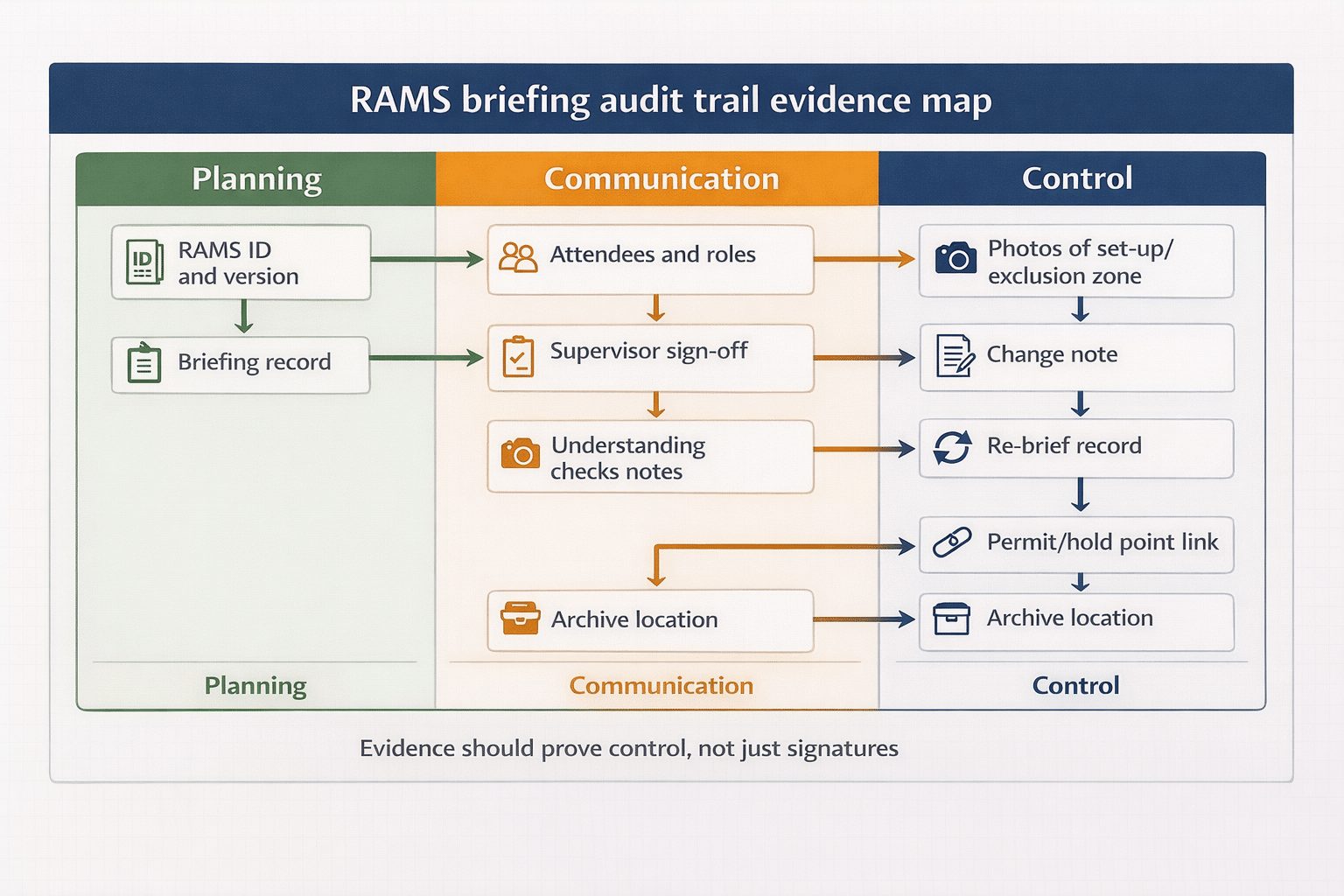
Evidence should show:
-
date and time
-
location or work area
-
task or work package
-
RAMS identifier and version number
-
who delivered the briefing
-
attendees and roles
-
signatures or equivalent confirmation
-
notes of any site-specific change agreed
If you are moving to digital, briefings can also be used to capture attendance and evidence trails. Paperless supports method statement and RAMS briefings as a briefing type, with options to attach documents and capture attendance evidence.

Download Your Free Briefing & Attendance Template
Ready-to-Use Briefing Sheet
Track attendance, signatures, and daily safety briefings with a free HSE-aligned record sheet for toolbox talks, inductions, and site audits.
What to cover in the RAMS briefing (a practical checklist)
Use this as a briefing prompt list so you do not miss the basics:
Task controls and boundaries
-
scope, limits, and interfaces
-
access and egress
-
exclusion zones and segregation
-
permits required, if any
People and competence
-
who is doing what today
-
any competence requirements, for example plant tickets
-
who is supervising and who has authority to stop the work
Plant, equipment, and materials
-
what plant is being used and where it will operate
-
pre-use checks and defect reporting
-
lifting accessories or tools that must be inspected
Hazards and controls that matter most
-
the top hazards for this job, not a full hazard list
-
control measures and how they will be applied on this site
-
hold points, checks, and who signs them off
Emergency and change control basics
-
what to do if things change
-
what to do if there is an incident or near miss
-
who to contact and how to escalate
If you want a role-based view of applying RAMS day-to-day, the supervisor-focused angle in RAMS application for site supervisors can help frame what supervisors should look for.

Common briefing mistakes that cause incidents, rework, or weak audits
Rushing the method sequence
If you skip the sequence, people fill the gaps with assumption. This is where shortcuts appear.
Fix: always brief in the order the job happens, and use the steps as your structure.
Briefing the document, not the job
Reading from the RAMS is not the same as briefing the work.
Fix: translate into site language, point to the physical area, and describe “what we do first”.
No understanding checks
A signature does not prove understanding.
Fix: ask simple task questions, get operatives to explain back, and capture any learning points.
No re-brief triggers
Work changes, weather changes, access changes, other trades arrive.
Fix: publish a short trigger list and treat re-briefs as normal, not as blame.
Poor evidence
Missing version numbers, missing attendees, unclear dates. This collapses your audit trail.
Fix: record the RAMS identifier and version, keep sign-off clean, and store evidence where it can be retrieved.
If you are aiming for a stronger compliance position overall, site RAMS compliance is a useful companion topic.
When to re-brief RAMS and how to manage change without chaos
Re-briefing is not optional when conditions change. The simplest approach is to treat re-briefs as “change control”.
Common re-brief triggers
-
scope changes, even small ones
-
sequencing changes
-
new plant or different equipment
-
new crew members or a new subcontractor gang
-
changes to access, lifting routes, or exclusion zones
-
weather affecting controls, for example wind limits, ground conditions
-
discovery of an unexpected hazard, for example undocumented services
How to run a re-brief quickly
-
state what changed
-
state what control changes as a result
-
confirm the team understands the new method or control
-
record who was present and that the change was briefed
-
link it back to the RAMS version or amendment note
A practical operational model is to keep briefing records tied to the RAMS version and re-brief record. Digital briefings can help here by keeping attendance and record history together. Paperless briefings support attendance records, document attachments, and evidence such as photos, which can help show what was briefed and where.
How digital RAMS briefings help on multi-crew sites
On larger projects, the failure point is usually not the RAMS creation. It is consistent communication across shifts, supervisors, and subcontractors.
Digital briefing workflows can help you:
-
attach the current RAMS version to the briefing record
-
capture attendance consistently across crews
-
keep evidence accessible, not buried in folders
-
email records to relevant managers where needed
-
reduce missed briefings when people join mid-shift
Paperless supports digital briefings where documents can be uploaded to the briefing, workers can self-enrol via link or code, and records can be sent by email, while keeping attendee data minimal for GDPR purposes.
03_kb_paperless_capabilities_an…
If you want a broader “how teams are doing this” view, digital site RAMS expands on the workflow side.
Frequently Asked Questions
Do operatives need to sign RAMS after the briefing?
Yes, but the signature is only one part of the evidence. You still need to confirm understanding and record which RAMS version was briefed. If the task changes, you also need a re-brief record so you can show the team was briefed on the amended controls.
How long should a RAMS briefing take on site?
As a rule, keep it short and task-led: often 5 to 15 minutes depending on complexity. Focus on the method sequence and the critical controls. If you try to cover every line in a long RAMS pack, attention drops and retention falls.
What should you do if an operative does not understand the RAMS?
Stop and close the gap before work starts. Re-explain the relevant step in plain language, show the work area or plant, and ask them to explain it back. If competence is the issue, reassign tasks or provide supervision rather than relying on a signature.
When is a RAMS re-brief required?
Re-brief when the task, method, plant, sequencing, access, or site conditions change, or when new people join the crew. If the controls you rely on are no longer valid in the real conditions, the original briefing no longer controls the work and you need a short, recorded update.
A RAMS briefing that people can follow and you can prove
A strong RAMS briefing is simple: walk the job in order, pull out the controls that prevent harm, and check understanding rather than relying on a signature. Treat changes as normal and re-brief when conditions shift, then record who was briefed and which version they were briefed on.
If you want to build a more consistent approach across supervisors, it can help to standardise how briefings are recorded and stored, especially where multiple crews and subcontractors are involved.
If you are reviewing how you manage RAMS across projects, see the RAMS overview here: RAMS feature overview.
Download Your Free Method Statement Template
Build Clear Method Steps Faster
Use a practical, site-friendly template to document sequence, roles, plant, and controls for clear briefings and easier site delivery.


