

The Ultimate Guide to Construction Permit to Work Systems (UK)
A permit to work system is one of the few site controls that forces clarity before high-risk work starts. It is not paperwork for its own sake. It is a structured way to confirm scope, isolations, interfaces, and responsibility so the work is authorised under controlled conditions.
In UK construction, permits are most valuable where conditions change quickly and multiple trades interact. The common failure mode is not that a permit was missing. It is that the wrong work went ahead under the wrong assumptions, often during handovers, time pressure, or simultaneous operations.
This guide explains what a construction permit to work system is, when it applies, how the lifecycle works on real sites, and what makes the process reliable. It also explains how digital permit workflows can improve visibility and evidence without removing the need for competent supervision. For product context on managing permits digitally, see Construction Permit Management Software.

Table of contents
- What is a permit to work system in construction
- Why permit to work matters on UK construction sites
- Where permits apply on real projects
- The permit to work lifecycle step by step
- Roles, competence, and accountability in a permit system
- Risks, failures, and misconceptions
- Best practice framework for running permits well
- Implementation roadmap for contractors
- Digital permit to work systems in practice
- Regulatory and compliance alignment
- Commercial and operational impact
- Future trends and industry direction
- Frequently Asked Questions
- Explore More Related Reads and Resources
What is a permit to work system in construction
A permit to work (PTW) system is a formal authorisation process used to control specified high-risk work activities. It defines the work scope, location, time window, hazards, and required controls, then records who authorised the work and who accepted responsibility for carrying it out.
A permit is not a substitute for risk assessment. HSE explicitly frames permits as a way to bring risk assessment “to life” at the point of work, with particular emphasis on competence, procedures, and communication.
A permit system also has boundaries. It should not be used for every task, because overuse drives permit fatigue, weakens attention, and encourages copying. A permit system works best when it is reserved for the activities where loss of control has severe consequences and where interfaces between trades or systems must be actively coordinated.
In construction, a permit to work system typically sits alongside risk assessments, method statements, site briefings, isolations, and supervision checks. The permit ties those controls together for a defined period of work and makes the authorisation explicit.
Why permit to work matters on UK construction sites
Permits matter because many construction incidents do not occur due to a lack of paperwork. They occur because people start work under the wrong assumptions, often under time pressure and changing conditions. A permit process creates a deliberate pause to check that the job is understood, controls are in place, and roles are clear.
Permits also protect projects operationally. They reduce clashes between contractors, prevent isolations from being bypassed, and make the site’s “permission to proceed” visible. On busier sites, the permit register becomes a coordination tool, not just an archive.
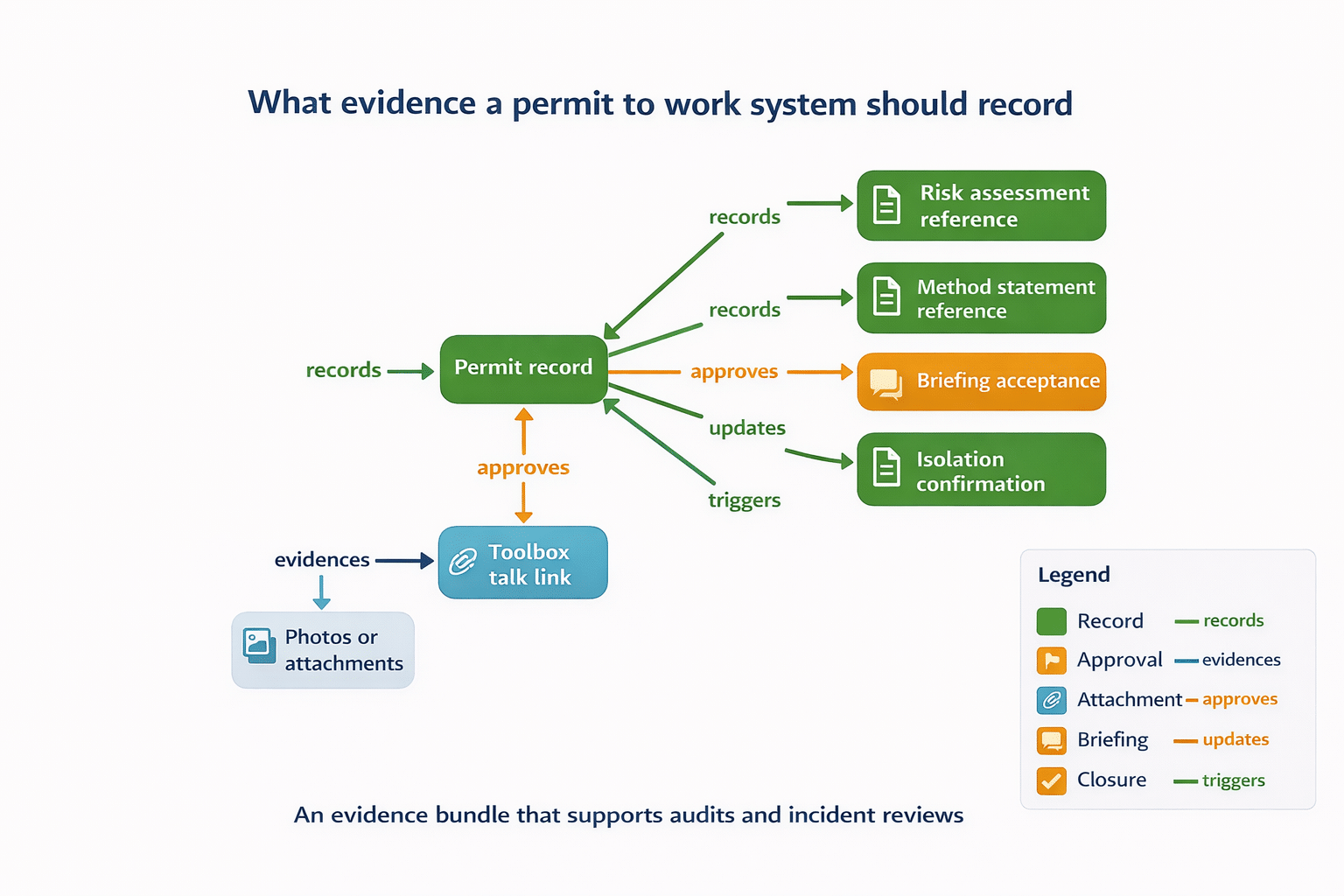
There is also a governance reality. After an incident, investigators look for evidence that the work was planned, authorised, briefed, monitored, and closed out properly. A permit system provides traceable decisions, including who accepted the job and what conditions were in force at the time.
HSE guidance on permit systems highlights the human factors angle, particularly competence and communication. A permit system that does not control these behavioural points will not be reliable in practice.
Where permits apply on real projects
Permits apply where the risk profile and the interface risk justify a formal authorisation control. That decision is not purely about the task label. It depends on the site context, the environment, and how the work interacts with other activities.
On civil engineering and infrastructure projects, permits commonly become essential because interfaces are complex and conditions change. Excavations interact with live services. Temporary works and plant movements change exclusion zones. Multiple contractors work under time constraints and shifting sequences.
On commercial builds and fit-out projects, permits often become critical for hot works, isolations, and confined space entry, especially during refurbishment where unknowns and legacy services increase risk. CITB hot-work permit guidance explicitly frames hot works as requiring permits and competent preparation.
Permits also apply where simultaneous operations (SIMOPS) create “clash risk”. If one contractor’s activity can compromise another’s controls, permits become a coordination layer. This is where a permit system is most effective, because it forces the site to define interfaces and sequencing rules.
Once permits are overused, the process degrades. A key decision factor is whether a permit adds real control beyond RAMS and supervision for that specific activity. If it does not, it is usually better to avoid issuing it and keep the system focused.

The permit to work lifecycle step by step
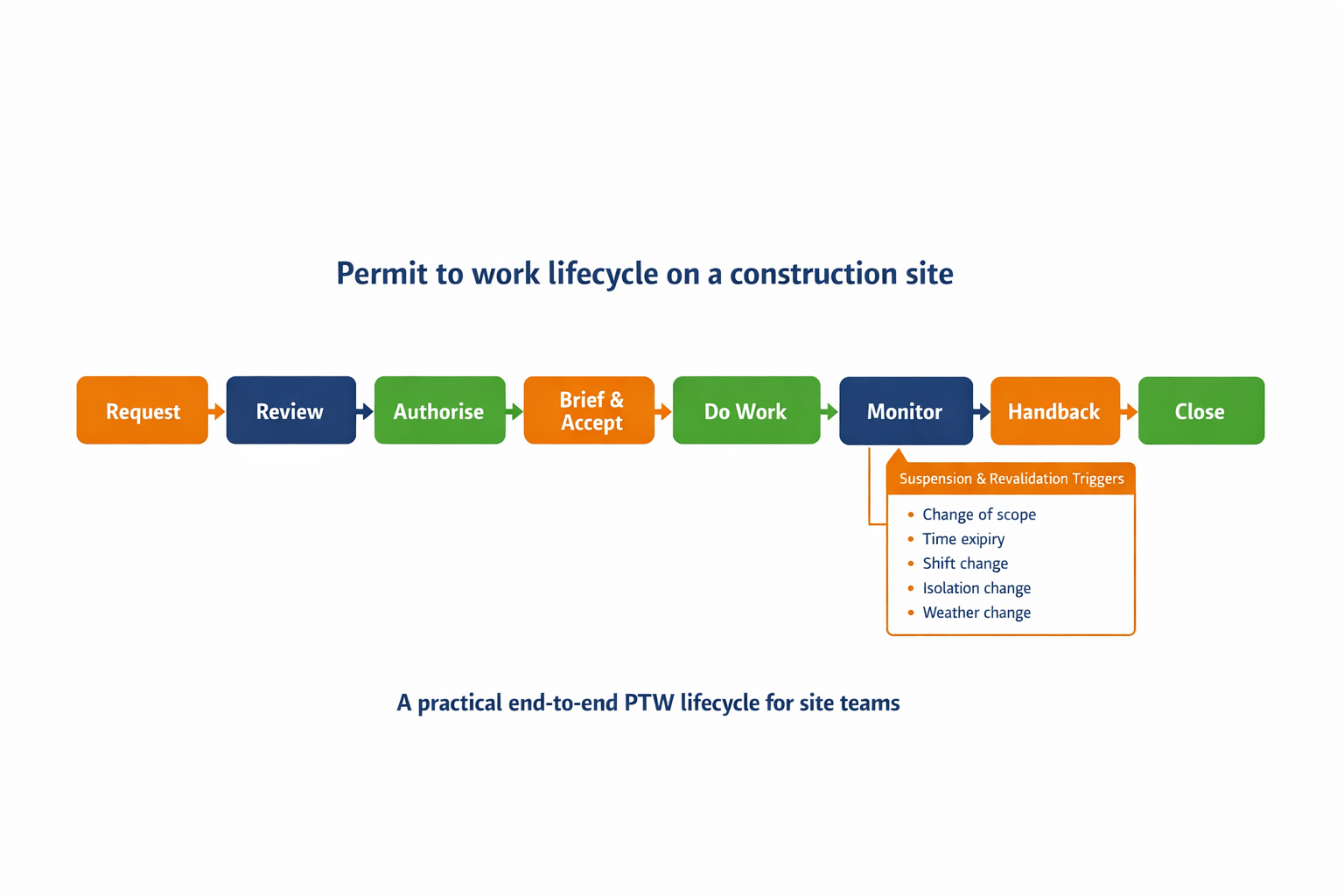
A reliable permit lifecycle runs from request through to close-out, with deliberate controls at each stage. The purpose is not only to authorise work. It is to keep the authorisation valid as conditions change.
A typical construction workflow starts with a request that defines scope, location, time window, and dependencies. The permit is then reviewed, usually by a supervisor or authorised person, to confirm hazards, controls, and whether isolations or specialist roles are required. A permit should not be approved unless its conditions can be met in reality on that shift.
Once authorised, the permit holder must be briefed and must accept the permit conditions. This is a control point where many failures occur, especially when the permit is handed over without a proper briefing or when the permit holder changes.
During the work, monitoring must confirm that controls remain in place and that the work remains within scope. If scope changes, time expires, isolations change, or a shift change occurs, the permit should be suspended and revalidated. HSE’s permit guidance stresses that permits support communication and competence controls, which is exactly what suspension and revalidation protects.
At handback, the site confirms the work is complete, the area is left safe, and any isolations can be safely returned to service. Close-out should record who confirmed handback, when, and what checks were completed.
Ready to Reduce Site Admin?
See Paperless in action.
Take a closer look at how Paperless can help you replace paperwork, improve visibility and keep project records easier to find and prove.
Roles, competence, and accountability in a permit system
Permits fail when roles are ambiguous. A construction permit to work system needs clear role definitions, authority boundaries, and competence expectations, otherwise the form becomes a proxy for real decision-making.
The permit issuer or permit authoriser is responsible for approving the permit conditions and confirming that the site can support them. This role requires authority over the work environment, not just knowledge of the task. The permit holder is responsible for following permit conditions and ensuring their team works within scope. That role must not be given to someone who cannot influence the way the work is actually performed.
Isolations introduce another key role. The isolating authority or competent person responsible for isolation must confirm the isolation is applied and tested. When isolation is part of the control set, it must not be treated as a tick-box. It is an operational control with a defined verification step.
Supervisors and managers also have a responsibility to maintain permit governance. This includes maintaining a permit register, ensuring permits are reviewed at shift change, and confirming handback. It also includes stopping work when conditions change.
A permit to work is not a replacement for robust risk assessment. HSE is explicit on this point, and it matters because it prevents organisations from relying on the permit as the only safety control.
Risks, failures, and misconceptions
The most common permit failures are predictable and repeat across site types. They tend to be process failures, not document failures.
One failure mode is generic scope. If the permit scope is not location-specific and time-bound, it becomes reusable paperwork. That directly increases permit fatigue because nobody trusts that the permit describes the work happening today.
Another failure mode is unmanaged interfaces. Permits are often treated as independent documents, while the real risk comes from interaction between tasks. SIMOPS is a practical example. A permit system should force the site to identify who else is impacted and what sequencing rules apply.
Handover failure is another high-risk point. Shift changes, permit holder changes, or partial completion can leave a permit “live” without a competent person maintaining control. This is why suspension and revalidation triggers must be explicit and enforced.
A common misconception is that permits slow work down. Poorly run permits do. Well-run permits reduce rework and stoppages because they prevent predictable clashes and late discoveries. The trade-off is that the site must invest in competence and consistent routines.
| Do's | Don'ts |
|---|---|
| Keep scope location-specific and time-bound | Issue generic permits that can be reused |
| Make shift change a revalidation trigger | Assume permit conditions still apply |
| Control interfaces and simultaneous operations | Treat each permit as independent |
| Require briefing and acceptance by the holder | Hand permits over without discussion |
Best practice framework for running permits well
A permit system becomes reliable when it is treated as part of the site’s daily control rhythm. It should be integrated with planning, supervision, and briefings, rather than being an isolated document exercise.
Start by defining permit triggers clearly. Triggers should be based on risk and interfaces, not just activity labels. Hot works, confined spaces, isolations, and excavation near services are common triggers, but context matters. CITB hot work material provides practical framing for why hot works require formal controls and competent preparation.
Then standardise the permit content to the minimum that protects control. A permit should include scope, location, time window, hazards, controls, isolations, roles, monitoring expectations, and close-out checks. Avoid long narrative sections that nobody can read on site.
Treat the permit register as a live control. It should allow supervisors and managers to know what high-risk work is active, where, and under what conditions. This is where digital systems often add value because they provide real-time visibility and reduce version confusion.
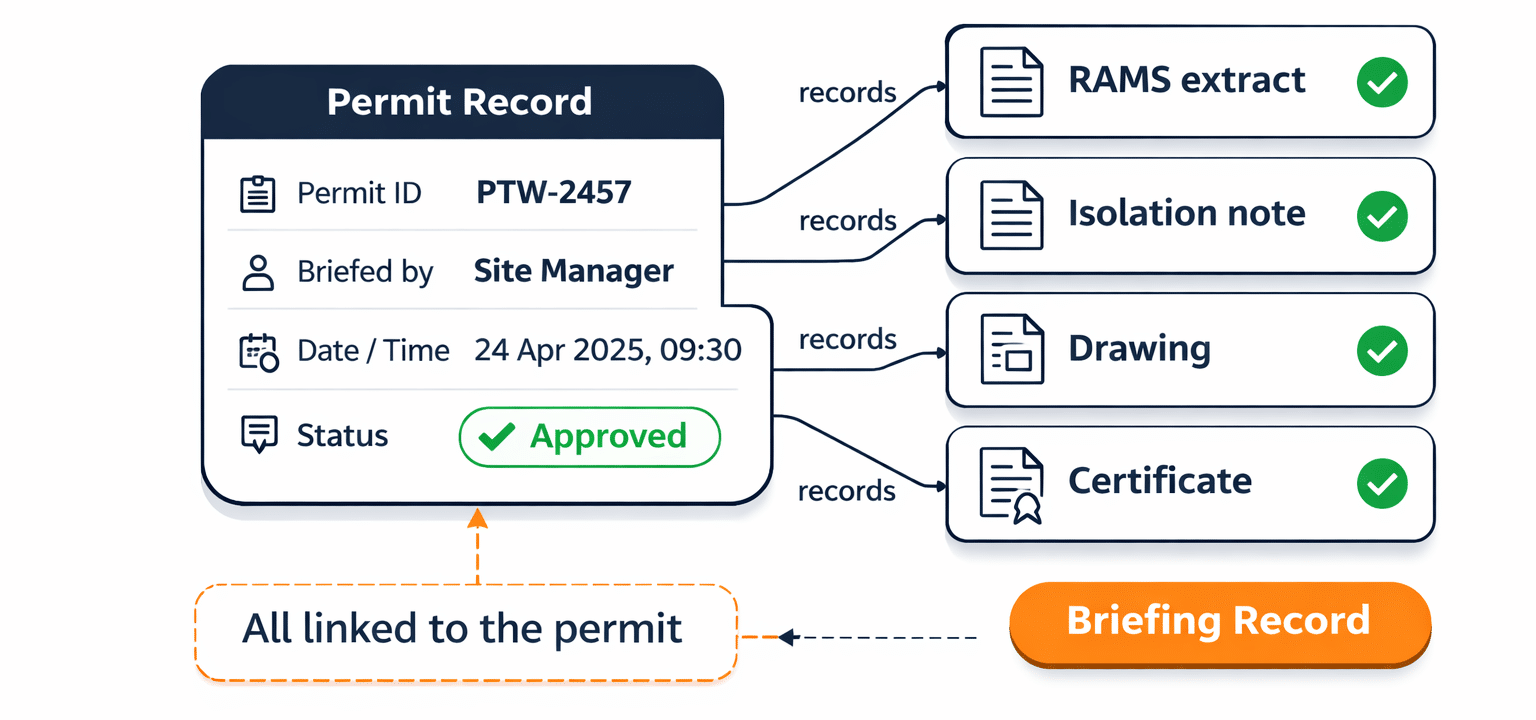
Finally, link permits to briefing and acceptance. A permit that is not briefed is not controlling behaviour. Where briefings are managed digitally, permits can be connected into the same evidence trail. For briefing workflow context, see Construction Safety Briefing Software.
Implementation roadmap for contractors
Implementing a permit to work system is a change programme, not a template exercise. The site needs clarity on triggers, competence, and what “good” looks like, otherwise permits will be issued inconsistently.
Start by mapping your high-risk work and your interface risks. Identify the activities and environments where the consequences of loss of control are severe. Then define your permit types and keep the set small enough that people understand the difference.
Next, define roles and training requirements. Decide who can issue, authorise, hold, and verify isolations. Validate that those people have the authority to control the work environment. This is also where you define your escalation rules for conflict or uncertainty.
Pilot on one project with a clear permit register routine. Build revalidation triggers into the day plan, including shift change, time expiry, scope change, and isolation change. Measure whether the permit process reduces clashes and improves clarity, rather than focusing only on completion speed.
Finally, standardise and audit. Audit should check whether permits are being used where they add control and whether close-out is happening consistently. It should also check whether permit conditions are realistic and whether briefings and monitoring are working in practice.
Digital permit to work systems in practice
A digital permit to work system does not change the fundamentals. The work still needs competent planning, supervision, and control. What digital can improve is the quality and visibility of the process.
The first improvement is visibility. Digital systems make it easier to know what permits are active, where they apply, and when they expire. That is especially useful for multi-site operations and for managers who cannot be physically present.
The second improvement is standardisation. Digital templates reduce the chance that key fields are missed. They can enforce mandatory checks, require acceptance, and record time-stamped approvals. That strengthens audit readiness, especially when permits need to be reviewed after a near miss or incident.
The third improvement is change control. A digital system can make it obvious when conditions have changed and can support suspension and revalidation workflows. That matters because permits often degrade during handovers and scope drift.
A real-world constraint is connectivity. Sites do not always have reliable signal. Any digital permit workflow used on site must handle offline work and synchronisation, otherwise teams will revert to informal workarounds. The trade-off is that offline capability can increase complexity in setup and training.

Regulatory and compliance alignment
Permit to work systems sit within the wider expectation of safe systems of work. In UK practice, that means risk assessment, competent planning, communication, and supervision that is appropriate to the risk.
HSE’s permit-to-work guidance emphasises that permits support the communication and competence aspects of controlling work, and that they should not be treated as a replacement for risk assessment.
Specific hazards also carry their own regulatory guidance and expectations. Confined space work is one example where planning, competence, and emergency arrangements are central. The HSE L101 Approved Code of Practice and guidance provides the baseline framing for safe work in confined spaces and is widely used as a reference point for what “reasonable” looks like in practice.
Hot works are another example where industry guidance supports formal permit control, particularly in environments with combustible materials or refurbishment unknowns. CITB hot work permit material reflects the expectation that hot works require formal controls and a competent approach.
This section is not legal advice. Its purpose is to help you align your permit system to the practical expectations that are commonly referenced during audits, investigations, and client assurance processes.
Ready to Reduce Site Admin?
See Paperless in action.
Take a closer look at how Paperless can help you replace paperwork, improve visibility and keep project records easier to find and prove.
Commercial and operational impact
The value of a permit system is easiest to see when it prevents predictable project disruption. A permit system reduces unplanned stoppages by making the site’s constraints visible before work starts. It also reduces rework by preventing clashes, particularly where isolations, temporary works, or access constraints affect other trades.
Permits also support consistent governance. When permits are logged, monitored, and closed out properly, the organisation can show that it had a control system in place, that the right people authorised work, and that change triggers were managed. That evidence matters after an incident and during client audits.
On multi-site operations, real-time visibility of active permits supports better oversight. Managers can identify patterns such as repeated permit suspensions, frequent time overruns, or permit types that are being overused. That can highlight training gaps or planning issues.
There is a practical trade-off. Strong permit governance requires time and discipline. If the process becomes too heavy, teams work around it. The design goal is a process that is strict where risk is high, but efficient enough that it can be followed on a busy site.
Future trends and industry direction
Permit processes are moving towards tighter integration with other site controls. Instead of permits being standalone documents, they are increasingly treated as part of a connected safety and operations record.
One trend is improved interface control. As sites become more complex and schedules tighter, organisations are paying more attention to SIMOPS coordination and the need for clear sequencing rules. Permits are an obvious place to record and enforce those coordination decisions.
Another trend is stronger evidence expectations. More clients and principal contractors want proof that high-risk work was authorised correctly and that close-out was completed. Digital workflows make that evidence easier to produce, but they also raise expectations for consistency.
A third trend is practical usability. Systems that do not work offline or that create excessive admin will not be adopted properly. The direction of travel is towards mobile-first workflows that are quick to run on site while still enforcing essential controls.
Finally, competence remains the anchor. No tool can compensate for unclear authority, weak supervision, or poor planning. The best permit systems are the ones that make competent decision-making easier to execute consistently.
Frequently Asked Questions
1) What is a permit to work system
A permit to work system is a formal process that authorises specific high-risk work only when conditions and controls are confirmed. It defines scope, location, time window, hazards, isolations, and responsibilities. It records briefing and acceptance, monitoring expectations, and handback and close-out so the authorisation remains valid in practice.
2) When do you need a permit to work on a construction site
You need a permit when the task or site context makes loss of control high consequence, especially where isolations, confined spaces, hot works, excavation near services, or complex interfaces apply. The decision should be based on risk and interaction with other work, not on habit or generic rules.
3) What should a permit to work include
A good permit includes a clear scope and location, a time window, hazards and controls, any required isolations and verification steps, named roles (issuer, authoriser, holder), briefing and acceptance confirmation, monitoring expectations, and close-out checks. It should be concise enough to be used on site.
4) Who can issue a permit to work
The issuer or authoriser should be a competent person with authority over the work environment and the ability to enforce conditions. This is often a site manager or supervisor role, but it depends on the project. The key requirement is that the issuer can control interfaces and stop work if conditions change.
5) Who is the permit holder
The permit holder is the person responsible for carrying out the work under the permit conditions. They must understand the scope and controls and must have the practical authority to ensure their team follows the conditions. If the holder changes during the job, the permit should be revalidated and accepted again.
6) What is the difference between RAMS and a permit to work
RAMS describe how work will be done safely, including hazards and controls. A permit authorises high-risk work for a specific time and place after checking conditions are met and responsibilities are clear. Permits do not replace RAMS, and HSE guidance makes clear permits are not a substitute for risk assessment.
7) What is the permit to work lifecycle
The lifecycle typically includes request, review, authorisation, briefing and acceptance, doing the work under conditions, monitoring, handback, and close-out. A key feature is change control, including suspension and revalidation triggers such as scope change, time expiry, shift change, or isolation change.
8) What is permit suspension and revalidation
Suspension is stopping the permit’s authorisation when conditions change or the job pauses. Revalidation is confirming that controls still apply and the work can restart safely. Revalidation should occur after shift change, time expiry, scope change, isolation change, or environmental changes that affect risk and supervision.
9) Do confined spaces require a permit to work
Confined space entry commonly requires formal permit controls because the risks can be severe and conditions can change quickly. UK guidance on confined spaces places strong emphasis on competent planning, safe systems of work, and emergency arrangements, which permits help coordinate at the point of work.
10) Do hot works require a permit to work
Hot works commonly require permits because they introduce a foreseeable risk of fire or explosion. Industry guidance includes hot-work permit templates and practical controls to ensure competent preparation and precautions. The permit helps confirm area preparation, fire watch, and close-out checks are completed consistently.
Explore More Related Reads and Resources
If you want supporting guidance on briefing, evidence, and rolling out consistent site routines, these related articles can help.
Safety briefings in minutes with AI
How to keep briefings short, relevant, and evidence-backed when time pressure is high.
Digital safety briefings in construction
What changes when briefings become mobile-first, and what still depends on supervision.
Construction safety briefings and digital RAMS
How briefings connect to RAMS and why linkages reduce misunderstandings at the point of work.
Safety briefing system for construction
A practical view of standardising briefing workflows across projects and crews.
Going paperless with safety briefings in construction
Common adoption barriers and how to make digital routines stick on live projects.
Streamline safety briefings and go paperless
Why evidence capture, sign-off, and version control matter when you scale across sites.






See What Paperless Could Do for Your Sites
One brochure. The full platform.
Explore the tools available to help reduce paperwork, improve visibility and keep workforce, safety and project records connected.