Manual Handling Toolbox Talk (UK Construction)
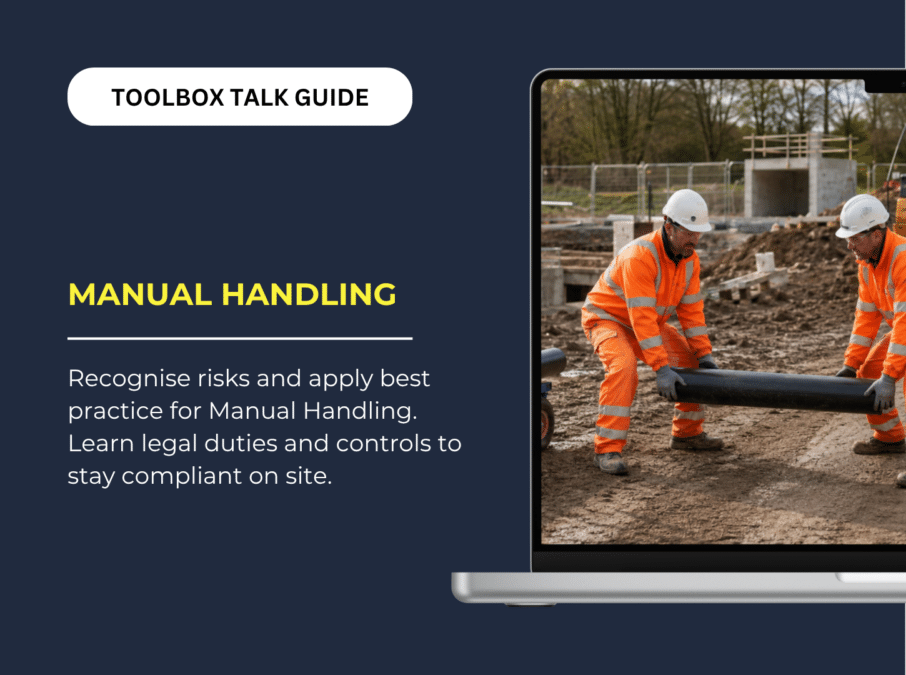
Topic: Manual Handling Toolbox Talk
Toolbox Talk Pack: 30 Site Essentials Toolbox Talk Pack
Availability: This individual Toolbox Talk is available as a FREE download
Region: UK
Manual Handling Toolbox Talk Guide

Manual handling takes place whenever a worker lifts, lowers, carries, pushes, pulls, supports or moves a load using bodily force. It appears throughout our toolbox talk topics for UK construction because materials, tools and equipment are moved at almost every stage of a project.
This guide explains how the load, task, working environment and individual capability combine to create risk. It also covers common site failures, starter checks and practical ways to remove or reduce handling before relying on lifting technique alone.
Jump to section
What is Manual Handling in construction?
Manual handling is the transporting or supporting of a load by hand or bodily force. It includes lifting an item from storage, lowering it into position, carrying it across site, pushing a trolley, pulling equipment and holding a component while it is fixed. The load may be a material, tool, piece of equipment or another object.
Risk is not determined by weight alone. The size, shape, stability, grip and centre of gravity matter, as do the distance, frequency, posture, route and working conditions. Mechanical lifting may remove the main lift, but workers can still face manual handling while attaching accessories, guiding loads, unloading smaller items or positioning components.
Why it matters on UK construction sites
Poorly planned handling can cause strains, sprains and other musculoskeletal injuries affecting the back, shoulders, arms, hands and lower limbs. Harm may result from one demanding movement or develop through repeated handling, awkward posture and insufficient recovery. A dropped or uncontrolled load can also cause crush injuries, cuts, damaged materials, blocked access routes or falls on stairs and uneven ground. Delays often follow when materials must be moved again because they were delivered or stored in the wrong place.
Who is exposed and how
Labourers, groundworkers, bricklayers, dryliners, carpenters, scaffolders, roofers, decorators and mechanical or electrical trades may handle materials repeatedly. Delivery drivers, store personnel and plant operatives can be exposed during unloading and distribution. Supervisors and engineers may also take on occasional lifts without considering the task. Nearby workers can be injured if a load is dropped, a trolley runs away or a large item blocks the handler's view.
Typical site tasks where this comes up
Handling risk can appear during deliveries, storage, installation, maintenance and waste removal.
- Unloading and distributing bags, blocks, fixings, tools and packaged materials.
- Carrying plasterboard, timber, ductwork, pipework or insulation through buildings.
- Positioning kerbs, paving units, doors, windows or prefabricated components.
- Pushing pallet trucks, wheelbarrows, trolleys or mobile equipment across site.
- Lifting tools and materials into vehicles, storage containers or work areas.
- Moving waste, offcuts and dismantled materials during clearing or strip-out work.
Common failure modes
Problems often begin before anyone touches the load, particularly when logistics and material positioning have not been planned.
- Materials are delivered far from their point of use, creating unnecessary lifting and carrying.
- A familiar or apparently quick lift begins without assessing its frequency, route or final position.
- The weight, grip or centre of gravity is unknown, or the contents can shift unexpectedly.
- A large sheet or long component blocks the handler's view or forces the load away from the body.
- Wet, torn or damaged packaging weakens the grip or allows part of the load to fall.
- A team lift starts without one person directing the movement or agreeing how to stop and lower the load.
- A handling aid is unavailable, unsuitable, overloaded or difficult to use on the planned route.
- Programme pressure encourages workers to rush, twist, carry too much or continue after fatigue develops.
Pre-start checks
These checks are a starting point only. They do not replace the project's risk assessment, method statement or task-specific controls.
- ☐ Avoidance: Confirm whether the handling can be removed through mechanical lifting, direct delivery or a different work method.
- ☐ Load: Check the weight, dimensions, grip, stability, sharp edges and likely movement of the contents.
- ☐ Route: Inspect the full route, including doors, stairs, slopes, floor changes, lighting and the destination.
- ☐ Handling aid: Select equipment suited to the load and surface, then check that it is serviceable and available.
- ☐ People: Consider individual capability, reported symptoms, fatigue, experience and any relevant limitations.
- ☐ Team handling: Agree the route, positions, commands and controlled set-down point before starting.
- ☐ Work area: Separate the movement from vehicles, pedestrians and other activities where an interface could develop.
How incidents happen and how to prevent them
A typical event begins when a load has to be moved farther than expected or through an area that was not prepared. The worker grips it from a poor height, lifts while twisted or finds that the view ahead is blocked. An obstruction, change in level or shifting load then forces a sudden correction. The worker may strain to retain control, lose balance or drop the item onto themselves or someone nearby.
Prevention starts with removing the handling or reducing the distance, frequency and physical demand. Plan delivery and storage around the installation sequence, use suitable lifting or carrying aids and prepare the route before movement begins. When handling remains necessary, arrange a stable starting height, secure grip and clear destination. Stop and reassess if the load behaves differently from what was planned.
⚠️ Hypothetical site example: Two workers carry a large plasterboard sheet through a doorway. The sheet blocks their view, one worker turns before the other is ready and the trailing worker twists while trying to keep the board upright. A board trolley, cleared route and agreed commands would reduce the immediate risks. If the trolley cannot reach the workface, the remaining handling still needs assessment.
When risk increases
Reassess the task when the load, route, people or work sequence changes.
- Deliveries arrive outside the planned sequence or must be unloaded quickly.
- The load becomes wet, damaged, unstable or heavier than the item previously assessed.
- The route includes stairs, temporary ramps, uneven ground, restricted openings or poor lighting.
- Access for a telehandler, hoist, trolley or pallet truck is removed as the project progresses.
- Repetition, fatigue, time pressure, cold conditions or required PPE affects movement and grip.
- A different worker or team takes over without being briefed on the planned method.
UK regulations and compliance
The Manual Handling Operations Regulations 1992, regulation 4 requires employers, so far as is reasonably practicable, to avoid hazardous manual handling. Where it cannot be avoided, the operation must be assessed and the risk of injury reduced so far as is reasonably practicable. Where reasonably practicable, employees should also receive general indications of load weight and information about an uneven centre of gravity where applicable.
The assessment factors in Manual Handling Operations Regulations 1992, Schedule 1 include the task, load, working environment and individual capability. The assessment should therefore consider more than a single load weight.
The HSE Manual Handling at Work guidance explains the avoid, assess and reduce hierarchy and confirms that the law does not set one specific weight limit. The HSE Construction Physical Ill Health Risks: Manual Handling guidance applies these principles to site materials, routes, work pressure, handling aids and construction methods.
The HSE Manual Handling Assessment Charts can help assess lifting, lowering, carrying and team handling activities. HSE notes that the tool is not suitable for every operation and may not provide a complete risk assessment by itself.
Key regulations and guidance
Manual Handling Operations Regulations 1992, regulation 4 - establishes the hierarchy for avoiding, assessing and reducing hazardous manual handling.
Manual Handling Operations Regulations 1992, Schedule 1 - identifies factors that should be considered during an assessment.
HSE Manual Handling at Work guidance - explains the legal hierarchy and practical approach to managing handling risks.
HSE Construction Physical Ill Health Risks: Manual Handling guidance - provides construction-specific assessment and control guidance.
HSE Manual Handling Assessment Charts - supports assessment of lifting, carrying and team handling activities.
Practical controls that make the difference
Prioritise changes to the logistics, load and workplace before relying on individual strength or technique.
- Remove the handling: Use cranes, hoists, telehandlers, conveyors or specialist attachments where this avoids hazardous manual movement.
- Plan material flow: Deliver materials close to their point of use while suitable plant and access remain available.
- Change the load: Select lighter materials, smaller packs, built-in handholds or prefabricated methods where reasonably practicable.
- Use suitable aids: Match trolleys, pallet trucks, sack barrows, grips and lifting devices to the load, route and ground conditions.
- Improve the layout: Store frequently handled or heavier items at a practical height and provide room to approach and position them without twisting.
- Control the work rate: Adjust repetition, distance and recovery time, and investigate reported discomfort or excessive fatigue.
- Support the controls: Provide task-relevant instruction and supervision. Good handling technique can help, but it is not a substitute for avoiding or reducing the hazardous operation.
FAQs
Is there one maximum weight that a worker can safely lift?
No. UK manual handling law does not set one safe weight limit. Weight is only one factor, alongside the task, load, environment, frequency and individual capability.
Does manual handling training make a difficult lift acceptable?
No. Training and technique support the controls, but employers must first consider avoiding the hazardous handling and reducing the remaining risk.
When should a team lift be used?
Team handling may help where the assessment shows it is suitable and the movement can be coordinated. If the load remains too awkward, unstable or difficult to control, use a suitable handling aid or change the method.
Explore more toolbox talk topics for UK construction .
Get the ready-to-use Manual Handling Toolbox Talk
Brief your site team on handling risks, load assessment, safer planning and practical controls.