Emergency Preparedness Toolbox Talk (UK Construction)
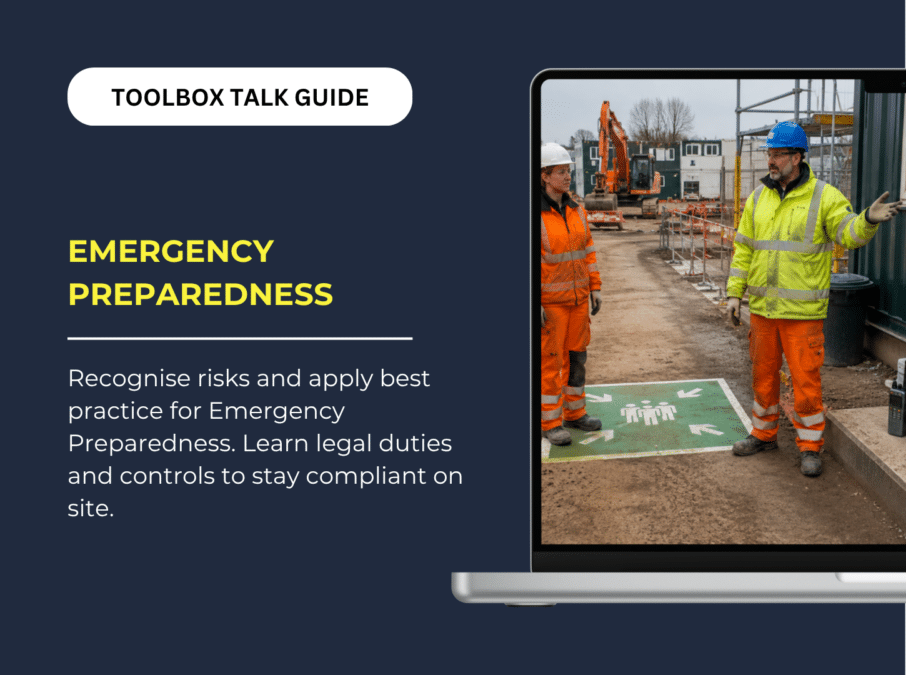
Topic: Emergency Preparedness Toolbox Talk
Toolbox Talk Pack: 30 Site Essentials Toolbox Talk Pack
Availability: This individual Toolbox Talk is available as a FREE download
Region: UK
Emergency Preparedness Toolbox Talk Guide

Emergency preparedness is the site-specific plan for recognising an emergency, raising the alarm, protecting people and getting the right help without delay. It belongs within toolbox talk topics for UK construction because changing layouts, work activities and personnel can quickly make an old response plan ineffective.
This guide explains who may be affected, where response arrangements fail and how supervisors can keep alarms, escape, accountability, access and rescue planning aligned with current work.
Jump to section
What is Emergency Preparedness in construction?
Emergency preparedness is the practical arrangement made before an event so people know how to respond to foreseeable danger. This may cover fire, collapse, serious injury, a service strike, flooding, chemical release or uncontrolled plant. The plan should define the alarm, command, evacuation, accountability and information needed by emergency services.
A general evacuation plan is not the same as a task-specific rescue plan. Work in a confined space, over water, at height or in an excavation may need dedicated equipment, trained people and a planned method. Workers should understand their actions and limits, and should not improvise a rescue for which they are unprepared.
Why it matters on UK construction sites
Construction sites change as structures rise, routes move, services become live and contractors arrive. An event can escalate when the alarm is unclear, access is blocked or nobody can confirm who remains in the area. Delayed isolation may worsen a fire, leak or electrical event. Poor directions and an incomplete roll call can also expose responders to unnecessary risk. Consequences include further injury, public harm, property damage, pollution and programme disruption.
Who is exposed and how
Operatives, supervisors, engineers, plant operators, drivers, security staff and visitors may all need to act. Lone workers and teams in remote, enclosed or elevated areas may not hear an alarm or receive help quickly. People with mobility, sensory, language or other support needs may require specific arrangements. Occupants, neighbours and the public can be affected near live buildings, roads, railways, utilities and shared access. First aiders, marshals and responders face added risk when information or control is poor.
Typical site tasks where this comes up
Emergency arrangements should reflect both routine site conditions and higher-risk activities.
- Establishing or changing hoardings, gates, traffic routes, welfare areas, fire points and assembly areas.
- Working at height, in excavations, over water or in confined spaces where evacuation or rescue may be difficult.
- Hot work, fuel storage, battery charging, temporary electrics and activities involving flammable or hazardous substances.
- Demolition, temporary works, lifting operations and work near live services or unstable structures.
- Refurbishment in occupied premises where site alarms, escape routes and emergency roles must interface with the client's arrangements.
Common failure modes
A written plan can still fail if it does not match the current site or cannot be followed under pressure.
- A generic company procedure is issued without site access details, foreseeable scenarios, local hazards or clear command roles.
- Escape routes, gates or assembly points become blocked, locked, poorly lit or exposed to plant movements as the layout changes.
- The alarm cannot be heard or recognised in noisy, remote or enclosed work areas, or outside normal hours.
- The attendance record omits visitors, delivery drivers or workers who moved between zones, leaving the roll call uncertain.
- No one is clearly responsible for calling the emergency services, controlling the gate, isolating services or providing technical site information.
- First aid, spill-control, rescue or fire-response equipment is missing, inaccessible, unsuitable for the identified scenario or not ready for use.
- Teams assume the emergency services will provide immediate specialist rescue, although the task requires planned on-site arrangements.
- Drills are treated as a formality, so alarm coverage, route problems and confusion over responsibilities remain undiscovered.
Pre-start checks
These checks are a starting point only. They do not replace the project's risk assessment, method statement, construction phase plan or task-specific controls.
- ☐ Scenarios: Identify the emergencies that are reasonably foreseeable from the work, equipment, materials, surroundings and current stage.
- ☐ Alarm: Confirm how warnings will be raised and received in every occupied area, including noisy, remote and out-of-hours locations.
- ☐ Escape: Walk the routes, exits and access to the assembly point, checking obstructions, lighting, signs, gates and changing interfaces.
- ☐ People: Confirm current attendance, visitor control, roll-call method and any individual assistance that may be required.
- ☐ Roles: Name the people covering incident control, emergency calls, first aid, gate access, isolation and communication for the planned shift.
- ☐ Resources: Check that required first aid, fire, spill and rescue equipment is suitable, accessible and ready for the identified risks.
- ☐ Site information: Verify the address, access point, emergency contacts, hazard information and locations of essential shut-offs or isolators.
How incidents happen and how to prevent them
Response often breaks down through several small mismatches. The plan reflects an old layout, a barrier redirects people, the alarm is unclear in one zone and site information is unavailable. Workers lose time deciding which route to use, while the emergency caller cannot explain the access, hazards or people involved.
Prevention starts by controlling hazards and planning for those that remain. Link arrangements to current risk assessments, permits, logistics and temporary works. Protect routes, test warnings, keep attendance current and assign responsibilities for every shift. Prepare any specialist rescue before work begins, then use findings from drills, changes and events to revise the plan.
⚠️ Hypothetical site example: A small fire starts near temporary electrics during late work. A delivery partly obstructs the nearest stair, the air horn is locked in the office and a visiting engineer is missing from the attendance list. A clear route, accessible alarm, confirmed shift roles and accurate visitor record would remove these response failures. Fire prevention and electrical controls remain the priority.
When risk increases
Reassess emergency arrangements whenever the hazards, site layout, people or available resources change.
- New floors, basements, enclosed zones or temporary routes increase travel distance or affect alarm coverage.
- Live services, hot work, fuels, hazardous substances, demolition or temporary works introduce a different emergency scenario.
- Night work, weekend work, lone work or reduced staffing removes normal first aid, marshal, supervision or gate coverage.
- Severe weather, flooding, power loss or poor mobile reception affects access, lighting and communication.
- Large deliveries, crane operations, road closures or stored materials restrict emergency routes and service access.
- Workforce numbers, languages, visitors, neighbouring occupants or members of the public change significantly.
UK regulations and compliance
For construction work in Great Britain, the Construction (Design and Management) Regulations 2015, regulation 30 requires suitable and sufficient arrangements for foreseeable emergencies where necessary for site health or safety. They must include any necessary evacuation and take account of the work, site, equipment, people and relevant materials or substances.
The Construction (Design and Management) Regulations 2015, regulation 31 requires sufficient suitable emergency routes and exits where necessary. They must lead as directly as possible to an identified safe area, remain clear, have emergency lighting where necessary and be indicated by suitable signs.
The Construction (Design and Management) Regulations 2015, regulation 32 requires suitable and sufficient fire-fighting equipment, detection and alarm systems where necessary. These must be suitably located, examined and tested at suitable intervals, and properly maintained.
The HSE Emergency Procedures guidance covers alarm raising, emergency calls, escape, competent control, essential isolation and people needing assistance. It supports agreed, recorded and rehearsed responsibilities, realistic practice and coordination in shared workplaces.
The HSE General Fire Safety guidance for construction explains that the Regulatory Reform (Fire Safety) Order 2005 sets the law on construction site general fire safety in England and Wales. It describes the responsible person's fire risk assessment and precautions for escape, warning and fire response.
Key regulations and guidance
Construction (Design and Management) Regulations 2015, regulation 30 - requires arrangements for foreseeable emergencies and any necessary evacuation.
Construction (Design and Management) Regulations 2015, regulation 31 - covers emergency routes, exits, safe areas, lighting and signs.
Construction (Design and Management) Regulations 2015, regulation 32 - covers fire detection, alarms, fire-fighting equipment, testing and maintenance.
HSE Emergency Procedures guidance - explains practical planning, communication, roles, training and rehearsal.
HSE General Fire Safety guidance for construction - applies fire risk assessment and response principles to construction sites.
Practical controls that make the difference
Emergency arrangements support the control of risk. They do not replace measures that prevent fire, collapse, exposure, contact or other dangerous events.
- Control the initiating hazard: Apply the risk assessment, design, isolation, permit, temporary works and work-method controls that prevent the emergency.
- Keep the plan site-specific: Show current access, escape, assembly, hazards, isolators and emergency resources on a simple plan available to those who need it.
- Protect escape and service access: Include routes in daily logistics checks and prevent storage, parking, deliveries or locked gates from obstructing them.
- Make warnings effective: Select distinctive alarms suited to noise, distance and work zones, then verify that everyone understands the signal and required action.
- Plan specialist rescue: Provide the equipment, competent people, communication and access required by task-specific arrangements before the hazardous work starts.
- Maintain reliable accountability: Record workers, visitors and drivers accurately, define who conducts the roll call and prevent re-entry until authorised.
- Test and learn: Use proportionate drills and equipment checks to expose practical weaknesses, record actions and revise the arrangements after material changes.
FAQs
What should every worker know about the site emergency plan?
They should recognise the alarm, know how to raise it, use the correct route, report to the assembly point and follow the roll-call procedure. They should also know when to stop, who is in control and that they must not re-enter until authorised.
How often should emergency arrangements be reviewed and practised?
There is no single interval suitable for every construction site. Review them after relevant changes, exercises or events, and plan testing at intervals suited to the hazards, workforce, layout and response systems.
Is calling 999 a complete emergency plan?
No. The site must also address immediate warning, evacuation, accountability, safe access, competent control and the information responders need. Higher-risk tasks may require separate rescue arrangements and resources.
Explore more toolbox talk topics for UK construction .
Get the ready-to-use Emergency Preparedness Toolbox Talk
Brief your site team on alarms, evacuation, accountability, emergency roles and response arrangements.