Ladder Safety Toolbox Talk (UK Construction)
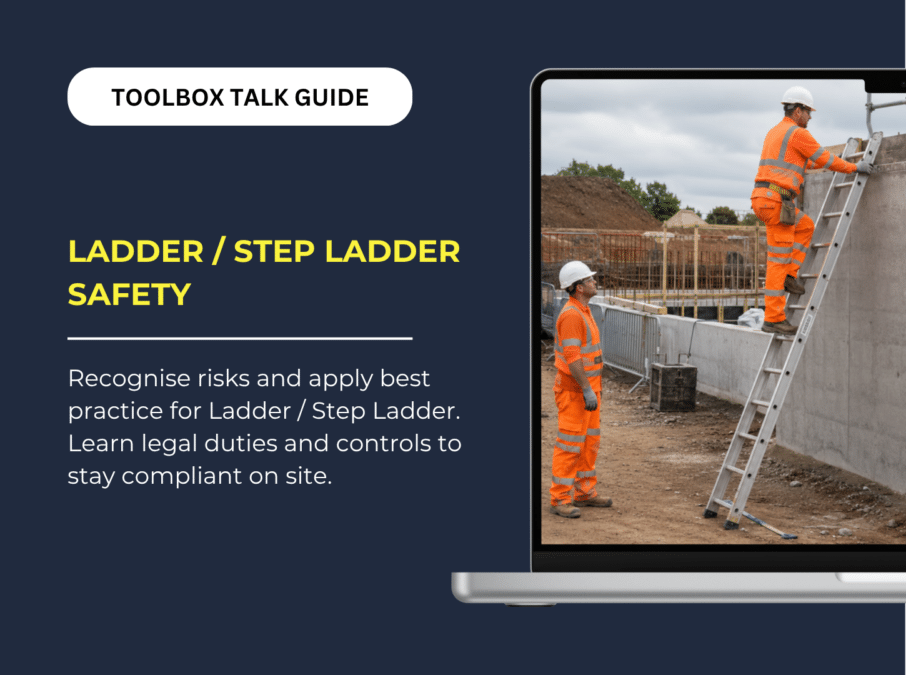
Topic: Ladder Safety Toolbox Talk
Toolbox Talk Pack: 30 Site Essentials Toolbox Talk Pack
Availability: This individual Toolbox Talk is available as a FREE download
Region: UK
Ladder Safety Toolbox Talk Guide

A ladder can be a practical choice for low-risk, short-duration work, but only after the task and location have been assessed. Ladder safety belongs within toolbox talk topics for UK construction because selection, condition, setup and user behaviour can each decide whether a routine task remains controlled.
This guide explains when a ladder may be suitable, how falls and instability develop, which workers may be affected, and what supervisors and users should check before work begins or conditions change.
Jump to section
What is Ladder Safety in construction?
Ladder safety is the planned selection, inspection, positioning, securing and use of a leaning ladder, stepladder or other suitable ladder. It begins with deciding whether a ladder is appropriate at all. The task may require a podium, tower scaffold or mobile elevating work platform if it involves longer duration, heavy materials, significant side loading, repeated movement or a need for both hands without reliable support.
A sound ladder is only one part of the arrangement. Firm ground, a strong resting point, correct configuration and a competent user are equally important. Access to another level also needs a secure transition at the landing.
Why it matters on UK construction sites
A ladder can slip, tip, buckle or be displaced with little warning. The user may fall onto concrete, reinforcement, plant, materials or an unprotected edge. Overreaching or applying sideways force can move the centre of gravity outside the stiles, while damaged feet or contaminated ground can remove grip. People below may be struck by dropped tools or materials, and an unsecured ladder in a vehicle route can expose drivers, visitors and other trades.
Who is exposed and how
Electricians, decorators, carpenters, dryliners, roofers, scaffolders, maintenance operatives and survey teams may use ladders for access, inspection or light work. Supervisors and store teams may move, issue or check them. Groundworkers, delivery drivers and members of the public can be affected if they pass beneath the task or strike the ladder. Carrying tools, stepping through an opening, fragile surfaces and overhead services add further exposure.
Typical site tasks where this comes up
Ladder decisions often arise during short tasks and temporary access, especially where the work area changes as the project develops.
- Measuring, inspecting, photographing or marking work above normal reach.
- Installing light fittings, cable clips, detectors, signs or small service components.
- Completing local decoration, snagging, sealing or minor repairs.
- Reaching a scaffold platform, roof level, excavation access point or temporary landing.
- Accessing plant, storage, ceiling voids or building services for planned checks and maintenance.
Common failure modes
Many failures begin with a convenient ladder being accepted without checking whether it suits the actual task and location.
- A ladder is chosen for reach alone, although the task needs prolonged work, force, heavy materials or unrestricted use of both hands.
- Feet are placed on soft, sloping, wet or contaminated ground, or levelled with loose bricks, timber or other improvised packing.
- A leaning ladder rests against weak glazing, plastic guttering, unfinished cladding or another surface that cannot support it.
- The ladder is left unsecured, or a person footing it is treated as the normal control without considering stronger securing options.
- The leaning angle is unsuitable, or a stepladder is not fully opened with its locking devices engaged.
- Worn feet, bent stiles, loose rungs, damaged stays or faulty telescopic locking mechanisms are missed or tolerated.
- The user overreaches, climbs too high, turns away from the ladder or applies side loading while drilling or pulling materials.
- Doors, vehicles, public routes or adjacent trades are not controlled, allowing the ladder to be struck or pushed over.
Pre-start checks
These checks are a starting point only. They do not replace the project's risk assessment, method statement or task-specific work-at-height controls.
- ☐ Equipment choice: Confirm that a ladder is justified and that a safer working platform is not required for the task.
- ☐ User: Confirm the person understands the assessment, ladder type, limits, setup and safe-use method.
- ☐ Suitability: Check the ladder is the correct type, length and duty for the user, tools, materials and access arrangement.
- ☐ Condition: Check feet, stiles, rungs, treads, stays, platforms, locks and fixings, then quarantine any defective ladder.
- ☐ Setup: Verify firm, level, clean ground, a safe angle or fully opened steps, and a strong upper resting point where relevant.
- ☐ Security: Agree how the ladder will be prevented from slipping, moving or being displaced throughout the task.
- ☐ Surroundings: Control doors, vehicles and people, and check weather, lighting, overhead services, edges and landing protection.
How incidents happen and how to prevent them
A typical fall begins with a task that changes after setup. The user reaches further, applies sideways force or carries more than planned. At the same time, unsuitable ground, a weak resting point or poor securing allows the ladder to move. Once balance is lost, there may be no protected platform or guardrail to stop the fall. Prevention therefore connects the work method to the setup: select the right access equipment, keep loads light, face the ladder, maintain secure contact, reposition rather than overreach and stop if the task no longer matches the assessment.
Supervisors should also consider the area around the ladder. Barriers or separation may be needed where people or vehicles could enter the work zone. Access ladders should provide a secure handhold and transition at the landing. Changes such as rain, damaged feet, moved materials or a new door route require the arrangement to be checked again.
⚠️ Hypothetical site example: An installer uses an untied leaning ladder to drill a bracket beside a doorway. The drill creates side loading while dusty ladder feet rest on smooth flooring. A delivery worker opens the door, the ladder shifts and the installer falls. Choosing a suitable platform, isolating the doorway and controlling the work area would remove the unstable combination.
When risk increases
Reassess ladder use when the task, work area or surrounding activity changes.
- Work becomes longer, repetitive or more physically demanding than originally planned.
- Rain, ice, mud, dust, strong wind or poor lighting affects footing, visibility or control.
- The ladder moves between soft ground and a smooth surface, or is dropped, struck or reconfigured.
- New deliveries, plant routes, doors, openings or other trades enter the working area.
- The task introduces side loading, trailing cables, bulky items or the need to reach outside the stiles.
- Access is close to an unprotected edge, fragile surface, overhead line or awkward landing point.
UK regulations and compliance
In Great Britain, The Work at Height Regulations 2005, regulation 4 requires work at height to be properly planned, appropriately supervised and carried out in a manner that is safe so far as is reasonably practicable. Planning must include suitable emergency and rescue arrangements, and work at height must be undertaken only when weather conditions do not jeopardise health or safety.
The hierarchy in The Work at Height Regulations 2005, regulation 6 requires employers to avoid work at height where reasonably practicable, prevent falls where it cannot be avoided, and minimise the distance and consequences of a fall where the risk remains. Equipment selection must follow this assessment rather than convenience.
The ladder-specific provisions in The Work at Height Regulations 2005, Schedule 6 allow a ladder for work at height only where the risk assessment shows that more protective equipment is not justified because of low risk and short duration, or because existing site features cannot be altered. The Schedule also addresses stable support, prevention of slipping, access length, secure handholds and safe use.
The HSE Safe Use of Ladders and Stepladders guidance explains that ladders are not banned and can be sensible for low-risk, short-duration tasks. Its 30-minute indication is guidance for considering alternative equipment, not an automatic legal threshold. HSE also covers pre-use checks, firm level ground, securing, three points of contact and task-appropriate competence.
Northern Ireland has parallel ladder requirements in The Work at Height Regulations (Northern Ireland) 2005, Schedule 7. These address risk-assessed ladder use, stable support, securing, access and secure handholds.
Key regulations and guidance
The Work at Height Regulations 2005, regulation 4 - covers planning, supervision, safe execution, rescue and weather in Great Britain.
The Work at Height Regulations 2005, regulation 6 - establishes the avoid, prevent and minimise hierarchy in Great Britain.
The Work at Height Regulations 2005, Schedule 6 - sets ladder-specific requirements for selection, stability, securing, access and use in Great Britain.
HSE Safe Use of Ladders and Stepladders guidance - explains proportionate selection, checking, positioning, securing and use.
The Work at Height Regulations (Northern Ireland) 2005, Schedule 7 - provides parallel ladder requirements for Northern Ireland.
Practical controls that make the difference
Start by reducing the need to work from a ladder. PPE may protect against related hazards, but it does not prevent an unsuitable or unsecured ladder from moving.
- Avoid unnecessary height: Prefabricate at ground level, lower the work or use extendable tools where this removes the exposure.
- Select stronger protection: Use a podium, tower or suitable powered access equipment when duration, reach, loading or task movement makes a ladder unsuitable.
- Match the ladder to the task: Confirm the type, length, configuration, duty, manufacturer information and any limits before issue and use.
- Build a stable setup: Use firm, level, clean ground, a strong resting point and the correct leaning angle, or fully open and lock a stepladder.
- Secure against movement: Tie both stiles where practicable or use an effective stability method suited to the assessment. Treat footing as a last resort.
- Control the work zone: Separate the ladder from doors, vehicles, pedestrians, public access and work above or below.
- Keep use within the plan: Maintain secure contact, keep the body between the stiles, carry only light items and climb down to reposition or change equipment.
FAQs
Are ladders banned on construction sites?
No. A ladder may be appropriate where the assessment shows low risk and short-duration use, or where existing site features restrict more protective equipment, and it can be used safely.
Is 30 minutes a legal maximum for ladder work?
No. HSE uses more than 30 minutes at a time as a guide for considering alternative equipment. Task risk, loading, reach, conditions and setup remain decisive.
Can another worker simply foot the ladder?
HSE describes footing as a last resort after tying, an effective stability device or secure wedging cannot be achieved. It should not become the automatic substitute for a properly secured setup.
Explore more toolbox talk topics for UK construction .
Get the ready-to-use Ladder Safety Toolbox Talk
Brief your site team on ladder selection, pre-use checks, stable setup, securing and safe working position.