Cold Weather Working Toolbox Talk (UK Construction)
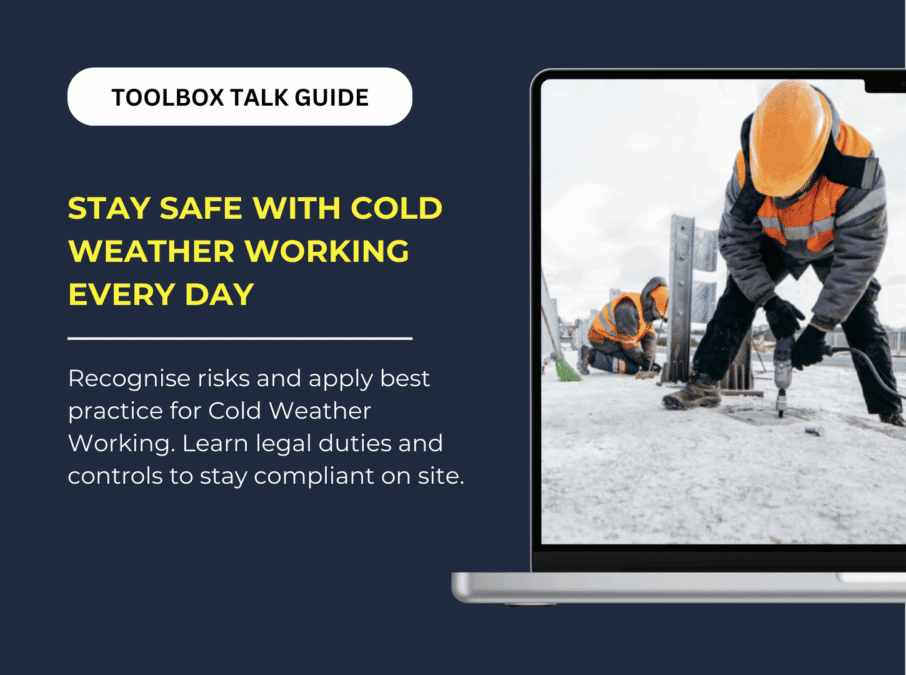
Topic: Cold Weather Working Toolbox Talk
Toolbox Talk Pack: 20 Health Hygiene Wellbeing Toolbox Talk Pack
Availability: This Toolbox Talk is included in the paid Health Hygiene Wellbeing pack
Region: UK
Cold Weather Working Toolbox Talk Guide

Cold weather working is one of the practical toolbox talk topics for UK construction because low temperatures often arrive with wind, rain, snow, ice, reduced daylight and rapidly changing ground conditions.
This guide explains how cold weather can affect people, access routes, plant and planned work. It also identifies useful pre-start checks, early warning signs, welfare arrangements and the points at which a supervisor should review, pause or reschedule the task.
Jump to section
What is Cold Weather Working in construction?
Cold weather working means carrying out construction activities where low air temperature, wind, moisture or contact with cold surfaces may affect health, comfort or the ability to work safely. It is not limited to snow or freezing conditions. A wet worker exposed to strong wind may become chilled quickly even when the air temperature appears less severe.
The assessment should cover more than personal exposure. Ice can affect walkways and access systems, reduced daylight can change visibility, and frozen or waterlogged ground can alter the condition of excavations, lifting areas and temporary works. Materials, tools and plant may also behave differently, so product information, equipment instructions and task controls need checking.
Why it matters on UK construction sites
Cold, wet and windy conditions can reduce hand dexterity, grip, concentration and communication. A worker may struggle to handle small fixings, operate controls or maintain a secure hold on tools. Bulky or saturated clothing can restrict movement, while steamed-up eyewear and hoods can reduce visibility or hearing if the equipment has not been selected as a compatible system.
Weather can also change the site itself. Water may freeze on stairs, scaffold boards, loading areas and vehicle routes. Snow can conceal edges, openings or uneven ground. Shorter daylight and poor weather may make pedestrian and plant interfaces harder to see. If these changes are treated as minor inconvenience rather than a change in risk, an otherwise familiar task can become unsuitable.
Who is exposed and how
Groundworkers, scaffolders, steel fixers, roofers, bricklayers, concrete crews, traffic marshals, security staff, delivery drivers and plant operators may spend long periods outside or in partially enclosed structures. Supervisors and engineers can also be exposed while inspecting remote work areas. New starters, agency workers, people returning after illness and anyone whose health may make them more vulnerable need suitable individual consideration without expecting them to disclose medical details publicly.
Typical site tasks where this comes up
Cold-weather risks arise during routine activities as well as weather-sensitive work.
- Setting out, surveying and inspecting work in open areas where teams remain relatively still for long periods.
- Working at height on scaffolds, roofs, formwork or steel frames exposed to wind, rain, frost and reduced visibility.
- Excavation, drainage and utility work where standing water, frozen surfaces or changing ground conditions affect access.
- Directing vehicles, receiving deliveries and operating plant during dark mornings, poor weather or on treated access routes.
- Placing, curing, sealing, coating or fixing materials whose permitted conditions are defined by the manufacturer or project specification.
Common failure modes
Problems often occur when the morning briefing relies on a general forecast but no one checks how conditions are changing at the workface.
- The plan considers air temperature but ignores wind, rain, wet clothing, shade and the length of exposure.
- Ice is treated on the main gate route, but stairs, welfare approaches, scaffold access and remote pedestrian routes remain unchecked.
- Workers receive warm clothing that does not fit properly or conflicts with high-visibility garments, gloves, harnesses, hearing protection or head protection.
- Wet gloves and clothing are reused because there is no suitable drying arrangement or accessible replacement stock.
- Breaks follow the normal schedule even though the task is exposed, low-movement or taking longer than planned.
- Plant is moved before windscreens, cameras, lights, steps, handholds and braking surfaces have been cleared and checked.
- Work continues after a material, sealant, coating or curing process moves outside its approved conditions.
Pre-start checks
These checks are a starting point only. They do not replace the project's risk assessment, method statement, permit or task-specific controls.
- ☐ Conditions: Check the current forecast, actual workface conditions and expected changes during the shift.
- ☐ Access: Inspect pedestrian routes, stairs, platforms, scaffold access, vehicle routes and welfare approaches for ice, snow, water and poor lighting.
- ☐ Workface: Confirm ground, excavations, temporary works, lifting areas and edge protection remain suitable.
- ☐ Equipment: Complete required checks on plant, tools, access equipment, lights and safety devices before use.
- ☐ Clothing: Verify that suitable dry layers, protective clothing, gloves and footwear fit and remain compatible with required PPE.
- ☐ Welfare: Confirm heated rest space, drinking water, changing or drying arrangements and agreed break arrangements are available.
- ☐ Stop points: Brief the team on symptoms, reporting routes, weather triggers and who can pause or reschedule the task.
How incidents happen and how to prevent them
A typical sequence begins with a manageable task becoming wetter, windier or longer than planned. Gloves lose insulation, hands become less effective and the worker compensates by gripping harder, removing a glove or rushing a fiddly operation. At the same time, access conditions worsen and visibility falls. The original controls no longer match the task, but work continues because no review point was agreed.
Prevention depends on reviewing the combined conditions, not a single temperature reading. Reduce exposure through sequencing, shelter, mechanical aids, shorter task periods and suitable breaks. Keep routes treated and inspected, provide dry replacement clothing, and use weather and workface triggers that supervisors can apply consistently. If the work, materials or equipment cannot remain within safe operating conditions, delay or change the task.
⚠️ Hypothetical site example: A fixing team starts work on an exposed slab after the main access route has been treated. Freezing rain then reaches the upper level, gloves become saturated and ice begins forming near the material store. The supervisor stops access, moves the team to a warm rest area, arranges dry replacements and has the workface and route reassessed before deciding whether the task can restart.
When risk increases
Cold-weather arrangements should be reviewed whenever exposure or site conditions change.
- Rain, sleet or snow wets clothing, walking surfaces, controls or electrical equipment.
- Wind increases on roofs, scaffolds, open slabs, bridges, coastal sites or between buildings.
- The task becomes stationary, more precise or longer than the assessment assumed.
- Daylight fades, lighting fails or snow, spray and condensation reduce visibility.
- New starters, lone workers, delivery crews or subcontractors enter areas covered by unfamiliar winter controls.
- A thaw, refreeze or temperature change affects ground, excavations, access systems, stored materials or completed work.
UK regulations and compliance
HSE's Temperature in the Workplace: What the Law Says explains that Great Britain does not set a general outdoor temperature at which construction work must stop. Instead, temperature-related risk must be assessed and controlled. For outdoor construction sites, protection from adverse weather is required and rest facilities must be kept at an appropriate temperature.
Under The Management of Health and Safety at Work Regulations 1999, employers in Great Britain must make a suitable and sufficient assessment of risks to employees and relevant non-employees. The assessment should reflect the work being done and be reviewed when there is reason to suspect it is no longer valid or there has been a significant change.
The Construction (Design and Management) Regulations 2015 require suitable and sufficient steps, so far as reasonably practicable, to provide a reasonable working temperature in indoor construction work areas and protection from adverse weather outdoors. Schedule 2 also covers drinking water, changing facilities and rest rooms or rest areas, including arrangements to maintain an appropriate temperature.
The HSE Outdoor Working Guidance recommends practical measures for cold environments, including appropriate PPE, facilities for warming up, more frequent breaks and considering whether work can be delayed to a warmer time without compromising safety.
Northern Ireland has corresponding construction requirements under The Construction (Design and Management) Regulations (Northern Ireland) 2016, including temperature, weather protection and welfare provisions for construction sites.
Key regulations and guidance
Temperature in the Workplace: What the Law Says - explains how temperature duties apply to indoor and outdoor construction work in Great Britain.
The Management of Health and Safety at Work Regulations 1999 - requires suitable and sufficient assessment and control of work-related risk in Great Britain.
The Construction (Design and Management) Regulations 2015 - covers weather protection, temperature and welfare on construction sites in Great Britain.
HSE Outdoor Working Guidance - provides practical cold-environment measures for employers.
The Construction (Design and Management) Regulations (Northern Ireland) 2016 - provides corresponding construction-site duties in Northern Ireland.
Practical controls that make the difference
Effective cold-weather management combines work planning, physical controls, welfare and suitable equipment.
- Plan around exposure: Move suitable tasks to sheltered areas or warmer periods and avoid leaving low-movement work in the most exposed locations.
- Protect the workface: Use suitable screening, shelters, drainage, lighting and access treatments without creating new wind-loading, fire or trip hazards.
- Use active inspections: Recheck routes, work platforms, excavations and plant interfaces as conditions change, not only at the start of the shift.
- Keep people dry: Provide suitable clothing systems, dry storage and prompt replacement for wet or damaged items.
- Provide warm recovery: Make heated rest space accessible and adjust break timing to exposure, work rate and conditions.
- Check task limits: Follow equipment instructions, temporary works requirements, lifting plans and product or material specifications affected by weather.
- Act on warning signs: Encourage early reporting and stop exposure if a worker shows concerning symptoms or can no longer carry out the task safely.
FAQs
Is there a fixed minimum temperature for outdoor construction work?
No general outdoor stop-work temperature is set in Great Britain. Employers must assess the actual conditions, protect workers from adverse weather and provide suitable welfare arrangements.
What should happen if a worker shows signs of serious cold exposure?
Stop the exposure, move the person to shelter and follow the site's first-aid and emergency arrangements. The
NHS Hypothermia Guidance
states that suspected hypothermia is a medical emergency.
Is warm PPE enough to control cold-weather risk?
No. Suitable clothing is important, but work planning, shelter, treated access, warm welfare, breaks, supervision and task-specific limits are also needed.
Explore more toolbox talk topics for UK construction .
Get the ready-to-use Cold Weather Working Toolbox Talk
Brief your site team on cold exposure, changing work conditions, winter access, suitable welfare and the warning signs that require action.