

The Ultimate Guide to CDM 2015 (UK)
Duties, Dutyholders, Documents, and Practical Compliance
CDM 2015 is the UK legal framework for planning, managing and coordinating health and safety on construction projects. If you are searching for a CDM 2015 guide, you are usually trying to answer practical questions: when CDM applies, who must do what, and what information and documents actually prevent problems on site.
This guide is written to address compliance and reduce ambiguity. It explains the duty holders (client, principal designer, principal contractor, designers, contractors and workers), the key deliverables (Pre-construction Information, Construction Phase Plan, Health and Safety File), and the triggers that change your obligations, including notifiable projects and F10 notification thresholds. It also clarifies the difference between the law (the Regulations), regulator guidance (HSE) and good practice workflows you can run on real projects.
The goal is simple: by the end, you should know what “good” looks like in operational controls, not just paperwork.

Table of contents
- Duties, Dutyholders, Documents, and Practical Compliance
- What is CDM 2015 and when does it apply?
- Why CDM 2015 matters in practice for safety, programme and cost
- What counts as construction work under CDM 2015, including domestic projects
- CDM 2015 workflow from concept to handover (PCI, CPP, H&S File)
- CDM 2015 dutyholders (client, PD, PC, designers, contractors, workers)
- Common CDM 2015 mistakes and how to avoid them
- A best-in-class CDM 2015 model for SMEs and multi-contractor projects
- How to implement CDM 2015 controls across projects
- Digitising CDM 2015 evidence trails (without changing duties)
- CDM 2015 law vs HSE guidance (PCI, CPP, H&S File, F10, Schedule 3)
- 10) RAMS, CDM 2015, and What Inspectors and Clients Expect to See
- The cost of weak CDM controls (time, rework, audit exposure)
- Where CDM 2015 delivery is heading
- Frequently Asked Questions
- Related Paperless Construction guidance
What is CDM 2015 and when does it apply?
CDM 2015 is the Construction (Design and Management) Regulations 2015, the UK framework that sets legal duties for managing health, safety and welfare on construction projects. The intent is lifecycle control, not just construction-phase control. Risk is influenced early, so CDM requires planning and coordination from concept and design through to handover and future use. HSE CDM 2015 hub.
A useful way to interpret scope is to separate what is law, what is regulator guidance, and what is good practice. The Regulations on legislation.gov.uk establish dutyholders, appointment triggers, notification rules, and core expectations such as planning, managing and monitoring. HSE guidance, including L153, explains how to comply in practical terms and what “good” looks like in proportionate controls. CDM 2015 Regulations (SI 2015/51) and HSE L153 guidance.
What CDM 2015 is not: it is not a “big sites only” regime, and it is not a document production requirement in isolation. A generic CPP that is not maintained, or a PCI pack that is not usable by those planning the work, will not deliver the outcomes CDM is designed to secure. CDM is best treated as an operating system: roles, information, and change control linked across the phases. HSE dutyholder summary.
Why CDM 2015 matters in practice for safety, programme and cost
CDM 2015 matters because coordination failures are rarely isolated to one trade or one moment. They compound through interfaces: design assumptions that do not hold on site, sequencing that conflicts with temporary works requirements, logistics that make safe access impossible, or residual risks that are not communicated in a way delivery teams can use. CDM is designed to prevent the predictable pattern where risks are “discovered” during construction rather than designed out or planned for earlier. HSE CDM overview.
The operational impact is equally significant. Weak PCI creates delays and rework because teams mobilise without constraints, surveys, and interface information in a usable form. A CPP that is generic, static, or disconnected from actual site rules increases disruption: repeated briefings, inconsistent supervision, and last-minute control changes when workface reality catches up. These are productivity drains, not just safety issues. HSE L153 guidance.
Financial exposure also follows predictable pathways: time loss, rework, temporary works changes, and higher supervision burden. Where projects are notifiable, failure to manage appointments and notifications properly can add avoidable compliance risk. CDM encourages proportionality, but it does not support “minimal effort” compliance that leaves site teams without control mechanisms. HSE dutyholder summary.
What counts as construction work under CDM 2015, including domestic projects
CDM 2015 applies to all construction work, and misunderstanding scope is one of the most common causes of late appointments and thin planning. The problem is rarely that people have never heard of CDM. It is that they assume it is only for major projects, or only for “new build”, or only when the job is notifiable. That is not how the framework is intended to work. HSE CDM 2015 hub.
Domestic projects are explicitly within scope. HSE guidance explains that if you are having construction work done on your own home, CDM 2015 still applies, and domestic client duties are passed to others carrying out the work on the client’s behalf, such as designers and contractors. This matters because coordination still needs to happen when there are multiple trades, structural alterations, or significant interface risks. HSE domestic clients and scope.
Examples people commonly get wrong include refurbishment and fit-out in occupied premises, planned maintenance with multiple contractors, and short-duration civils works where buried services, temporary works, or traffic management increase interface risk. CDM should be applied proportionately, but it should still be applied. Where there is more than one contractor, the requirement to appoint a Principal Designer and Principal Contractor is triggered. CDM 2015 Regulations (appointments and duties).
Asset spec placeholder (for your designer):
Asset name: Does CDM apply? decision tree (Construction work, domestic vs commercial, more than one contractor, notifiable thresholds)
Placement: End of this section
Format: A4 portrait or 1:1 square
Notes: Outputs should include: appoint PD and PC, CPP required before start, welfare arrangements, consider F10 where thresholds met. HSE scope and notifiable thresholds reference.

CDM 2015 workflow from concept to handover (PCI, CPP, H&S File)
CDM 2015 runs best when you treat it as a lifecycle workflow with explicit handovers, rather than a set of isolated documents. The consistent pattern on real projects is that weak early information forces late decisions, and late decisions create risk and disruption during mobilisation and construction. The purpose of the framework is to keep the design and construction phases coordinated so that risks are eliminated or reduced early, and residual risks are communicated in a way that delivery teams can act on. HSE L153 guidance.
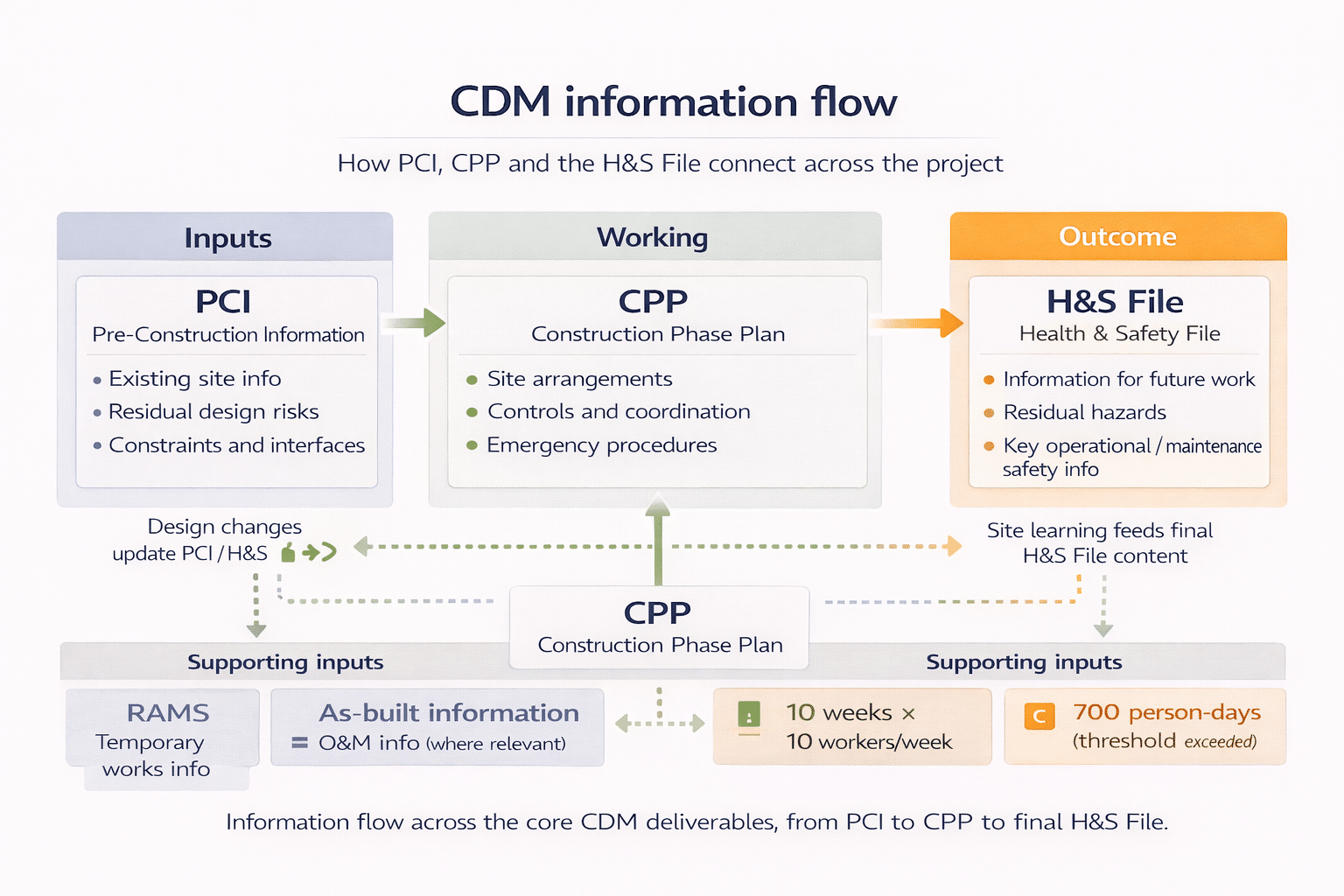
A practical way to frame the core process is to follow the information flow: client and design inputs feed PCI, PCI enables planning and mobilisation, the Principal Contractor maintains a CPP that reflects the construction phase reality, and the Health and Safety File is developed during the job and handed over for future use. This structure is grounded in the Regulations and reinforced in HSE guidance, including the expectation that information is reviewed and updated as work proceeds. CDM 2015 Regulations.
CDM 2015 lifecycle stages and what “good” looks like
Stage 1: Concept and feasibility
At this stage, “good” means clear scope, constraints and governance. You want early clarity on interfaces, access, live environment constraints, surveys, and any client standards that will affect how work is planned and controlled.
Stage 2: Pre-construction
This is where PCI quality is made or broken. “Good” means PCI that is clear, proportionate and usable, design risk discussions that reduce risk where possible, and residual risks packaged in a way that the delivery plan can incorporate.
Stage 3: Mobilisation
Mobilisation is where plans meet reality. “Good” means the CPP exists before construction starts, welfare and site rules are defined, induction and coordination arrangements are ready, and responsibilities are explicit. CPP requirements within CDM Regulations.
Stage 4: Construction
Construction phase control is about coordination cadence and change control. “Good” means regular coordination checks, briefings aligned to current plans, monitoring that verifies controls in place, and a clear trigger for revising and re-briefing when conditions change.
Stage 5: Handover and closeout
The Health and Safety File should not be a last-week scramble. “Good” means capturing relevant information during delivery and handing over a usable file for future maintenance, refurbishment, and demolition planning. Regulations on H&S File review and information inputs.

Ready to Reduce Site Admin?
See Paperless in action.
Take a closer look at how Paperless can help you replace paperwork, improve visibility and keep project records easier to find and prove.
CDM 2015 dutyholders (client, PD, PC, designers, contractors, workers)
CDM becomes much easier to run when everyone stops treating dutyholders as job titles and starts treating them as accountable functions. HSE summarises the dutyholders and their main duties, including the client, principal designer, principal contractor, designers, contractors, and workers. This is the backbone of responsibility mapping and should be the basis for your project governance. HSE dutyholder summary.
The Regulations also use the phrase “plan, manage and monitor”, which can sound abstract. In practice, it translates into operational behaviours: making appointments at the right time, coordinating information flow, ensuring workable sequencing, and maintaining controls when changes occur. If your project cannot explain who is accountable for what, and how information travels from design to delivery, you do not have a CDM system, you have documents. CDM 2015 Regulations.
What “plan, manage and monitor” means in practice
-
Planning means defining constraints, interfaces, sequencing, and hold points early enough that teams can mobilise safely.
-
Managing means coordinating the flow of information and decisions across dutyholders so that workface plans remain aligned.
-
Monitoring means verifying controls exist on site and in behaviours, not just in documents. HSE L153 guidance.
Skills, knowledge, experience, and organisational capability
HSE guidance focuses on capability, not box-ticking competence. In practical terms, that means evidence packs: relevant experience, supervision arrangements, monitoring checks, and a clear structure for approvals and briefings that is proportionate to the risk profile. HSE L153 guidance.
Dutyholder summaries you can use as anchor sections
-
Client duties: suitable arrangements, time and resources, appointments, welfare assurance. HSE dutyholder summary.
-
Principal Designer duties: plan, manage and monitor pre-construction, coordinate design risk, ensure designers comply, liaise with PC, manage the H&S File lifecycle. CDM Regulations.
-
Principal Contractor duties: plan, manage and monitor construction phase, coordinate contractors, ensure CPP exists before start, ensure cooperation and site arrangements. CDM Part 3 duties.
Asset spec placeholder (RACI):
Asset name: Dutyholder accountability map (RACI style)
Placement: End of this section
Rows: appointments, PCI, design risk management, CPP, site induction and briefings, welfare, coordination, temporary works interfaces, change control, H&S File inputs, handover
Columns: Client, Principal Designer, Principal Contractor, Designers, Contractors, Workers
Reference: HSE dutyholder summary.

Common CDM 2015 mistakes and how to avoid them
Most CDM problems are not caused by people refusing to comply. They are caused by systems that do not connect roles, information and change control, so compliance degrades under time pressure. This section is intentionally practical and mirrors the patterns HSE focuses on: suitable arrangements, coordination, and usable planning rather than paper-only compliance. HSE dutyholder summary.
Late appointments (PD and PC)
When PD and PC are appointed late, PCI is thin and design risk coordination becomes reactive. The result is that mobilisation decisions get made on assumptions, and those assumptions fail during delivery.
Treating the Principal Designer as a title, not a coordination function
The PD role is often collapsed into “lead designer”, which misses the coordination duty: ensuring design risk is managed and residual risks are communicated to those who need them.
CPP written once and never maintained
A CPP must exist before construction starts, but the operational risk comes from treating it as static. If conditions, sequence, design, or interfaces change, the CPP and briefings should reflect that change. CDM Regulations (CPP duty).
Weak evidence of capability
Capability fails when supervision arrangements are not credible for the risk profile, or when monitoring is not planned, recorded, and closed out.
H&S File left to the end
If you do not capture asset data, residual risks, and relevant design and construction information during delivery, the file becomes incomplete, and the client inherits uncertainty for future works. Regulations on H&S File review and inputs.
A best-in-class CDM 2015 model for SMEs and multi-contractor projects
A strong CDM system is simple enough to run under real pressure, but structured enough to produce consistent evidence. The most reliable frameworks link three things: responsibility mapping, information quality, and change control. That is what prevents “drift” between what was planned, what was briefed, and what actually happened on site. HSE L153 guidance.
The framework below is deliberately operational. It avoids inventing requirements and focuses on mechanisms that help dutyholders satisfy the Regulations and HSE expectations: clarity of roles, usable information, and active monitoring.
The 5-part CDM 2015 control framework
-
Appointments and governance early (especially where more than one contractor is involved)
-
Usable PCI (clear, proportionate, and structured for those planning work)
-
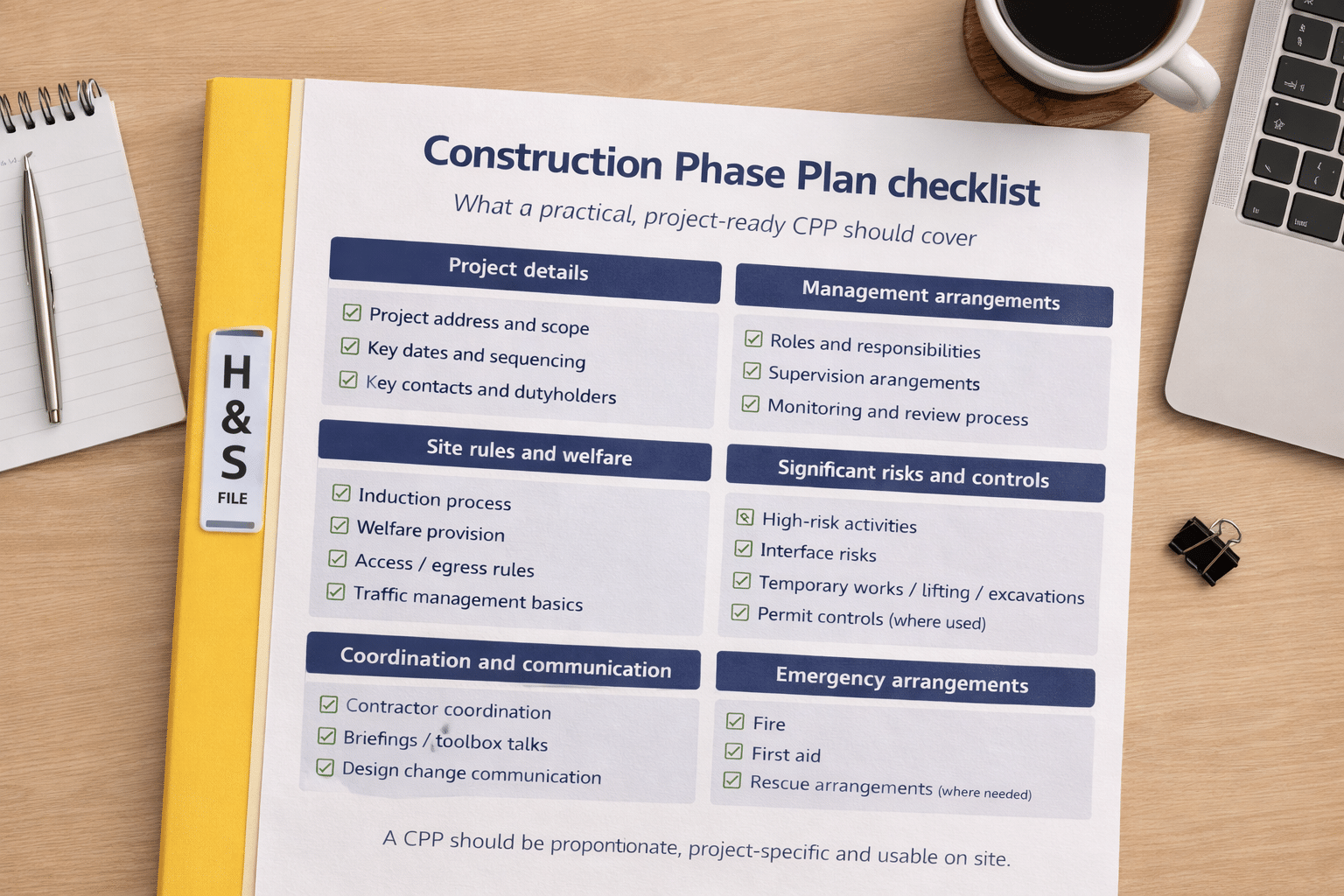
CPP readiness before start (site rules, arrangements, particular risk measures, coordination approach)
-
Coordination cadence (daily briefings plus planned coordination checks and targeted inspections)
-
H&S File built during delivery (capture inputs continuously, not retrospectively)
Asset spec placeholder (CPP checklist):
Asset name: CPP content checklist visual
Placement: End of this section
Format: Portrait
Reference: CDM Regulations (CPP duty).

How to implement CDM 2015 controls across projects
Implementation fails when you try to “train” your way out of inconsistent inputs. Standardisation has to come first: consistent appointment triggers, consistent PCI structure, consistent CPP structure, and a consistent briefing and change control method. Once those are stable, training and governance become much easier because people are learning one system, not a new approach on each job. HSE L153 guidance.
Phase 1: Baseline your current state
Assess a sample of recent projects against three questions: were appointments timely, was PCI usable, and did CPP and briefings stay current when conditions changed?
Phase 2: Standardise minimum viable controls
Define a PCI intake template, a CPP template that maps to site rules and particular risks, and a responsibility map for approvals, briefings, and monitoring.
Phase 3: Train and embed
Train supervisors and planners on what “good” looks like in briefings, understanding checks, and change triggers. Keep it role-based, not generic.
Phase 4: Govern and improve
Run periodic coordination reviews and audits that test evidence of control: version history, briefing records, monitoring actions and closeout, and H&S File inputs captured during delivery.
Digitising CDM 2015 evidence trails (without changing duties)
Digital tools do not transfer legal duties, but they can make compliance more reliable by reducing evidence gaps. The value is not “more documents”. The value is fewer uncontrolled versions, fewer missed briefings, and clearer traceability when change happens.
In CDM terms, digitisation is most useful when it strengthens the lifecycle chain: PCI inputs are structured and findable, CPP versions and approvals are controlled, briefings are recorded against the issued version, and changes trigger updates that are visible to the right people. This aligns with the practical emphasis in HSE guidance on planning, coordination and maintaining information as projects evolve. HSE L153 guidance.
If you are standardising digital evidence trails around RAMS and briefing records, a related reference point on your site is RAMS guide (evidence and governance).
CDM 2015 law vs HSE guidance (PCI, CPP, H&S File, F10, Schedule 3)
For CDM content to be credible, it must separate three layers: what the Regulations say, how HSE explains compliance, and what operational practices are sensible for running projects reliably. This avoids over-claiming and prevents your internal standards becoming “invented legal duties”.
The primary legal text is the CDM 2015 Regulations on legislation.gov.uk. HSE provides guidance and summary pages that explain the intent and practical expectations. L153 is the main HSE guidance publication supporting CDM 2015. CDM 2015 Regulations, HSE dutyholder summary, HSE L153 guidance.

Watch a Live Demo Now
No Time to Book? See It in 2 Minutes.
See how Paperless works right now, with no appointment needed. This short live demo covers digital inductions, safety briefings, workforce tracking, and compliance tools.
10) RAMS, CDM 2015, and What Inspectors and Clients Expect to See
It is easy to overstate legal requirements for “RAMS” as a single named document. In practice, the expectation is that risks are assessed, work is planned, and control measures are implemented and supervised. RAMS is one common way of demonstrating that planning and control for a task has been done in a structured, communicable format.
In audits and inspections, evidence often matters as much as the document content. The questions are practical: was the method reviewed by competent people, was it briefed to the workforce doing the work, and were changes controlled. If the task changed but RAMS did not, the process is not credible.
The most useful evidence set is typically:
-
Approved RAMS version for the task and workface
-
Named reviewer and approver, with dates
-
Briefing record linked to the approved version
-
Change log and revised version history
-
Re-brief record where changes occurred
-
Permits, inspections, or hold point checks linked to the method
HSE guidance for CDM 2015 provides context on the management expectation and how dutyholders should plan and coordinate construction work. HSE: L153 guidance on CDM 2015.
Notifiable projects and the F10 notification thresholds
HSE guidance states projects are notifiable if construction work is scheduled to last longer than 30 working days and have more than 20 workers working simultaneously at any point, or exceed 500 person-days. HSE notifiable thresholds (domestic and scope page).
For the notification route, use HSE F10 notification.
Asset spec placeholder (calculator):
Asset name: Notifiable threshold calculator (30 days and 20 workers, or 500 person-days)
Placement: After the notifiable thresholds subsection
Format: 16:9 landscape
Reference: HSE notifiable thresholds.
Schedule 3 “particular risks” and what “specific measures” should look like
Schedule 3 lists categories of work involving particular risks. The practical point is how these risks influence planning, sequencing, supervision, and the measures recorded and maintained in the CPP. CDM Schedule 3.

The cost of weak CDM controls (time, rework, audit exposure)
Weak CDM delivery is often mislabelled as “a safety issue”, but the business impact is usually what gets noticed first: missed handovers, rework, and programme disruption. These outcomes happen when project controls do not keep pace with changes, and when site teams lose confidence that the plan reflects reality.
The most common cost drivers are predictable: mobilisation delays due to missing PCI, interface clashes due to weak coordination, increased supervision load because responsibilities are unclear, and repeated briefings because people are working from outdated versions. Good CDM systems reduce those costs by enforcing clarity and traceability.
At leadership level, this section should frame CDM as a control system that supports productivity and predictability, not as a compliance tax. That framing is consistent with HSE’s emphasis on planning and coordination as the route to safer, more controlled projects. HSE L153 guidance.
Where CDM 2015 delivery is heading
The direction of travel in CDM delivery is towards higher information quality and stronger evidence trails, because that is what prevents drift between design intent, planned controls, and workface reality. The organisations doing this well are not adding complexity. They are simplifying, standardising, and making change visible.
Three trends matter most for practical delivery. First, earlier and cleaner PCI packaging, so designers and contractors can plan realistically. Second, better integration between residual design risk information and construction planning, so delivery teams do not discover critical assumptions late. Third, digitised traceability for versions, approvals, briefings, and changes, so evidence is available without document chasing.
These trends align with the intent of CDM and HSE guidance: plan early, coordinate effectively, and maintain usable information as projects evolve. HSE CDM overview.
Frequently Asked Questions
Does CDM 2015 apply to domestic clients?
Yes. HSE states CDM 2015 applies to all construction work including domestic projects, and domestic client duties are passed to others carrying out the work on the client’s behalf, such as designers and contractors. HSE domestic clients guidance.
Do I need a principal designer on a small project?
Project size is not the deciding factor. Where there is, or it is reasonably foreseeable that there will be, more than one contractor, CDM requires appointment of a principal designer and principal contractor. CDM 2015 Regulations (appointments).
Who is responsible for the Construction Phase Plan (CPP)?
The CPP is a construction phase control document and must exist before construction starts. In practice, it is produced and maintained under the principal contractor’s construction phase management duties. CDM Part 3 (construction phase duties).
What is Pre-construction Information (PCI) in CDM 2015?
PCI is information needed to plan, manage and coordinate the work. It should be clear and proportionate, and shared with those who need it so they can plan safely and realistically. HSE L153 guidance.
What is the Health and Safety File and who inputs to it?
The file should be reviewed and updated as the project progresses. The principal contractor must provide the principal designer with relevant information for inclusion in the file. CDM Regulations (H&S File duties).
When is a project notifiable and when do I submit an F10?
HSE states a project is notifiable if it lasts longer than 30 working days and has more than 20 workers simultaneously at any point, or exceeds 500 person-days. The notification route is the HSE F10 form. HSE notifiable thresholds and HSE F10.
What are Schedule 3 “particular risks” in CDM 2015?
Schedule 3 lists categories of work involving particular risks. The point is not labelling work as “high risk”, but ensuring the CPP and planning include suitable measures for those risks. CDM Schedule 3.
Where should I start if I want a practical CDM system?
Start with clarity on appointments, a usable PCI structure, and a CPP that is maintained with change control. Then implement a coordination cadence that keeps briefings and monitoring aligned to the latest issued version. HSE L153 guidance.
Related Paperless Construction guidance
If you want to go deeper on specific angles, these related articles expand the topic and provide practical examples.
-
What is a Principle Designer? Duties Under CDM 2015 (UK)
This article explains the role in layman terms, using HSE guidance and the CDM regulations, then shows common mistakes that cause friction on real projects -
What is a Principal Contractor? Duties Under CDM 2015
This article explains what the principal contractor is, when one is required, what the law expects in practical terms. -
Learn the Differences between a Principle Contractor and Principle Designer?
This article explains what each role is, when they are required, what they must do, and where projects usually go wrong. -
Daily Activity Briefings (DABs): improve site coordination and safety
Practical cadence and briefing discipline that supports change control. -
RAMS guide: compliance, evidence and governance
Use this to standardise approvals, version control, and briefing evidence that stands up in audits.
If your CDM 2015 goal is consistent evidence of control across projects, focus on the mechanics that survive real delivery: version control, approvals, briefing records, and change-triggered updates. For teams standardising RAMS and briefings as part of that system, a practical next step is RAMS and safety briefings. This supports the operational side of CDM without changing dutyholder accountability.


