

Differences between a Principle Contractor and Principle Designer? Duties Under CDM 2015 (UK)

Introduction
The difference between a Principal Contractor and a Principal Designer is one of the most common points of confusion in UK construction compliance. Both are “principal” dutyholders under CDM 2015, but they control different phases and coordinate different people. If you are writing RAMS, setting up a job, or responding to a client questionnaire, mixing these roles up can create gaps in risk ownership and handover.
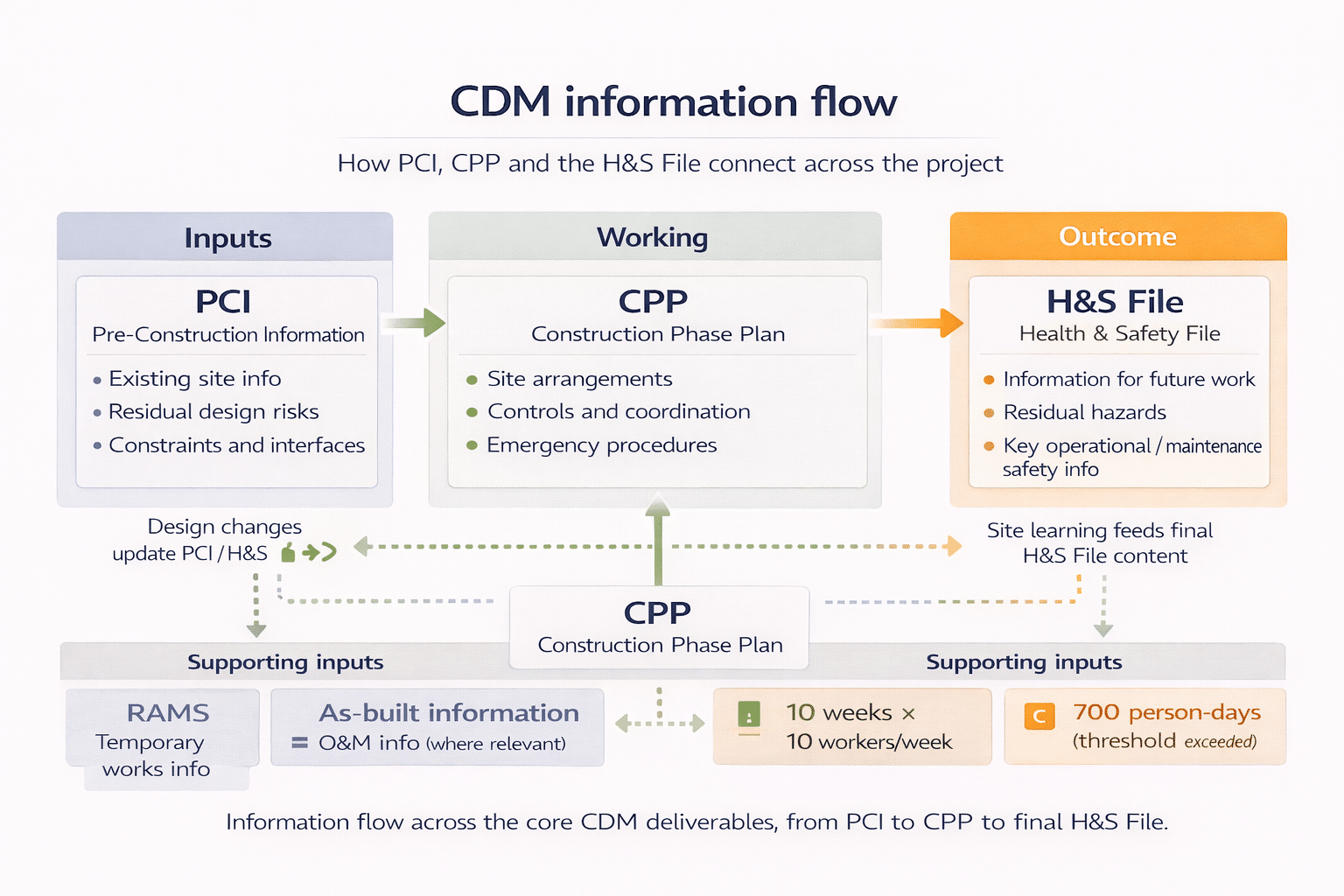
For the full CDM 2015 picture, including duty holders, key documents (PCI, CPP, H&S File), F10 thresholds and practical workflows, see our Ultimate Guide to CDM 2015
If you are also drafting risk assessments and method statements, the distinction matters even more because governance depends on who reviews and coordinates risk at design stage versus on site. For broader context on controlled RAMS production and review, see risk assessments and method statements guidance.
This article explains what each role is, when they are required, what they must do, and where projects usually go wrong.
Quick Answer..
A Principal Designer (PD) is appointed to plan, manage, monitor and coordinate health and safety in the pre-construction phase, mainly by coordinating designers and design risk management. A Principal Contractor (PC) is appointed to plan, manage, monitor and coordinate health and safety in the construction phase, mainly by coordinating contractors and site controls.
Principal Designer vs Principal Contractor: scope and timing
The cleanest distinction is “design phase coordination” versus “site phase coordination”.
-
Principal Designer: controls health and safety coordination during pre-construction, including ensuring designers eliminate, reduce, or control foreseeable risks through design and providing relevant information to others.
-
Principal Contractor: controls health and safety coordination during construction, including planning, management, monitoring, and organising cooperation between contractors on site.
In practice, the PD is the “design risk coordinator”, and the PC is the “site delivery coordinator”.
When each role is required and who appoints them
Where a project involves, or is likely to involve, more than one contractor, CDM 2015 places duties around appointing a PD and a PC. The legislation sets out the framework for appointments and what happens if the client fails to appoint.
Two practical points that reduce mistakes:
-
If you are tendering or mobilising and there is more than one contractor, confirm who is appointed PD and PC, in writing, before you assume who coordinates what.
-
If the client is unclear, the project can drift into “everyone and no one” ownership, which tends to show up later as RAMS approval delays, conflicting method statements, or interface incidents.
Principal Designer: what they actually do (and what they do not do)
The PD’s core legal duty is to plan, manage, monitor the pre-construction phase and coordinate health and safety during that phase.
What that looks like on real jobs:
-
Coordinating designers so design risk management is not fragmented across disciplines.
-
Helping the client compile and maintain pre-construction information so contractors can plan work safely.
-
Communicating residual risks and design assumptions that must be controlled during construction.
What the PD is not:
-
Not the person running day to day site supervision.
-
Not a substitute for a contractor’s method statement planning or task level risk assessment.
Principal Contractor: what they actually do (and what they do not do)
The PC’s core legal duty is to plan, manage, monitor the construction phase and coordinate health and safety during that phase.
What that looks like on real jobs:
-
Coordinating contractor sequencing, interfaces, logistics, access, and public protection controls.
-
Liaising with the client and the PD to keep risk management connected between design assumptions and site reality.
-
Ensuring arrangements exist for cooperation and coordination between contractors working at the same time or in the same area.
What the PC is not:
-
Not responsible for redesigning solutions that should have been addressed by design risk management, unless changes are required due to site constraints.
-
Not a replacement for each contractor’s duty to plan and control their own work.

How PD and PC connect: the handover that prevents gaps
Most failures happen in the seam between phases. HSE guidance explicitly expects liaison between PD and PC so risks are effectively managed through the project, not split into silos.
A simple handover approach that works in practice:
-
PD confirms residual risks, design assumptions, temporary works design intent (if applicable), and key interfaces.
-
PC confirms how those risks will be controlled on site through sequencing, logistics, supervision, exclusion zones, permits, and RAMS requirements.
If that loop is missing, you tend to see:
-
RAMS that do not reflect design constraints
-
late discovery of public interface hazards
-
rework due to “unknowns” surfacing after mobilisation

Watch a Live Demo Now
No Time to Book? See It in 2 Minutes.
See how Paperless works right now, with no appointment needed. This short live demo covers digital inductions, safety briefings, workforce tracking, and compliance tools.
Practical example: small UK project with multiple contractors
Imagine a small commercial refurbishment where there is a designer, a main contractor, and two specialist subcontractors.
-
The Principal Designer coordinates design decisions that eliminate or reduce foreseeable risks, and ensures pre-construction information is shared so contractors can plan.
-
The Principal Contractor coordinates how the contractors will work safely on site, manages interfaces, access, and public protection, and keeps the PD informed if site conditions force design changes.
If the designer changes a layout that affects access or temporary stability, that is PD-led design risk work. If the site team changes the sequence, hoarding layout, or delivery routes, that is PC-led construction phase control.
Common mistakes that cause compliance gaps
-
Wrong role, wrong phase: teams ask the PC to “sign off design risk” or ask the PD to “run the site”.
-
No written clarity: appointment and scope are assumed rather than explicit, especially on fast-start jobs.
-
Residual risks not carried into RAMS: design assumptions are not visible to the people writing or approving RAMS, so controls are incomplete.
-
Interfaces ignored: multiple contractors means multiple interfaces, and that is exactly why the “principal” coordination roles exist.

Frequently Asked Questions
Is it “principal” or “principle” contractor and designer?
It is principal contractor and principal designer in CDM 2015. “Principle” is a different word and is incorrect in this context.
Can the same organisation be both Principal Designer and Principal Contractor?
CDM 2015 defines separate dutyholder roles with different functions and timing. Whether one organisation can take on both depends on the project structure and capability, but the duties still need to be met in full for each role. I cannot confirm your project’s suitability without the appointment and scope details.
Who is responsible for coordinating contractors on site?
The Principal Contractor coordinates the construction phase where more than one contractor is involved, including cooperation and coordination between contractors.
Who is responsible for coordinating design risk management?
The Principal Designer coordinates health and safety in the pre-construction phase and ensures designers cooperate and manage foreseeable risks through design.
The one-line difference that prevents most errors
Principal Designer and Principal Contractor are not interchangeable titles. The PD coordinates design risk and pre-construction information so risks are eliminated or reduced before work starts. The PC coordinates site delivery so construction phase risks are controlled while the work is carried out. Where projects fail, it is usually because the PD to PC handover is weak, so design assumptions are not carried into RAMS and site controls.
If you need a stronger governance model for RAMS drafting, review, approval, and change control, return to this RAMS governance guide.
If you are also drafting risk assessments and method statements, the distinction matters even more because governance depends on who reviews and coordinates risk at design stage versus on site. For broader context on controlled RAMS production and review, see risk assessments and method statements guidance.
Want a controlled way to produce and manage RAMS so approvals, briefings, and changes stay aligned to dutyholder responsibilities? Use the governance workflow and evidence checklist in risk assessments and method statements guidance, then cross-link to your dutyholder explainers: What is a Principal Contractor? and What is a Principal Designer?.

See What Paperless Could Do for Your Sites
One brochure. The full platform.
Explore the tools available to help reduce paperwork, improve visibility and keep workforce, safety and project records connected.


